Why a dramatic monologue for ‘That Summer in Puglia’?

I’ve long been intrigued by authors’ creative choices, so I’m always grateful for glimpses of the process involved in the birth of a novel.   Examples of such glimpses might include: how Marilynne Robinson constructed the character of John Ames in her wise and lyrical Gilead – of which she speaks in a Paris Review interview; where the roots of Giuseppe Tomasi di Lampedusa’s The Leopard are to be found – which transpire from his Places Of My Infancy; or how Vladimir Nabokov arrived at the voice of the eponymous protagonist of Pnin – as revealed in the autobiographical Speak, Memory.  Of course the books hold their own as narratives – I don’t need more, in order to enjoy and appreciate them – but insights into the inspirations, challenges and decisions behind them never fail to enrich the experience for me with the unique perspective they offer.

So I thought readers might be interested to know how I had reached one of the key decisions for any novel: that of narrative form, which impacts how we respond to a text.  That Summer in Puglia is in dramatic monologue form, which is rarely used in novels, unlike in poetry and drama.  So why, you might ask, did I opt for it?

First, it may be helpful to clarify a couple of common sources of confusion.  A dramatic monologue is a variant of first-person narrative.  It’s distinct from interior monologue, as it involves the narrator speaking to an interlocutor, or ‘narratee’.  Interior monologue tends to give readers access to the narrator’s uncensored thoughts, including those unlikely to be divulged to anyone.  By contrast, narrators in dramatic monologues may or may not state facts and opinions – purposely or unwittingly.

128px-giotto_di_bondone_003
Giotto, ‘The Seven Virtues – Lady Justice’, 1306, fresco, Cappella degli Scrovegni, Padua. Photo by The Yorck Project. Clemency famously weighs slightly more than Punishment on this Iusticia’s scales.

This means that as readers we find ourselves in the interlocutor’s seat: it’s for us to shift between one moment judging the narrator’s actions, intentions and reliability, and the next empathising with him or her, as if we were listening to a human being sitting right across the table.  That quality can give rise to a drawback: the tension between judging and empathising means that stretches of absorption in the protagonist’s narration will alternate with moments of distance from it as we seek to read ‘between the lines’ of what is being asserted and omitted.  The author has to fine-tune this alternation of intensity and detachment – which often coincides with that of past events and of the present-tense ‘frame’ – in order to avoid the flow being interrupted too often for the reader.

The narrator’s voice involves many considerations too, such as: how can his tone and register convey his character and background?  (I’ll use the pronoun ‘he’ on this blog post, as my protagonist is a man.)  How should it change to reflect his evolution from the first to the final page?  And that of his relationship with the interlocutor?  And to signal when he is in control and when instead the intensity of re-living past events makes him barely aware of the other’s presence?  I’m not sure I’d have had the confidence to attempt a novel in dramatic monologue form, and to persevere, without the encouragement and feedback of great writers on my MA at Goldsmiths – I mean ‘great’ in every sense: admirably able, for sure; but also insightful, generous, enthusiastic…  Writing may be solitary, but few communities involve the closeness and trust which comes with mutually exposing your work for constructive criticism.

So why did I go for the dramatic monologue form for That Summer in Puglia?  Recklessness?  Too much time on my hands?  (I wish!)  The challenge?  None of these.  After experimenting at length with third-person narration, I opted for dramatic monologue because of its coherent linking of several aspects of the work.

I wanted Tommaso’s narration to expose not only his own fragility, but also that of the young private investigator, Will, as the latter’s tale eventually emerges.  I was both encouraged and intimidated by the fact that also the narrator in The Fall senses that the narratee has a secret, and yet that Camus leaves it undisclosed.  However, I soon realised that his interlocutor has to be faceless because the eponymous fall is that of humankind – the canvas couldn’t be larger.  In my novel, Will has to be an individual for at least two reasons: his story accounts for why only he has succeeded in tracking down a man long presumed dead; and he and Tommaso offer each other real possibilities of positive transformation – at real cost, and demanding real choice.  By contrast, the name of Camus’ protagonist, Jean-Baptiste Clamence, hints at clemency and salvation but he entraps his prey without mercy.

Ephebe from Pompeii
Photo (May 1925) of The Ephebe (20-10 BC) found at Pompeii by the archaeologist Amedeo Maiuri

I thought a dramatic monologue would be ideal for a narrator who, despite his knowledge of the ancient world, is only now engaging in an overdue ‘excavation’ of his past: his unreliability would heighten the tension between sympathy and judgment.  Readers could identify with the empathetic listener, who catalyses and facilitates Tommaso’s growing awareness of the actual course of past events.  Ostensibly, Tommaso longs for Will to let him go, but his unconscious yearning runs deeper: at stake is his chance to come to terms with his past and to move on.  The dramatic monologue form had two further merits: it conveys a sense of isolation; and it plays on the irony that it is a dialogue of which readers ‘hear’ only one side, while Tommaso unwittingly caused a tragedy by denying others the opportunity for dialogue.

In an excellent article about his writing of The Reluctant Fundamentalist, Mohsin Hamid points to the dramatic monologue’s power to engage readers as ‘co-creators’ because it prompts us to develop our own versions of the characters and events: they reflect our personal perspective when we fill in the gaps, make connections or interpret the action.

To help readers settle into the role of ‘co-creators’, I needed to put them in the position of inferring what Will is saying and doing at specific points.  I therefore studied rhetorical devices used in dramatic monologues (e.g. Browning’s My Last Duchess, in addition to The Fall and The Reluctant Fundamentalist) and other relevant forms (e.g. Ralph Ellison’s Invisible Man, Julian Barnes’ Talking it Over, Rousseau’s Confessions).  In none of the former did the authors develop the narratee’s own story arc (Camus and Hamid hint at his background/occupation).  However, there was no doubt in my mind that my novel’s coherence demanded it.  In the event, some of it flowed intuitively as I got to know my characters, while feedback from tutors and colleagues was invaluable in identifying and addressing sections where the information to be conveyed about Will presented a tougher challenge.  I think Camus or Hamid would have chosen to do the same, had the stories they were telling required it – but theirs called for different sets of creative decisions and solutions.

I considered but eventually sacrificed metafictional opportunities, in order to keep readers immersed in the realism of Tommaso’s narration.  I aimed for ‘solidity of specification’ and for psychological truthfulness.  The multi-sensorial rendering of the settings, for example, is based on my own experience and research.  I consulted books, maps and videos, and took photographs and notes.  I walked in-situ like a ‘Method actor’, striving to take in the landscape through the filter of the protagonist’s perception.   Psychological truthfulness came largely intuitively, but some aspects of it were enhanced by reading and by others’ feedback.

Tommaso’s language is characterised by the formality of his Italian linguistic roots, and by the faintly archaic tone of foreigners who learnt much of their English from literature.  As part of my research, I attended a one-day translation masterclass held by Tim Parks, in order to become aware of linguistic idiosyncrasies which would impact Tommaso’s tone and register – unlike him, I did not learn English as an adult, but have been bilingual since my early teens.  I also fine-tuned Tommaso’s use of emotionally charged key words.  For example, he says ‘my father’ when he begins talking about him, but then repeatedly slips into ‘Dad’ and ‘Daddy’.   For the handling of his lapses into Italian, I referred to Simonetta Wenkerts’ The Sunlit Stage and Marina Warner’s The Lost Father.

These are just a few glimpses into an aspect of writing and into the creative process behind That Summer in Puglia.  I hope you’ll have found them interesting, whether you’re a fellow author or reader.

Photo credits:

Giotto’s The Seven Virtues – Lady Justice, by The Yorck Project: 10.000 Meisterwerke der Malerei.  Reproduced under GNU Free Documentation License.

The Ephebe, made available by Carlo Raso under CC License.

Past reviews

eln-1-smallest

I review contemporary fiction for The European Literature Network and others.  Here are some reviews of books I really enjoyed.

17.10.2016  #RivetingReviews: Valeria Vescina reviews BELLA MIA by Donatella di Pietrantonio (translator: Franca Scurti Simpson)

Earthquake  noun

1: a shaking or trembling of the earth that is volcanic or tectonic in origin

2:  fig. upheaval

(Source: Merriam-Webster Dictionary)

Most of us won’t have experienced the convulsions of the ground, which also in 2016 have devastated entire communities, from Ecuador’s Manta to Italy’s Amatrice, but the news coverage will have driven the horror home. And who hasn’t grasped since childhood the extent of the turmoil implied by the figurative sense of the word? That is one of the reasons why this novel of loss and of the subsequent existential journey, set in the aftermath of the L’Aquila earthquake, establishes an immediate connection with the reader.

The title Bella Mia refers not to a woman but to L’Aquila, in a folk song full of nostalgia for this legendary city of the ninety-nine churches and ninety-nine fountains. In the novel, there is no returning to it: it will not be the same after the 2009 earthquake, even if the original stones and bricks are used in the re-building. Similarly, the reconstruction of the survivors’ identities and relationships will require more than reassembling pieces of their former lives. What the novel’s protagonists cannot foresee is the transformative power of love and creativity.

The three main characters are linked by a fourth, Olivia, who perished in the earthquake. The first-person narrator, Caterina, is her twin. She is sharing temporary accommodation with her elderly mother and with Olivia’s teenage son Marco in one of the “new towns” of prefabs. Caterina had been the weaker of the two sisters, never wanting to have children, believing herself not able to look after another, when standing on my own two feet is hard enough. She is now ashamed to be there, alive by mistake. […] The earthquake lottery […] saved me, and I am sometimes wistful for the end I was denied. I’m not a mother; he [Marco] isn’t the fruit of my narrow womb. […] He scares me, as does the enormity of my task.

The task of all the characters is to find a new balance, now that the earth has stopped shaking. Balance is the quality permeating the novel, almost as if, through the elements of writing, the author were whispering cues to help her fictional creatures attain their own balance. The author denounces the superficiality with which the inhabitants were reassured after the first tremors, the shoddiness of the “new towns” and the authorities’ insensitivity, but does it through Caterina’s passing remarks and actions. Upon moving into the prefab apartment, she and her mother find a bottle of spumante wine waiting for them from the government. Caterina opens it carefully to stop it popping and drains the contents into the sink. Her action needs no explanation. The narrator’s voice may give a first impression of spontaneity, with her terse sentences and the force of her initial fear and anger, but this is counterbalanced with lyrical insights disguised as throwaway comments. There are no concessions to sentimentalism. Details of the tragedy and its prolonged aftermath are realistic and yet eschew the gore and the grime: the novel’s primary focus is on the internal worlds of the survivors, who are yearning for light. The outstanding translation by Franca Scurti Simpson renders faithfully all aspects of the writer’s style, most crucially, its concision, which demands that every word convey its precise meaning and echoes.

Caterina’s process of reconstruction involves acquiring that part of herself which she had left to her twin. Olivia was simply the best part of me. I willingly showed her my weaknesses so that she could take care of every one of her younger twin’s fragilities, she who was so full of grace and fortune. But as she learns to take care of their elderly mother, of Olivia’s son and of a young neighbour who has lost her little girl, she understands that it was too simple for her and others to rely on Olivia. She seemed to be able to do everything without effort, without pain. She didn’t know how to complain, and this not knowing is how she lost herself in the end: when the earthquake struck, she made Caterina and Marco leave the home while she searched for his jeans to spare him embarrassment. Nobody, other than our mother, had ever really paid attention to her. […] As happens to those who appear to be too strong, she wasn’t protected, she seemed not to need it, independent and invulnerable creature that she was. Caterina comes to realise that Olivia wasn’t always happy: she gave Marcoan imaginary father by making every effort to protect the child from noticing her husband’s neglect of them both.

The leitmotif of balance is therefore carried also by the two instruments of Caterina’s transformation: the outward focus which gradually alters her innermost self, and the specific form of her artistic expression. Caterina is in fact a ceramicist. From the earth which reduced to rubble all that I had made, issues the clay with which she gives shape to her new creations: baubles decorated with birds, which will lead her to a man who understands her intent and to whom she’ll open up; and her sculptures of the screaming twins where she depicts Olivia’s mouth open in an unending scream, while her own expression surprises her: she continues to shout but she’s overwhelmed by beauty.

On hearing the call of a scops owl, a repetitive kew in e-flat, for the first time since the night of the earthquake, she is not distressed but elated. There is a sort of hope in the note. She has leapt beyond her old self, in which optimism was an unusual state of mind. Of the owl’s dual favourable-mournful symbolism in Italian folklore, she has chosen the less common one: the auspicious connotation dating back to the cult of Minerva.

It would be incorrect to infer too much neatness from the symmetries in the book’s structure. The subtle play of balance and counterbalance constantly engages the reader, while offering a reassuring framework to explore the chaos of complex issues with no easy answers. Between those things left unsaid by one character to another, those musings with no clear-cut conclusions, the action suspended in mid-air as the novel closes, the author leaves space for readers to fill in the gaps – in the book and beyond.

It comes as no surprise that Donatella Di Pietrantonio has been hailed as one of the most notable debuts of the past decade on the Italian literary scene. Bella Mia won the Brancati Prize and was shortlisted for the Strega Prize, two of Italy’s top literary prizes. English-language readers can now discover why.

Reviewed by Valeria Vescina

Bella Mia

by Donatella Di Pietrantonio

Translated from the Italian by Franca Scurti Simpson

Published by Calisi Press (2016)

15.6.2016  #RivetingReviews: Valeria Vescina reviews A WHOLE LIFE by Robert Seethaler (translator: Charlotte Collins)

Shortly before his death in 1985, Italo Calvino drafted Six Memos for the Next Millennium, his series of Norton Lectures for Harvard University (previous speakers included T. S. Eliot, Stravinsky, Borges…). The challenge – which occupied him for a year, reportedly “becoming an obsession” – was to select six literary values worthy of being carried over into the next millennium. The resulting masterpiece opens up with a chapter on the virtue of ‘lightness’: “the lightness of thoughtfulness, [which] can make frivolity appear chunky and opaque.”A Whole Life attests to the enduring value of just this kind of ‘lightness’ – a lightness of touch which counterbalances the depth of Robert Seethaler’s themes, distilling them into thoughts and images that linger in the reader’s mind.

The protagonist, Andreas Egger, is a labourer whose long life unfolds in the mountains of Austria. With the exception of his years as a soldier and then as a prisoner during and after the Second World War, he has not left. He is an uncomplicated man, rather than a ‘simple’ one. He adapts to the changes in the world around him with a mixture of “silent amazement” and openness to experience: with the arrival of electricity in the valley, and of a firm set to build cable cars, he begins working for the latter; with the advent of tourism, he becomes a mountain guide and likes “these people […] whose breathless chatter revealed to him the secrets of other fates and opinions.” Above all, he develops ways of coping with harshness and tragedy. Orphaned as a child and raised by a relative whose beatings lead to Egger’s permanent limp, he confronts his abuser. Later, after his pregnant young wife is killed in an avalanche, he finds ways of enduring grief and of drawing comfort from small things. Every experience alters him slightly, each filtered through his consciousness at that point in time, so that he evolves like a tree trunk, each year creating a fresh ring around the core. I am reminded of Joseph Roth’s ‘Job’ and ‘Barbara’, where glimpses of ‘moments’ across a character’s whole life quietly elevate it to an epic dimension.

Seethaler does not romanticise the Alps. They are sublime in that they elicit Egger’s and other characters’ wonder and terror, but his response to both emotions is practical, and his personal history a testimony to neither the mountains nor the past being rosier environments than our own present day. What the mountains do offer – with their beauty and menace, magnificence and isolation – is a perfect framework for exploring the novel’s themes: the cycle of life and death; the seeming insignificance of human life in the vastness of the universe; the struggle against grief’s power to annihilate; the role of love; sources of everyday joys, strength and meaning.

A Whole Life has been an unexpected success in the German-speaking world, and now beyond it. Could it be that its quality of ‘lightness’, in Calvino’s sense, enables it to gently connect at a profound level with a wide readership? Novels of this kind defy easy classification: they eschew overtly literary ‘markers’ while still handling weighty universal themes with a delicate touch. The paradox is that the unassuming bridging of these apparent contradictions constitutes a huge technical feat on the part of the author – not light work at all. The novel was deservedly shortlisted for the Man Booker International Prize 2016.

There is a seeming simplicity to Seethaler’s language, which Charlotte Collins’ outstanding translation captures. The brevity of the sentences, the terseness of the dialogue, the absence of lengthy philosophical musings, the local colour and specificity of a scene, convey a first impression of utter naturalness, as if the characters couldn’t possibly move or speak in any other way in the setting. But the rhythm of the prose and the weight of every word in this short book testify to the thoughtfulness behind it. The characters may phrase existential questions with curtness, and the terms of reference of their mental images and utterances may be those of people steeped in mountain life, but those very same questions have occupied humanity for millennia, everywhere.

Were the novel’s protagonists modern-day scholars of Ancient Greek and Roman Classics at the University of Vienna, they too might reflect that ‘No one can take away from any man so much as a single moment’ – and then they might smile, realising that Epicurus reached that conclusion in the third century BC. They might say, “Dead is dead and that’s that. There’s nothing after that” – and then recall Lucretius’ verses about why “Death to us is nothing”. Like Egger, they might pity a man “who had spent all his life thrashing his own happiness away from him” by dwelling on his losses to a destructive extent, but they would likely make a passing reference to the Stoics. In every era, we inevitably explore the themes running through A Whole Life, formulating the discourse in a manner appropriate for our age.

At the end of his life, Egger feels he has “every reason to be content”, even though many of his dreams have never been realised, and despite his heart-rending losses. He possesses the ability to capture the joy of the earth warmed by the sun under his ‘night-damp feet’, the wood which “had stored the warmth of the last days of summer and smelled of dry moss and resin”, and the coolness of a flat rock on which he lies down. In his work, he has been able to find pleasure and ways of dissolving “despairing thoughts”. Above all, he has been warmed and sustained by the experience of love: by the brief period with his wife Marie, and, following her death, by memories of the moments they shared.

Marie is warmth and sunshine. In her first encounter with Egger, she is standing by “the warmth of the stove”, serving at the inn where he’s seeking to recover after seeing a man run to his death in a blizzard. In the weeks which follow, Egger and Marie take walks together in the sun. To propose to her, he arranges for fires to be lit on the mountain to form the words “For you, Marie”. By contrast, death comes as “the Cold Lady”, whom a goatherd in the book’s opening scene vainly attempts to elude. Yet, as the novel closes, the Cold Lady reappears in the likeness of a ghostly Marie: the scar across the nape of her neck, bright-red and “shaped like a crescent moon” in her lifetime, is now a shimmering sickle. This final conflation of life, love and death is consistent with the character of Egger, a man who has long learnt to connect the fragments of existence. In other writers’ hands, these motifs and symmetries might easily have become clunky, but Seethaler weaves them in unobtrusively, in keeping with the rare quality of ‘lightness’ that suffuses this quietly powerful book.

By Valeria Vescina

A Whole Life

By Robert Seethaler

Translated by Charlotte Collins

Published by Picador (2015)


10.9.2016 Amazon review on Paolo Gallo’s La Bussola Del Successo

Finalmente, un libro nel quale la parola “successo” ha un significato piu’ ampio e profondo del solito. L’ autore ci invita a considerare come le nostre scelte in campo lavorativo debbano e possano essere coerenti con i nostri valori e la nostra personalita’, oltre che con le nostre capacita’ e competenze. Il testo e’ supportato da solide cognizioni accademiche di Management e di Organisational Behaviour, e da efficacissimi esempi tratti dalla lunga esperienza di Paolo Gallo nella gestione delle Risorse Umane. Il tono e’ quello di un amico esperto e saggio, generoso nell’ accompagnare gli altri nel loro cammino, e del quale ci si puo’ fidare. Certamente, il libro offre spunti utilissimi a chi intende scegliere, cercare o cambiare lavoro. Ma la portata degli argomenti lo rende una lettura piacevole e stimolante per chiunque: tanti dei temi sono attinenti non solo al campo lavorativo ma ad altri aspetti della vita. Spero che “La Bussola del Successo” venga tradotto in molte altre lingue, per poter raggiungere un vasto pubblico internazionale.

20.12.2012 Amazon review on Nikita Lalwani’s The Village

Nikita Lalwani’s `The Village’ opens with Ray Bhullar, the main character, being watched by three security men. It is the first instance of a recurring motif: who is watching whom, and what does each see? Ray has come to Ashwer, an Indian open prison, to direct a documentary that promises ‘a non-judgmental’ approach. She and her fellow crew members, Serena and Nathan, are the ones doing the observing and the framing through the camera’s viewfinder. But it gradually becomes apparent that they’re in turn being observed – and judged. The shifts in perspective unsettle the protagonist, and with her the reader, by revealing the frameworks through which each subject views its object and vice-versa. Ray wants to capture the complexity of reality on camera, in the belief that Ashwer’s life-affirming example can ‘spread light, not darkness’. But for her colleagues, and for her boss in London, the reality of Ashwer must be manipulated as it lacks the drama that television audiences are presumed to crave. Soon enough, Ray is looking through the viewfinder and secretly altering the exposure set by Serena because it would ‘blast all the layers of light and shadow out of the scene’. And yet, inevitably, Ray too becomes entrapped by conflicting pressures until she finds herself in a moral quagmire. Her final response defines who she is.

A key theme of the book is authenticity. The descriptions of the Indian settings and characters are vivid and memorable, devoid of nostalgia or stereotype, and all dialogue rings true. Ray’s perceptions, narrated from a close third person point of view, are unflinchingly realistic, making her emotional journey believable and gripping. She is torn between worlds – the India of her roots versus the Britain in which she has always lived; and the media’s potential for good versus the brutal consequences of its transactional modus operandi. Ray has to traverse a moral maze to be able to discover what she values and therefore what her authentic self is made of. In the process, media ethics are put in the dock, as trust – on which Ashwer’s success is based, and which the television crew was to honour – is thoroughly betrayed.

The open prison is no mere convenient framework for the action, but another key theme. At the most obvious level, the book presents an eloquent case for reappraising the conventional monolithic approach to punishing crime, by pointing to the ways in which traditional prison systems fail to prevent re-offending. Lalwani deploys the concept of the open prison village also as a metaphor for the culture which any individual lives in and is shaped by: she shows that to relate authentically to oneself and others, one may first need to perceive the invisible bonds and boundaries that characterise any given society or milieu – including work environments, in this particular case the media. Only when Ray has moved from looking to seeing through this more demanding viewfinder can she remain true to timeless human values – no longer naively but from a wiser vantage point.

This is an intelligent and moving novel which deserves and rewards close reading. Its imagery and characters live on in the memory.

Connection and Compassion

In one of my favourite books of literary criticism, The Naïve and the Sentimental Novelist, Orhan Pamuk says that ‘Often the centre emerges as the novel is written’.  This was my experience with That Summer in Puglia.  I started drafting a story, and trusted that I’d gradually discover what I cared most deeply to communicate.  The themes and the connections between them surfaced as the plot and character sketches became a narrative. The entire process was thus partly intuitive, partly analytical – what Pamuk calls being ‘the naïve and the sentimental novelist’.

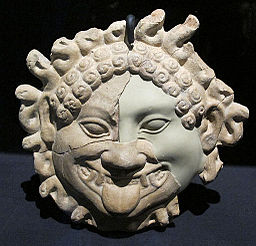
256px-antefissa_circolare_a_testa_di_gorgone2c_510-500_ac_ca-2c_da_taranto_28man_taranto29
Head of a Gorgon, 510-500 BC, Museo Archeologico Nazionale, Taranto (ancient Taras, colony of Sparta) photo by Sailko

The main theme of That Summer in Puglia is the timeless value of compassion – not ‘pity’, but the ‘feeling with’ suggested by its Latin root – towards others and oneself. Other themes feature prominently: the perils of unresolved grief; the power of love in its many forms; the importance of dialogue and mildness. However, compassion is notable for playing a vital role in them all.

It’s one of the strands running through every form of love: from a stranger’s kindness, to the affection of parents and children; from profound friendship, to romantic love, and all the way to the concept of agápē. I hope that as you read That Summer in Puglia you’ll find yourself moving from judging Tommaso to really caring for him, and that his tale will remind you of something truly marvellous: that not just in fiction, but everywhere around us, acts of love great and small can transform lives.

In the story, unpredictable combinations of factors impact the characters’ internal worlds, relationships and actions. In the process, a theme closely related to compassion is explored: the need to test the goodness of any action by asking whether love for fellow human beings would enjoin us to take it. As philosophers have cautioned since ancient times, certainty of one’s own virtue can too easily slide into self-righteousness.

This is where the theme of the importance of mildness and dialogue comes in. We live in times where the need for them at societal level is more evident than ever.


Photo credit: Head of a Gorgon by Sailko. Reproduced under CC Commons License.