
‘How dare we predict the behaviour of man?’ wrote Viktor Frankl, Austrian psychiatrist and holocaust survivor, and author of Man’s Search for Meaning. His quote is at the front of Alice Jolly’s The Matchbox Girl (Bloomsbury, November 2025), but the theme at which it hints is shared also by Rachel Seiffert’s Once The Deed Is Done (Virago, March 2025). Both books are on the 2026 Walter Scott Prize for Historical Fiction shortlist, and I wholeheartedly recommend them. These beautifully written and painstakingly researched novels will steep you in life under Nazism and make you ask yourself an uncomfortable question: how might you have behaved under those circumstances? Of course, each of the two books handles several other themes.
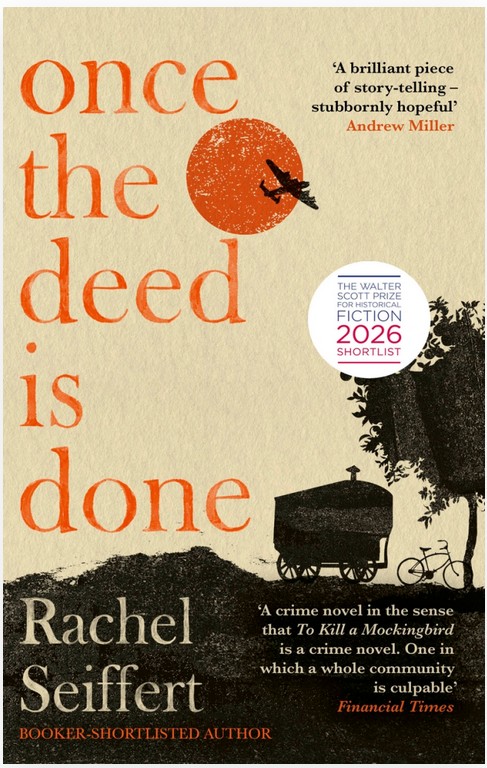
I begin with Rachel Seiffert’s Once The Deed Is Done, which I originally reviewed more briefly under ‘My top historical fiction reads’ in May 2025.
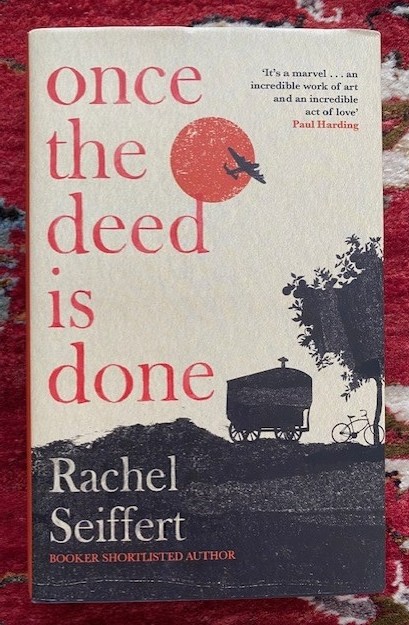
Once The Deed Is Done sheds light on a page of history rarely covered in fiction, immersing us so deeply in the events and in the protagonists’ inner and outer worlds that it feels as if we were there.
Lüneburg Heath, Northern Germany, 1945. It’s March, and the Reich’s defeat is imminent. We follow the thoughts and actions of the residents of a small town through multiple narrators’ points of view: young and old, those who were faithful to the Nazis, those who put up quiet resistance to them… Something mysterious and sinister happens one night on the town’s outskirts, near the munition works manned by Eastern European forced labourers. Fragments of that night’s events transpire slowly, as some of the townsfolk were there, or watched from a distance, or heard rumours.
We eventually discover what happened, through the eyes of a British Army sergeant, of a young fugitive carrying a baby in her arms, and of Ruth, a British Jewish Red Cross officer. Ruth and the sergeant oversee a camp for displaced people, set up by Allied forces at the war’s end on the town’s outskirts. There, we track the fortunes and inner lives of a large cast of characters: men, women, and two children who are among the hundreds of thousands forcibly transported by the Nazis to work in German factories and farms. Among them are mothers separated from their children, and vice-versa. Ruth works relentlessly to find the whereabouts of their loved ones, a Sisyphean task in the immediate post-war chaos. She faces tough choices every day: whether to ignore evidence of black-market activity in the camp or not; to move the two children to Hamburg, where they would be better catered for, but where their chance of finding again those they love would be lower, unless… Nor is repatriation the wish of every displaced person: those from Poland and Ukraine fear returning to lands now under Stalin’s control.
Few novelists can weave such a compelling narration through so many characters’ perspectives. Authors capable of it reward us with an uncommonly rich reading experience. We hear both the choral effect and the individual voices. Seiffert does not shy away from the enormity of the horror at the centre of this novel, but she also paints the minutiae of every character with the finest brush. The protagonists are three-dimensional people. The town where the shocking events have taken place is both itself and a microcosm of Germany: who supported, who acquiesced in, who resisted Nazism? One of the characters, the yard man Herr Brandt, realises the only reason he’s not on the Allies’ list of Nazi sympathisers is that he was not awarded a manufacturing contract he desperately sought. He contrasts his own cowardice with schoolmaster Arno’s brave dissent, and yet Arno feels a coward for not having done more.
Through her unsentimental and yet moving prose, Seiffert lays out the facts, and poses questions that linger in the mind about the past and the present. That is what the best historical fiction does. Seiffert’s novels have received well deserved recognition: one was shortlisted for the Booker Prize, another three were longlisted for the Women’s Prize… How wonderful to see Once The Deed Is Done on the shortlist of the Walter Scott Prize for Historical Fiction 2026.
Meet narrator Adelheid Brunner, a fictional Viennese neurodivergent 12-year-old when the book opens in 1934. She is the eponymous “matchbox girl” by virtue of her obsession for collecting and organising matchboxes. Adelheid refuses to speak, seeking safety in her silence, as she finds it difficult to understand what’s appropriate to say. ‘Staying silent’ is a recurring motif in the novel: some silences protect people, while others prove fatal. Adelheid’s complexity and her compulsion to understand things, to categorise them (into binaries which they resist), and to write them all down make her an engrossing narrator.
Much of the action takes place in the Curative Education Ward of the Vienna Children’s Clinic, where Adelheid is sent as a young patient and where she later works. From the very start, events in the outside world shape the lives of everyone in the ward: patients, doctors, nurses… From the murder of Chancellor Dolfuss, all the way to post-WW2 reconstruction, we follow history in the making through Adelheid’s unflinching gaze. Many of the events and behaviours she witnesses confound her because, with the advent of Nazism, reality acquires an upside-down quality. In a memorable paragraph, Dr Josef Feldner, one of the doctors on the ward, warns Adelheid that they’re now in a world in which she must do “the Wrong Thing in order to do the Right Thing” and that others must pretend not to see her doing it.
Feldner is one of many real-life characters in the novel. He bravely rescues a Jewish boy by passing him off as his nephew – an open secret which his colleagues keep. As readers, we’re plunged into the darkness and moral ambiguities the hospital staff navigate. Dr Hans Asperger, who sees the individuality and potential of every child in his pioneering research and work on autism, is the same man who signs off on the transfer of dozens of children to the notorious Am Spiegelgrund, where many are murdered. The insightful Dr Anni Weiss and Dr Georg Frankl leave Vienna and emigrate to the US because they are Jewish. Sr Viktorine Zak (whom Asperger called ‘a genius’) shines for her profound love and warm care of the children – she must have chosen to stay and look after them, knowing and not knowing about the encroachment of eugenicist ideology on the Children’s Clinic under Dr Franz Hamburger.
We’d all like to think we’d be as brave as Dr Feldner under the same atrocious circumstances – but would we be? The novel instills a sense of humility: the acknowledgment that most of us are fortunate (so far) not to be put to such tests. Where would we personally draw the line between compliance and resistance? Another of the novel’s epitaphs comes to mind, this time from psychiatrist and autism researcher Lorna Wing: ‘Nature never draws a line without smudging it’. How clearly can we draw one between ‘normal’ and ‘pathological’ behaviour? And between survival and collaboration?
The novel is superbly written and engaging. Adelheid has a strong voice and a complex perspective. The narration moves at a fast pace, taking in the stories of all the central characters. Alice Jolly is to be applauded also for highlighting the contributions of many people to our understanding of neurodiversity: the focus isn’t solely on the controversial Dr Asperger, but also on the forgotten Drs Feldner, Weiss, and Frankl, and Sister Viktorine Zak, whose character is particularly moving. How good for her to be given visibility: being a woman and a nurse, she features little in histories of autism, despite Asperger’s high esteem of her. Recognition of her work seems apt also because yet another ‘gender gap’ – in the diagnosis of autistic girls and women – has finally been addressed in very recent years.

