Review of ‘Love lay down beside me and we wept’

Photo of Love Lay Down

love lay down beside me and we wept by Helen Murray Taylor

My rating: 5 of 5 stars


Any one-liner for describing what this memoir is about would do it an injustice: it could not encompass its range. It’s about depression, attempted suicide, surviving it, recovering, building a new life… About societal expectations and how they shape us. About our system of mental healthcare. And it’s very much about love.

‘Love Lay Down’ is an important book. Helen Murray Taylor shares with generous openness and formidable eloquence her story of depression’s vortex and of her recovery. Her memoir is vivid, raw, at many points heartbreaking. At the same time, it’s infused with wit, with her ability to perceive the surreal and the outright comedic in some of the worst circumstances. She lets us into her intense emotions and thoughts at the time, as well as into her capacity for looking back at them now with hard-won distance.

Love blazes a luminous, life-saving path throughout this memoir: the love between Helen and her husband; that of family; of friends, colleagues… The whole book strikes me also as a real act of love by its author towards readers: as a gift of hope – and of feeling seen and heard – to sufferers from depression; and as a gift of understanding to all. ‘I hope that no one who reads this has ever found, or will ever find, themselves being dragged under by the force of their depression. But if that is you, […] please, please, call out for help. The help when it comes might not steer you to dry land but it might be the lifejacket that lets you turn on your back and float, the thing that lets you rest awhile, that keeps you afloat a little bit longer. Survival isn’t always about kicking against the waves. Tomorrow the tide might turn and wash you ashore.’

Re-posted from my Goodreads review
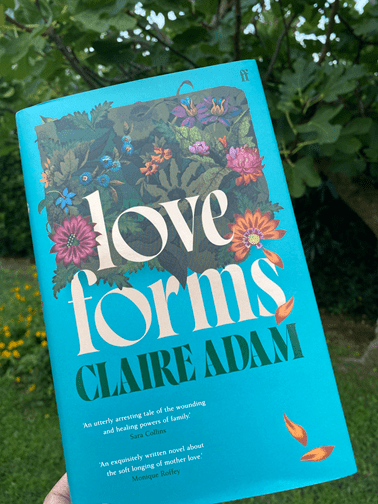
Review of ‘Love Forms’ by Claire Adam

Longlisted for The Booker Prize

Love Forms by Claire Adam

My rating: 5 of 5 stars

‘It was my father who made the arrangements. My uncle helped, since he lived down south, where all this kind of business is carried out.’

The opening of ‘Love Forms’ sets the tone for the whole novel: a voice that immediately draws you in with its fresh, direct, familiar cadence; and ‘the arrangements’ at the heart of the story. These arrangements see the then sixteen-year-old protagonist, Dawn, whisked off from her home in Trinidad to Venezuela, where she must give birth in secret and surrender her baby for adoption. The reason? ‘She made a mistake and brought shame to her family.’

It’s not long before Dawn realises that the real mistake – whether really hers or her parents’ – was to give up her daughter. The intense longing to find her again impacts the rest of Dawn’s life. Though she goes on to graduate in medicine in the UK, work, marry, and raise two beloved sons, her yearning for the lost child becomes an ever-present, aching part of who she is. When she’s fifty-eight, we witness one of her many attempts to track down her daughter – a search that plays out as a roller coaster of emotions.

Dawn feels so real, that I was absorbed by her evolving feelings and her growing understanding of herself, of her family, and of the changing world around her. This is partly thanks to Claire Adam’s sensitive psychological portrayal of her main character, and partly because of the three-dimensionality she lends to the places – Trinidad, Tobago, Venezuela and London – and times the protagonists inhabit. The dialogue across generations – between Dawn and her parents, siblings, and children – is deeply affecting, as powerful in its silences as in its words. These exchanges and the characters’ actions sustain a taut narrative tension: I often found myself wondering about the consequences of certain conversations – and discovered their outcomes in the novel’s final chapters.

It’s all there in the title: ‘Love Forms’ is about different kinds of love (starting with that of a mother for her child), and about the ways it’s kindled, grows, is challenged, changes… and how it changes us in turn. It’s a poignant, beautifully written novel, and one of the finest I’ve read in a long time. I couldn’t recommend it more highly.


Stephanie Bretherton’s “The Fire in Their Eyes”

Re-blogged from Goodreads

The Fire in Their Eyes by Stephanie Bretherton (Breakthrough Books, 2025)

My rating: 5 of 5 stars

“The Fire In Their Eyes” is a breath of fresh air: a thriller that keeps you hooked right up to the end, it’s boldly original, unafraid to experiment with form, and courageous in its engagement with urgent issues. It reveals the interconnections between these issues, while weaving a narrative that is both emotionally gripping and intellectually engaging. If you crave fiction that does more than entertain – stories that challenge you to think and that spark meaningful conversation – this book is for you.
Structured across dual timelines, the novel follows three female protagonists, all of them gripped by a strong sense of impending danger. Each woman fights, with grit and intelligence, to prevent a catastrophe. Though separated by time and geography, the threats they face are connected.
In the Arctic, geneticist Eloise races against time at a scientific research station to neutralise a fresh danger to humanity. What is its link to the DNA of “Sarah,” a woman whose 74,000-year-old remains were discovered on Mt. Kenya?
Meanwhile in Manchester, psychiatric nurse Jessica – whose husband Max unearthed Sarah’s remains – is experiencing a heightened sense of threat. What is the cause of this change in her? And how will it affect her deep, tender bond with Max?
In a lush Kenyan valley 74,000 years ago, the shamanic Old Woman – Sarah’s daughter – perceives an impending danger that could annihilate her people. It falls to her to discern the precise nature of the threat and devise a way to combat it.
Stephanie Bretherton’s novel is underpinned by meticulous research. Complex scientific ideas – particularly in biology, genetics, and virology – are conveyed with clarity and precision and linked back to some of the most profound questions of our time. For example, the author draws links between globalisation, climate change and other environmental issues, rising population density, and the emergence of new pathogens. She also explores the spiritual and philosophical questions raised by natural disasters, political opportunism, and the consequences of human actions. One question resonates especially strongly: from one generation to the next, how do we pass on the best of what it means to be human? The power of all forms of love to help us meet the toughest challenges is one of the novel’s connecting threads.
This is not, however, a didactic book. Each of its three narrative strands is as gripping as a thriller, with high stakes and expertly controlled pacing. The tension builds steadily towards an emotionally resonant climax. I found Jess and Max’s story particularly moving – an honest, tender portrayal of love and the difficulties it must overcome.
The novel’s intricate structure is beautifully handled. You always know exactly where you are and feel secure in the hands of a confident storyteller. Each of the three protagonists is surrounded by sharply drawn secondary characters: family, friends, and colleagues who feel fully alive. The integration of emails, text messages, and unsent letters lends further realism and emotional depth. The settings are equally immersive: Eloise’s sterile research facility and the bleak beauty of the Arctic; Jess at the psychiatric hospital where she works, in the swimming pool where she finds release, and in the quiet refuge of memory – drifting back to a long-ago dive among minnows; and the Old Woman’s tribal village – rich with ritual and community – and its wild surroundings.
This is a novel of gripping storytelling, literary substance, and lasting insight – one I wholeheartedly recommend. “The Fire In Their Eyes” is the second book in “The Children of Sarah” series, and I already look forward to its sequel.