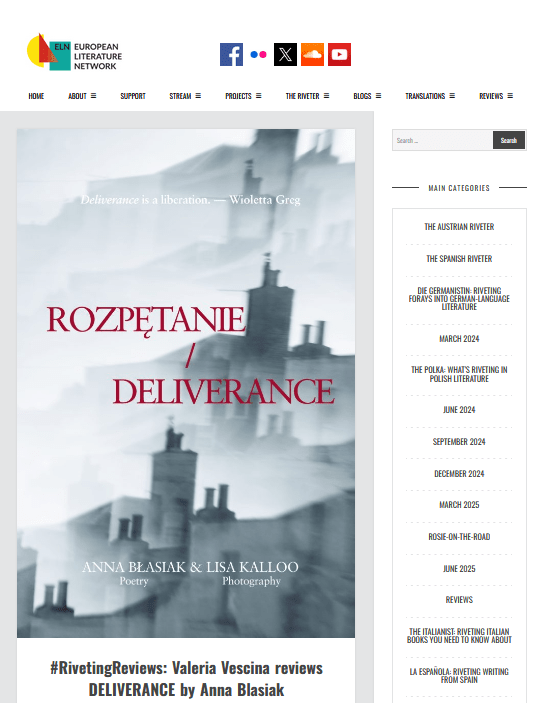
The European Literature Network’s latest Riveting Reviews include one from me on Anna Błasiak’s Deliverance (Holland House Books). It’s a moving poetry collection about growing up queer in Poland and gradually attaining one’s full identity. Its superbly inventive blend of art forms holds rich layers of meaning that thoroughly reward attentive reading. I felt privileged to be asked to review this memorable collection.
Here is the link to the article, and here one to the book publisher’s website.
If you’re looking for exciting content and discussion – including book recommendations – about European literature (especially, but not only, in English translation), take a look at all that the European Literature Network‘s website has to offer – it’s a real treasure trove!
So, what to consider when reviewing a work of fiction? Here are my top ten tips.
Begin with a gripping line or paragraph which conveys your overall opinion. It could be phrased as (a) a statement or (b) a question. As an alternative, you could begin with (c) a quote from the book which encapsulates its themes. An example of each:
The title says it all: smoking kills – though in the case of this novel, the victim is not the smoker but those he kills (‘and not through passive smoking,’ he clarifies) in order to enjoy the pleasures of a cigarette. We’re firmly in humour noir territory: the book’s incisive, satirical take on modern-day life offers a succession of laugh-out-loud moments.[1]
What might drive a left-wing intellectual to espouse xenophobic views and defend the indefensible? How might the community around him react? How would you react if he were your father? In Autopsy of a Father, Pascale Kramer poses uncomfortable questions and tests your tolerance of disquiet.[2]
‘“Fate,” said Arthur. “The capital letter F. But chance is a powerful force, and suddenly you acquire a Fate that was never assigned to you. Some kind of accidental fate. It happens in a flash.”’[3]
Give us a reason why we should read the book / why it should spark our curiosity
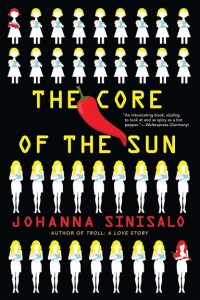
E.g.: One of the most original novels I’ve read in a long time, The Core of the Sun is set in an alternative present – in the “Eusistocratic Republic of Finland”.[4]
In your plot summary, tell us about the protagonist(s)’ approach to the key issue/conflict/mystery
E.g.: Caterina’s process of reconstruction involves acquiring that part of herself which she left to her twin. […] But as she learns to take care of their elderly mother, of Olivia’s son and of a young neighbour who has lost her little girl, she understands that it was too simple for her and others to rely on Olivia.[5]
What questions does the story raise?
Does it interrogate and challenge any stereotypes? Or the opposite?
Does it prompt us to read relevant books?
An example of questions raised: Raimo leaves readers to judge: was there any love at all on his part, or only desire, fetishism, possession and the drive to dominate, self-justified with theword ‘love’? Can any of these ever coexist with love, or do they often taint it, but only to hardly perceptible and therefore unrecognised degrees?[6]
Tell us how the book makes you feel
What, if anything, will move us? Or amuse us, etc?
What causes that response? It could be an episode, or the language, or…
E.g.: It would be incorrect to infer too much neatness from the symmetries in the book’s structure. The subtle play of balance and counterbalance constantly engages the reader, while offering a reassuring framework to explore the chaos of complex issues with no easy answers.[7]
What might this book add to readers’ lives?
E.g.: ‘A Whole Life’ attests to the enduring value of just this kind of ‘lightness’ – a lightness of touch which offsets the depth of Robert Seethaler’s themes, distilling them into thoughts and images that linger in the reader’smind.[8]
Select your quotes carefully
The ones you choose should illustrate your points
Try to find one or two that are representative of the book as a whole
E.g.: He possesses the ability to capture the joy of the earth warmed by the sun under his “night-damp feet”, the wood which “had stored the warmth of the last days of summer and smelled of dry moss and resin”, and the coolness of a flat rock on which he lies down.[9]
Analyse the author’s (and the translator’s, if it’s a foreign work in English) treatment of the most relevant elements of writing, such as:
individuality of voice (style, language…)
characterisation
sense of place
structure
E.g.:
The writing alternates wit and humour with darkness and melancholy, dramatic tension with aphorisms, the real with the surreal, poignant observation with optimism. The rhythm of the prose is thus pleasantly engaging, and the plot suspenseful – not least due to some ethically questionable choices on the protagonist’s part – but more compelling still is the development of the themes over the story’s arc. Antoine Laurain succeeds in creating a first-person narrator who is whimsically and yet realistically unaware of the full depth of his unhappiness until he has distanced himself from it.[10]
Authors of intimate stories that reflect the course of a country’s historical fortunes face a challenge: to create fictional protagonists we’ll care about without their writerly imagination being clipped by the magnitude and details of nationally significant events. Aareleid deftly overcomes that challenge, giving us believable human beings through the eyes of…[11]
You can mention relevant novels or short stories by other writers
E.g.: The themes may bring to mind Margaret Atwood’s The Handmaid’s Tale, but it would be a disservice to both authors to insist on comparisons.[12]
Ensure your review’s ending addresses your central idea
E.g.: This is a book which challenges you to work hard and amply rewards you for it: a gripping read in its own right, and fiction that enhances our engagement with the world we inhabit.[13]
Where to go for advice on some great German reads? You can turn to the excellent New Books in German if you’re looking for new titles. And now there’s also an amazing compendium: The German Riveter. It covers fiction and poetry written since the fall of the Berlin Wall 30 years ago, as well as literature from the Nazi period (Heinz Rein, Hans Fallada, Timur Vermes), poetry of the Holocaust, the ‘Krimi’, children’s books, memoir ‘snapshots’ of 1989 and English-language extracts of untranslated works. Click here for FREE access to the full text, illustrated by the great Axel Scheffler.
The German Riveter was produced by the European Literature Network with support from Arts Council England, the Goethe Institut, the German Embassy in London, the British Council, Frankfurt Book Fair and the British Library. It’s the seventh edition of The Riveter, previous ones having focused on writing from Poland, Russia, the Nordic countries, the Baltics, Switzerland and queer writing from Europe. The launch took place at the British Library: EuroLitNet founder Rosie Goldsmith interviewed authors Durs Grünbein, Julia Franck and Nino Haratischvili and their translators Karen Leeder, Charlotte Collins and Ruth Martin, all of whom read out in German and English from their work.
Rosie Goldsmith presenting the Riveting Germans event at the British Library
Speakers and interviewer at Riveting Germans event at British Library – Nino Haratischvili reading
It was a privilege for me to be asked to review ‘F’, a novel by Daniel Kehlmann which I can highly recommend. You can find out why on pp. 64-65 of The German Riveter.
The fall of the Berlin Wall is a subject which began interesting me years before it occurred. The potential for it was the focus of my International Relations dissertation in 1986. I first visited East Berlin in 1984. I recall especially well the visit to the Pergamon Museum, not only thanks to its astonishing contents but also because of the conversation with a museum attendant who told me how lucky I was to be there one moment, and wherever else I might wish, the next. The subsequent year, while completing my degree at POLSIS, I was fortunate to be awarded a residency at the West German foreign ministry’s Research Institute for Political Studies; it enabled me to conduct field research into the potential for German reunification, including interviews with personalities across the political spectrum. So, for me the experience of seeing the Wall coming down in 1989 was charged with layers of emotion.
Pergamon Museum, 1984
Pergamon Museum, 2011
By mere coincidence, the Wall plays a large role in one of my favourite reads of 2019, Deborah Levy’s The Man Who Saw Everything: it is integral to the plot but also serves as a metaphor, as a recurring motif… This is a novel to treasure, the kind which rewards you with fresh discoveries as you return to it.
So, no shortage of suggestions here if you’re looking for some great books! Happy reading!
Recently the European Literature Network published The Swiss Riveter, a compendium of writing about contemporary fiction, poetry and memoir from Switzerland. It contains essays on Swiss literature’s richness and diversity, as well as reviews and extracts, including an exclusive English excerpt of Peter Stamm’s The Gentle Indifference of the World (to be published this year in Michael Hoffman’s translation) and an essay by Swiss-British writer Alain de Botton.
My review of Pascale Kramer’s Autopsy of a Father (Bellevue Literary Press, 2017) appears on pp. 56-57. Kramer won the Grand Prix Suisse de Littérature in 2017 for her oeuvre. Autopsy of a Father is a powerful novel for our times: it tackles xenophobia, racism and nationalism. You can access the review here.
The European Literature Network promotes literature in translation. The Swiss Riveter was produced with support from Pro Helvetia, the Swiss Arts Council, the Embassy of Switzerland in the UK, Arts Council England and ELit Literature House Europe. Sections of it are now available also in digital form here.
This is the fifth of the European Literature Network’s Riveters. The first was devoted to literature from Poland, on the occasion of the 2017 London Book Fair’s Polish focus. The second, on literature from Russia, coincided with ELNet’s Russian events at the British Library. In The Nordic Riveter of October 2017, five countries were represented: Sweden, Norway, Denmark, Finland and Iceland. The fourth covered the Baltics, the focus of the 2018 London Book Fair.
The Polish Riveter
The Russian Riveter
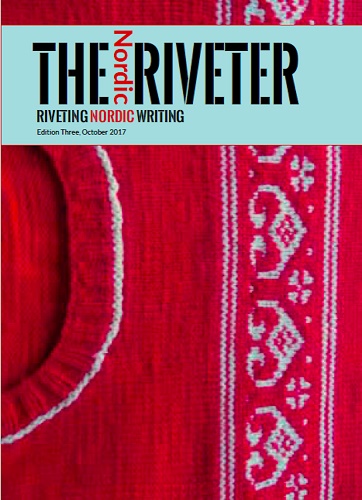
The Nordic Riveter
The Baltics Riveter
Image credits:
Images courtesy of The European Literature Network.
Riveting Reads: on Simonetta Agnello Hornby and Nicola Gardini
The European Literature Network champions international literature – if you aren’t already aware of its activity, do check out its website.
Every month, its Riveting Reviews section features reviews of (mainly) European literature – mostly of works recently translated into English. It also offers a Riveting Reads section, consisting of brief (only a few lines long) recommendations of a wider range of books, including fiction and non-fiction not yet available in English translation, as well as texts published years ago.
My recent full-length ‘Riveting Review’ was of Antoine Laurain’s ‘Smoking Kills’ (see here). My July ‘Riveting Reads’ are focused on works by Italian authors: ‘The Little Virtues’ by Natalia Ginzburg; ‘Nessuno Puo’ Volare’ by Simonetta Agnello Hornby; and ‘Le 10 Parole Latine che Raccontano il Nostro Mondo’ by Nicola Gardini. I hope you’ll enjoy reading about them and about all the other intriguing titles chosen by my fellow contributors.
Image credits:
Image of ‘Riveting Reads’ from the European Literature Network website.
In April, the European Literature Network published The Baltics Riveter, a compendium of writing about contemporary fiction from Estonia, Latvia and Lithuania. Publication coincided with this year’s country focus on the Baltics at London Book Fair, where the magazine was widely distributed and enthusiastically received. It contains historical notes, reviews and extracts of some very exciting literature.
The Baltics Riveter is now available also in digital form here. This is the fourth of the European Literature Network’s Riveters. The first was devoted to literature from Poland, on the occasion of the 2017 London Book Fair’s Polish focus. The second, on literature from Russia, coincided with ELNet’s Russian events at the British Library. In The Nordic Riveter of October 2017, five countries were represented: Sweden, Norway, Denmark, Finland and Iceland.
I normally review English-language editions of novels originally written in Italian, German and French, the languages and cultures I grew up with. But the editor of The Riveter asked whether I might review Estonian author Kai Aareleid’s Burning Cities, translated by Adam Cullen (Peter Owen Publishers, 2018). I’m very grateful for the suggestion: the novel weaves a powerful domestic tale within the larger tapestry of seven decades of Estonian history; most of the story unfolds in the years during which the country was part of the Soviet Union. You can find my article on pp. 58 and 59 of the magazine, or here. I hope it will encourage you to discover Kai Aareleid’s work and more of the riveting literature from the region.
Image credits:
Images courtesy of The European Literature Network.
In October this year, the European Literature Network published The Nordic Riveter, a compendium of writing about contemporary Nordic fiction in English translation. It’s available in bookshops, embassies, universities, libraries and arts organisations – and now also for download from http://www.eurolitnetwork.com/the-nordic-riveter-to-download/ . Whether you are a ‘Nordic Noir’ addict, a newbie to literature from the region, or are curious to discover its different strands and what they offer, you’ll find much to inspire and inform your reading.
This is the third of the European Literature Network’s Riveters. The first was devoted to literature from Poland, on the occasion of the 2017 London Book Fair’s Polish focus. The second, on literature from Russia, coincided with ELNet’s Russian events at the British Library. This time, five countries are represented: Sweden, Norway, Denmark, Finland and Iceland.
The Polish Riveter
The Russian Riveter
I normally review English-language editions of novels originally written in Italian, German and French, the languages and cultures I grew up with. But the editor of The Nordic Riveter asked whether I might take a look at Finnish author Johanna Sinisalo’s The Core of the Sun, which had come highly recommended. I’m very grateful for his suggestion: the book is highly engaging and thought-provoking. You can find my review here: http://www.eurolitnetwork.com/rivetingreviews-valeria-vescina-reviews-the-core-of-the-sun-by-johanna-sinisalo/. I hope it will intrigue you and encourage you to discover this and more of the literature discussed in The Nordic Riveter.
Image credits:
All images from the European Literature Network website.








 Valeria Vescina