Historical fiction – my top reads of the last 12 months

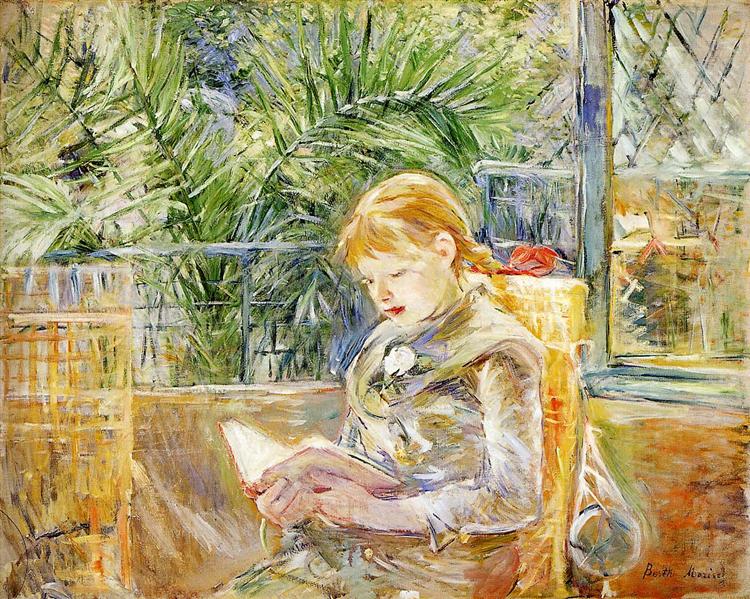
Berthe Morisot, La Lecture (Reading), 1888 (Public domain image. Source: Wikiart)

I’ve always loved historical fiction, so putting together a full list of titles I’d recommend would make for a very long post. The first novels to captivate me were Nathaniel Hawthorne’s The Scarlet Letter and Giuseppe Tomasi di Lampedusa’s The Leopard at secondary school. Soon after, I discovered Dacia Maraini’s The Silent Duchess. To these, over the years, I added books by Umberto Eco, Carol Shields, A.S. Byatt, Hilary Mantel, Rose Tremain, Tracy Chevalier, and many others.

What must historical fiction do, for it to stand out for me? First, it must be beautifully written. I’m very open to experimentation with form – perhaps a result of my own background as a novelist and creative writing tutor. I prize books strong in characterisation, sense of place, story structure and plot development, and other elements of the craft. Second, I’m thrilled when a novel teaches me something surprising. It could be an event central to the whole book, or a small, striking detail. I’m especially drawn to forgotten or silenced perspectives. Third, I value insights and themes that shed light on the past and the present: do they challenge harmful narratives or illuminate legacies we’re still contending with? And fourth, the story must be painstakingly researched and imagined, to possess the authenticity on which everything else rests. That includes a serious attempt at immersing me in the worldviews of the time and place depicted.

If any of this resonates with you, here are seven books I read in the past twelve months that I hope you’ll enjoy. They’re listed in alphabetical order.

Astraea – Kate Kruimink (2024, Weatherglass Books)

This powerful little volume (115 pages) won the 2024 Weatherglass Novella Prize. Set on a ship in the nineteenth century, it’s about a cargo of female convicts destined for Australia. We experience events from the point of view of fifteen-year-old Maryanne. It’s a haunting yet hopeful tale of resilience and camaraderie in the face of misery and brutality. The narration is viscerally immersive, anchored in Maryanne’s raw physical and mental perceptions. Look out for Kate Kruimink, who has already published two other novels.

Costanza – Rachel Blackmore (2024, Renegade/Dialogue Books)

Costanza Piccolomini, the woman at the centre of this novel, was the muse, lover and model of Gianlorenzo Bernini, the leading sculptor of seventeenth-century papal Rome. In a horrific act of violence, Bernini ordered a servant to disfigure her, in the belief she had been unfaithful to him with his younger brother. Basing herself on the facts that have come down to us about Costanza and the other protagonists, Rachel Blackmore has painstakingly reimagined her life. The reconstruction of the all-important social and cultural context is outstanding, and her conjectures about what happened highly plausible, while her portrayal of Costanza’s inner world is empathetic and engaging. The novel tackles enduring themes: double standards, the abuse of power, and coercive control.

For Thy Great Pain Have Mercy on My Little Pain – Victoria MacKenzie (2023, Bloomsbury)

This slim novel brings to life two well known English mystics, Julian of Norwich and Margery Kempe. They are, respectively, the first woman to have written a book in English, and the first author of an autobiography in English. Victoria MacKenzie imagines their meeting in 1413. She draws on their writings and on her research into the medieval context to offer us vivid portrayals of both. Their personalities and circumstances differ greatly from each other: Julian, a reflective anchoress, and Margery, a chaotic mother of fourteen. And yet, their experiences and spirituality make for a strong connection between the two. MacKenzie balances their alternating voices with a poet’s precision and sensitivity. A luminous reading experience.

Once The Deed Is Done – Rachel Seiffert (2025, Virago)

This is the fifth novel by Rachel Seiffert, whose The Dark Room (historical fiction) was shortlisted for the Booker Prize. Once The Deed Is Done opens in March 1945, as the collapse of the Reich draws near. A multi-point-of-view narration gives us access to the thoughts, choices, and personal histories of several inhabitants of a Northern German village. Ruth, a British Red Cross officer, is tasked with supervising and caring for displaced people in a camp the advancing Allied Forces have just set up on the village’s outskirts. Gradually, a dark, shocking secret harboured by some of the villagers emerges. The novel highlights an issue rarely covered in WW2 fiction: the fate of forced labourers during and after the war. With her moving, unsentimental prose, Seiffert poses tough questions about individual and collective responsibility.

The Painter’s Daughters – Emily Howes (2024, Simon & Schuster) Peggy and Molly Gainsborough are the charming objects of portraits by their father Thomas, one of eighteenth-century England’s most acclaimed painters. Emily Howes turns the two sisters into the subjects of her deeply moving debut novel. Molly suffers episodes of mental confusion from a young age and Peggy instinctively shields her. When the family moves from rural Ipswich to fashionable Bath, hiding Molly’s condition becomes harder. Add to this mix a beguiling composer who enters the sisters’ lives, disrupting their close bond and putting Molly’s fragile sanity at risk. Howes steeps the characters’ thinking firmly in the mentality of the era, rendering their feelings, actions, and dilemmas convincing and deeply affecting. The novel delicately examines themes of devotion, mental illness, sisterly love and rivalry, and other family dynamics. It thoughtfully explores the complex area between protectiveness and control in challenging circumstances, without casting judgment.
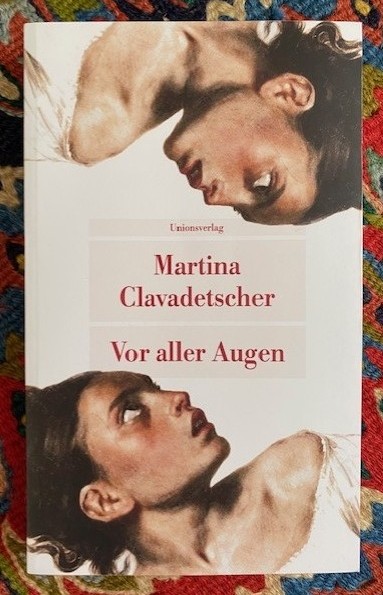
Vor Aller Augen – Martina Clavadetscher (2022, Unionsverlag) I’m afraid this one isn’t available in English yet. Martina Clavadetscher is a well-known author of books and plays, and the winner of the 2021 Swiss Book Prize. In Vor Aller Augen (In Plain Sight), she foregrounds nineteen women portrayed in iconic paintings: from Cecilia Gallerani in Leonardo’s Lady with an Ermine to Victorine-Louise Meurent and Laure in Edouard Manet’s Olympia, from Joanna Hiffernan in James Whistler’s Symphony In White no. 1 to Dagny Juel in Edvard Munch’s Madonna. Clavadetscher not only captures the moments immortalised on canvas, but, above all, lets each protagonist recount her life story in her own distinctive voice. The silenced object of the painter’s (and the viewer’s) gaze thus becomes the active subject, a real-life woman demanding recognition.

And finally, a bonus recommendation: not a novel, but a piece of historical life writing. Fiction can vividly evoke what it was like to live in another era, but so can micro-history and exceptionally well-crafted family memoirs like the one featured below. Originally published in German, it appears in a superb English translation by Jamie Bulloch.

Alice’s Book – by Karina Urbach, trans. Jamie Bulloch (2022, MacLehose Press)

The title refers to So kocht man in Wien!, a bestselling cookbook authored in 1935 by historian Karina Urbach’s Jewish grandmother, Alice. Forced to flee Austria for England in 1938, Alice survived, while her sisters perished in concentration camps. After the war, she discovered that her book had been reissued in 1939 in an ‘Aryanised’ edition: the author ostensibly a German man; and the names of Jewish and foreign recipes germanised. Despite her repeated appeals, the publisher refused for decades to acknowledge Alice as the true author; it returned the rights to her heirs only after being publicly exposed in 2020. In Alice’s Book, the cookbook is symbolic of loss. It offers a powerful vehicle for tracing the devastating impact of Nazi persecution on one Jewish family – dispersed across China, England, and the U.S. – and for honouring Alice’s spirit of resilience, generosity, and hope. It also sheds light on the disturbing reality of companies and individuals that continued to profit from crimes committed against Jews long after the war had ended.

About me: I’m Italian and British, and moved from England to Switzerland a few years ago. I hold an MA in Creative & Life Writing from Goldsmiths College (University of London). My debut novel, That Summer in Puglia, was published in 2018. I’ve just completed the manuscript of my second novel, Habit of Disobedience, set in Southern Italy in the late 1500s. Inspired by true events, this tale of nuns who stood up to the Church explores themes of power, control and female resistance that resonate today.
Accuracy and authenticity in historical fiction

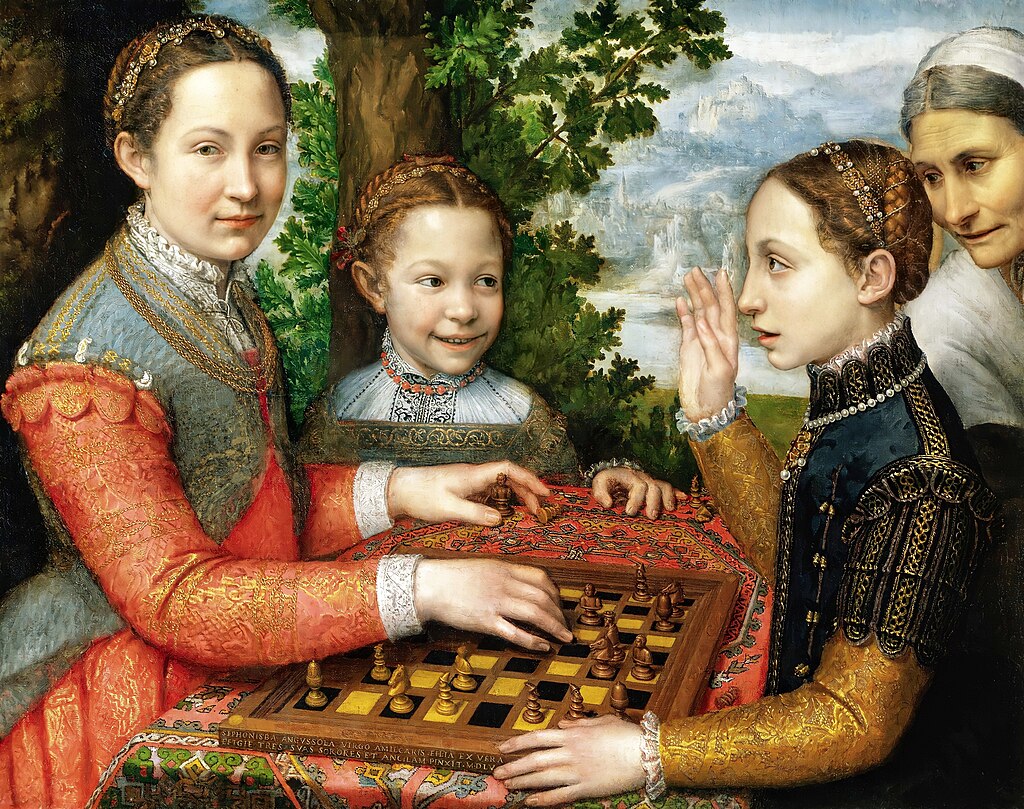
Sofonisba Anguissola’s The Chess Game (1555) is packed with meaning. Among other things, it’s a statement about women’s agency and about Sofonisba and her sisters’ exceptional education. The strategy game of chess was normally the preserve of men. Dama (le jeu de dames) was considered more appropriate for women.

Speak of accuracy and authenticity in historical fiction, and you’ll find writers agreeing on some things but not on others. “Shoulds” abound. Accuracy, you’ll often hear, is objective: it involves verifiable facts, from dates and places to furniture and dress. Authenticity, by contrast, is somewhat subjective: the reader must perceive the story’s world as faithful to the era in question.

Like many dichotomies, this clear-cut view of accuracy as objective and of authenticity as subjective is an over-simplification. The accurate details that authors of historical fiction work so hard to respect are unavoidably a selection, made from their own perspective and as a function of the story; conversely, readers may query the authenticity of well-documented elements that clash with widely held stereotypes and tropes. This matters because authors’ answers to these challenges lead to differing choices. It’s particularly important with respect to fictional re-imaginings of the female experience: recent decades of scholarly findings into ordinary women’s lives – whose legacy most impacts the present – now provide us with invaluable insights.

I’ve spent years researching and writing Habit of Disobedience, a novel inspired by real-life 16th-century women in Southern Italy. Scouring manuscripts, books, and articles in historical archives and libraries; attending history conferences; visiting museums of all kinds; corresponding with historians, in my search for missing details… You’ll gather my efforts at faithfulness – accuracy and authenticity – were not half-hearted. Still, since the key protagonists of my story are ordinary women, there are too many gaps to fully piece together the micro-history. I’m a novelist and tutor in creative writing, not a historian: my interest lay in attempting to inhabit the past until I could ‘see’ and ‘hear’ the characters in places that today convey only a faint echo of their struggles, joys, fears, and dilemmas. Where history left voids, I found doors I could open to fictional elements: characters and threads that capture people and the heartrending situations they experienced.

It’s the approach that felt right for this novel. The true events that inspired Habit of Disobedience are dramatic, and the fictional yarns I wove through them had to be highly consistent with their contemporary context. I’ve aimed to offer what Stephen Greenblatt expressed superbly in a 2009 article: for my protagonists to ‘carry the burden of a vast, unfolding historical process that is most fully realized in small, contingent, local gestures.’1

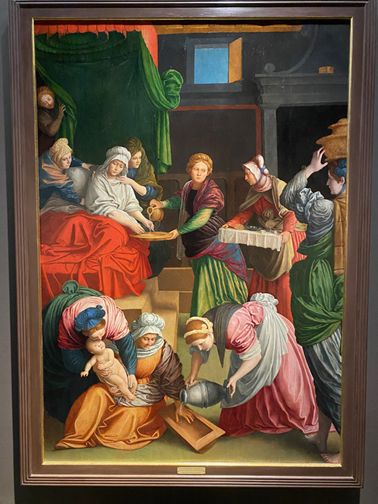
A realistic ‘women’s world’ in Gaudenzio Ferrari’s Birth of the Virgin (1541-43). The water from a baby’s first bath was thrown into the hearth for a girl and outside the front door for a boy.

There’s an additional reason why I’ve strived for faithfulness: I wanted to give a voice to these unheard women because of their relevance to the present day. The novel highlights their acquiescence in a system they thought they could not change, the areas of agency they carved out for themselves, and the trigger for their resistance. It holds a mirror to our times, without anachronisms. That’s also why I’ve aimed to immerse readers in the mentality of the time (to the extent available to me, five centuries later) – our value system affects how we frame and express our emotions in different eras and cultures.2 The more deeply readers let themselves be drawn into my protagonists’ worldview, the greater their surprise at how much of it persists today in changed forms.

Participants at a recent Women Writers Network discussion felt that most people today still live in a patriarchal society. The impact on women is obvious, but it is, ultimately, negative for everyone. It’s a framework of attitudes, beliefs, behaviours, and rules that most of us, no matter our gender, have absorbed and unwittingly sustain until we recognise them. Historical fiction can shine a powerful light on them.

As authors, we strive for accuracy and authenticity – seeking to shift perceptions, however slightly, away from stereotypes and tropes. In doing so, we can contribute much-needed nuance to the public discourse, making it more inclusive and less polarised.

In the words of Hilary Mantel: ‘What can historical fiction bring to the table? It doesn’t need to flatter. It can challenge and discomfort. If it’s done honestly, it doesn’t say, “believe this” – it says “consider this.” It can sit alongside the work of historians – not offering an alternative truth, or even a supplementary truth – but offering insight.’3

I look forward to telling you more about Habit of Disobedience as soon as it finds its publisher.


[1] https://www.nybooks.com/articles/2009/11/05/how-it-must-have-been/?utm_medium=email&utm_campaign=NYR-081124-news&utm_content=NYR-081124-news+CID_075386c07c1251a015e3b5bd8741dede&utm_source=Newsletter&utm_term=Stephen%20GreenblattHow%20It%20Must%20Have%20Been

[2] The academic field of history of the emotions was eye-opening in this respect, as was Arlie Russell Hochschild’s concept of ‘emotional labour’.

[3] The BBC Reith Lectures. Hilary Mantel’s Reith Lecture 2 – The Iron Maiden. https://www.bbc.co.uk/programmes/b08vkm52/episodes/player

Image credits:

Sofonisba Anguissola’s The Chess Game (1555). Photo by Mortendrak, reproduced under Creative Commons Attribution-Share Alike 4.0 international license.

Gaudenzio Ferrari’s Birth of The Virgin (1541-43). Photo by the author, taken at the Pinacoteca di Brera.  

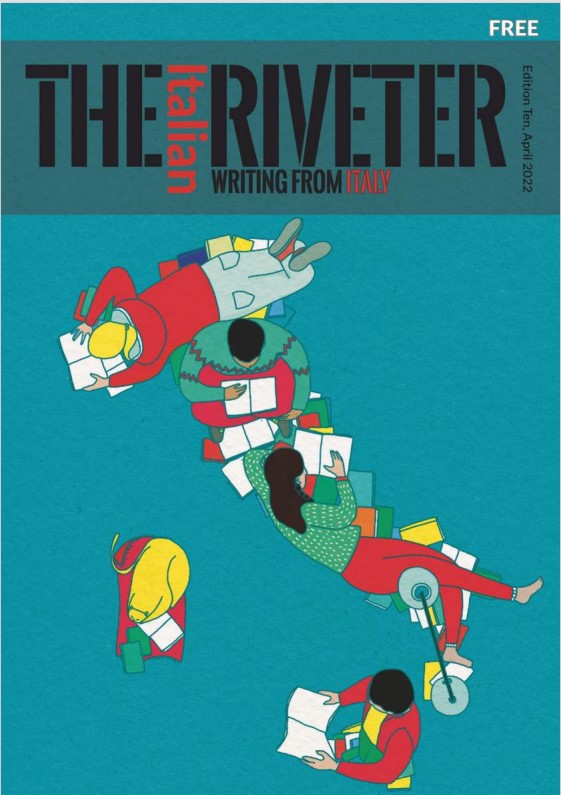
THE ITALIAN RIVETER: CONTEMPORARY ITALIAN LITERATURE IN ENGLISH TRANSLATION

The European Literature Network has just released The Italian Riveter, an incredible resource for lovers of literature from Italy.

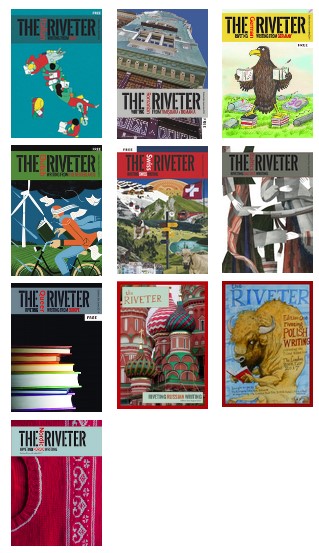
This is the tenth special issue of The Riveter, previous ones having focused on the literary output of Romania, Germany, Netherlands, Switzerland, the Baltics, queer authors, Russia, Poland and the Nordic countries. Click here to view them – they are free to download. Printed copies are available to order from newsstand.co.uk.

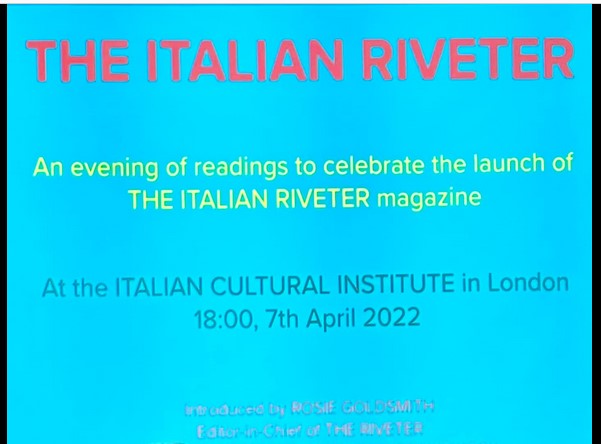
The Italian Riveter was launched at London Book Fair on 5 April and at the Italian Cultural Institute, London on 7 April 2022. The Italian Cultural Institutes of London, Dublin and Edinburgh sponsored its publication. ‘Why Italy? Why an Italian Riveter?’ Rosie Goldsmith, founder of the European Literature Network, answers those question in her introduction. Rosie, editor West Camel and design & production editor Anna Blasiak are indefatigable champions of literature in translation.

Contributors include many well-known novelists, poets, translators and critics from Italy, the UK and far beyond. So, The Italian Riveter offers the pleasure both of a superb read in its own right and of discovering new books to delve into. You’ll find exclusive interviews with the likes of Jhumpa Lahiri, Gianrico and Francesco Carofiglio and Tim Parks. Anna Blasiak delves into Italian poetry and Barry Forshaw into crime fiction. Paolo Grossi of New Italian Books talks about promotion abroad, and Diego Marani about the Italian ‘cultural mind’. Maria Teresa Carbone focuses on women’s writing, and Enrica Maria Ferrara specifically on Ferrante Studies. 

Distinguished translators from Italian provide overviews of different genres, as well as reviews and extracts of books. For example, Howard Curtis covers lost Italian classics ripe for re-discovery, while Clarissa Botsford writes about the ‘new Italians’, including Cristina Ali Farah, Igiaba Scego and Nadeesha Uyangoda; Shaun Whiteside tells us about translating from Italian, and Ann Goldstein about translating Elena Ferrante; Denise Muir and Antonella Ranieri discuss children’s literature and children’s picture books, respectively; Katherine Gregor explains what differentiates the Italian historical novel and curates the section on untranslated Italian fiction.

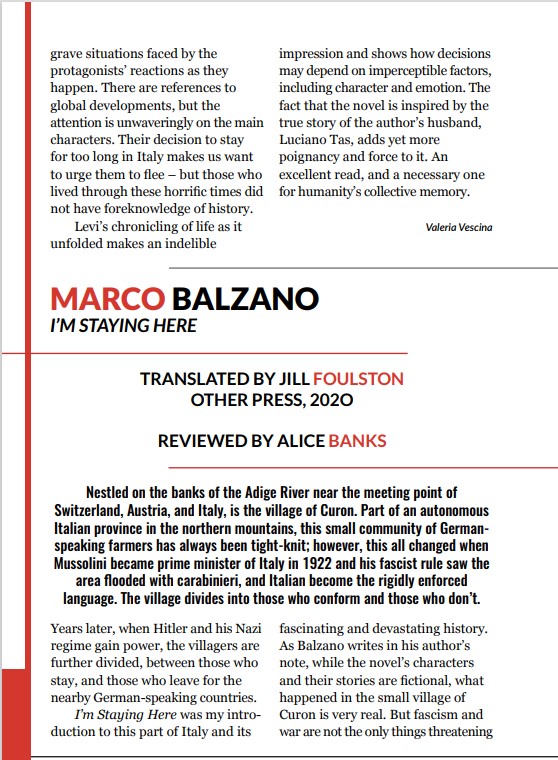
Every section includes different contributors’ reviews of works in the relevant genre. I was delighted to write about Lia Levi’s Tonight is Already Tomorrow, a work of historical fiction based on true events. The Italian Riveter is interspersed with pieces in the ‘Postcard from…’ series, to cover the literature of different regions, reflecting the diversity which characterises the peninsula. I was asked to write the ‘postcard’ from my native Puglia, and hugely enjoyed reading the ones from other parts of Italy.

Are you looking for great book recommendations? Or maybe researching contemporary Italian literature? Whatever your reason for landing on this post, you’ll enjoy and treasure The Italian Riveter.

History in fiction – why it matters

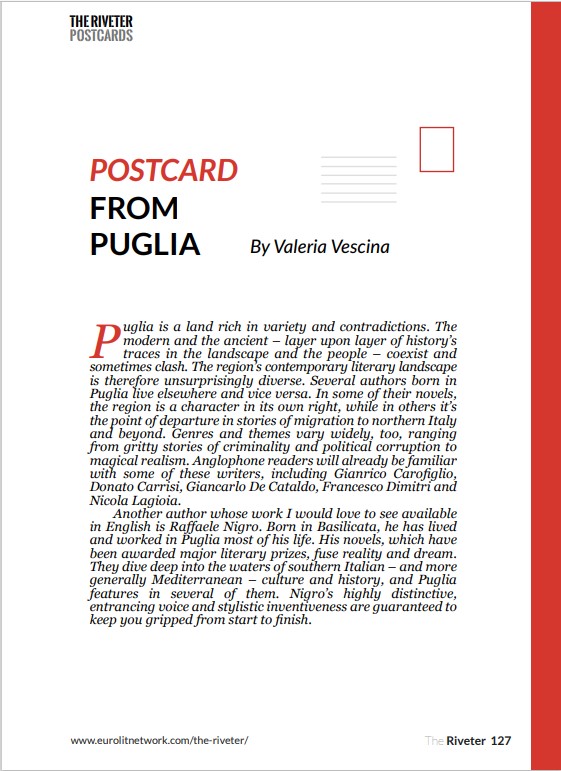
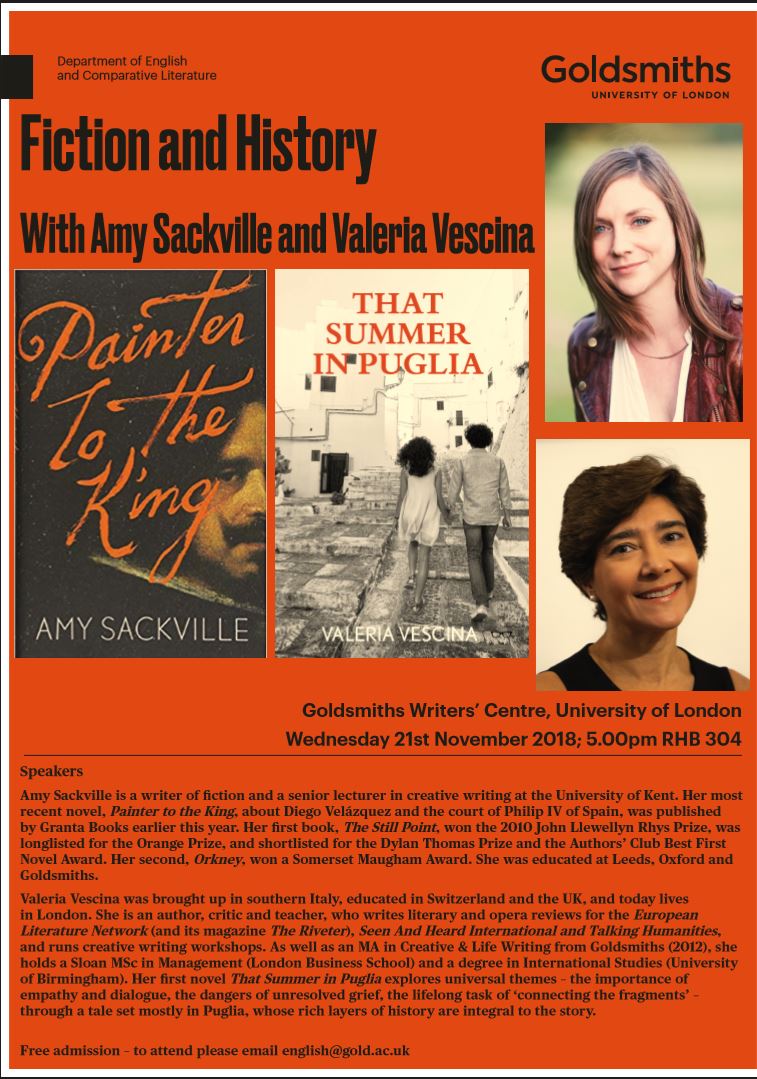
Recently, Amy Sackville and I were invited to speak at the Goldsmiths Writers’ Centre on the topic of ‘Fiction and History’ with reference to our novels. Amy presented Painter to the King (Granta), where she brings to life Diego Velazequez and the Court of Philip IV of Spain; I spoke about That Summer in Puglia (Eyewear Publishing), to which layers of history and diverse cultures are integral.

The Goldsmiths Writers’ Centre is ‘the home of new writing, debate about literature and more’, so the questions from writer and lecturer Ardu Vakil, our interviewer, were duly stimulating. My thanks to Prof. Blake Morrison: it was an honour to be invited to Goldsmiths, having been there years ago as a Creative & Life Writing MA student, and a pleasure to see some of my former tutors, including Ardu. This blog post is in response to requests, on the night and subsequently, to make available online my own reflections on history in fiction.

Goldsmiths Writers' Centre flier

Why weave history into fiction? Because it does something which really matters: it raises awareness of the legacy of history in our present day and of the fact that history is narrative. Novels can alert readers to these two issues and their consequences in ways which imprint themselves in our minds more deeply than intellectual notions alone.

The past conditions our present everywhere, but there are places where this is more evident than in others. My native Puglia, the region located in the ‘heel’ of Italy, is one such place. Part of the Ancient Greek world since the Bronze Age, it was eventually conquered by the Romans. The Via Appia soon stretched all the way from Rome to the port city of Brundisium (modern Brindisi), carrying armies and goods to this natural ‘Gateway to the East’ (‘Porta d’Oriente’). A succession of conquerors followed: Byzantines, Berbers, Normans, Swabians, French, Venetians, Spaniards… Over the centuries, they left an abundance of visible traces. First-time visitors to Puglia today are astonished by the sight of Ancient Greek or Roman ruins side by side with Norman churches, Swabian castles, Anjou palaces, Venetian loggias, Baroque jewels, the idiosyncratic ‘trulli’, whitewashed kasbahs… As a child whose bedroom windows opened onto the 11th-century round church of St. John of the Sepulchre, built by the Normans (influenced by the church of the Holy Sepulchre in Jerusalem) on top of a Roman house, I was conscious of walking daily where other children had walked for at least two-thousand years.

Of course, that is exactly what we’re all doing, physically or metaphorically, everywhere – but most places don’t bring us face to face with that realisation. Puglia has the power to do this also in slightly less obvious ways, and so my novel highlights the ‘living traces’ of diverse people and cultures in the region: the inhabitants’ physical appearance, which surprises foreigners; the mixture of languages which flowed into the local dialect; the cuisine; fairy tales which blend Greek myth with historical fact; proverbs where ancient gods and Christianity meet… I might write a future post about exactly how these traces appear in That Summer in Puglia. In the meantime, these sketchier references are here to help illustrate my answer to the wider question of why history in fiction – including, but not restricting ourselves to, historical fiction – matters.

Some awareness of how dynamically history still impacts the present is salutary for at least two reasons. First, it highlights positive aspects to be grateful for and exposes toxic ones. Second, by reminding us of the transience of life, it has high ‘existential value’: it awakens in us the instinct to make our existence meaningful; and the realisation that we’re tiny drops in the flow of humanity encourages empathy towards others not merely across time but across geographies. At the very least, it’s a spur to seeking to understand our world better and to take responsibility for daily actions. At its best, it pre-empts dangerous Othering. Umberto Eco’s Inventing the Enemy offers a memorable discussion of why intellectual awareness and courage are essential to countering the instinct to invent an enemy in the process of identity formation (individual as much as national).

Equally salutary – particularly when nationalism is experiencing a resurgence at all longitudes – is the recognition that history is narrative. All history is incomplete: the most scrupulous historians, committed to seeking the truth, are not exempt from the imperative to select the dots to connect; they have to sift through the facts and the personalities of the past in order to determine which to include or exclude. Even the most consciously unbiased will do that from a point of view inevitably tinged with the unconscious bias of their time and of other factors. And even the most balanced account can only be partial, a cross-section of reality. Think of the fils rouges running through your own life: they all tell true stories, but each thread can connect only certain aspects of your existence.

Omissions and distortions can have tragic consequences, especially when they’re wilful. That’s true both for societies and individuals and whether the narrative in question is the history of a nation or of a person. The story of Tommaso, the protagonist of That Summer in Puglia, is that of a man who unwittingly misinterprets and distorts past and present at great cost to himself and others, until the complexity of the truth catches up with him and presents him with a choice.

The link between the words ‘history’ and ‘story’ reminds us that both are narratives. The distinction between them in the English language is relatively recent: it first appears only around the late fifteenth century. In some other tongues – for example Italian (storia), French (histoire) and German (Geschichte) – one term still describes both. Layers of history – and different versions of them – shape national as well as personal identities; they give rise to frameworks of beliefs and of normative behaviour. I’m intrigued by how history with a capital ‘h’ affects personal histories as well as our own times. I’ve explored some of these intersections in my first novel and will explore others in my second one, a story set in late sixteenth-century Southern Italy. I hope That Summer In Puglia shows how layers of history and of diverse cultures account for my native region’s deep-rooted contradictions, which give rise to its intense beauty but also to conflicts between and within my protagonists; ultimately, their task is that of ‘connecting the fragments’.

512px-Vaso_di_Talos_particolare
Vase of Talos, Jatta Museum, Ruvo di Puglia

The word ‘history’ comes to us via the ancient Greek but derives from the proto-Indo-European ‘weid’ for ‘to see’, the root for the words ‘wisdom’ and ‘vision’. It strikes me as one of those cases in which etymology transmits a timeless truth: while knowledge and wisdom are different things, seeking ‘to see clearly’ is integral to acquiring some degree of wisdom. To ‘see clearly’ is always a challenge though, not least as it requires viewing things from multiple perspectives. An education which stresses the value of the arts and humanities encourages that, by training us to open-mindedness, empathy and critical thinking. Historian Diarmaid MacCulloch has argued the case (full text here) particularly effectively: ‘Never assume that the humanities are an optional extra, a bit of leisure-time fun, alongside the real hard-nosed human business of science, medicine or engineering. Without hard and creative thinking in the humanities, the human society in which you and I find ourselves may well go mad. Look around you at the world in which we live, and try to prove me wrong.’ Fiction and non-fiction are cornerstones of the arts and humanities.

Most novelists – I, for one – don’t write to a theme. Rather, a cluster of them tends to reveal itself only in the course of writing, and sometimes only afterwards. It’s in the nature of creative work that this remains true even when we set out to explore a specific issue. Historical novels can show powerfully how the past still affects the present. They can foreground microhistory, which is arguably as significant for our everyday as who won which battle (with some notable exceptions). They can convey people’s acceptance as givens, in their time, of rules and customs we find abhorrent, prompting us to query widespread present-day attitudes future generations will decry. They pose the question: how would you have behaved in those circumstances? The temporal distance inherent in historical novels (to varying degrees which impact the defamiliarization effect) can make it easier for us as readers to discern and engage with aspects of our own reality.

Researching the lives of ordinary people in sixteenth-century Southern Italy threw up surprises for me, such as the incidence of slavery, and the deep roots – immemorial by then – of a misogyny we’re still struggling against. The greatest challenge for me as I write my second novel is to resist all temptation to project a twenty-first century worldview onto characters from another era. As the great Carlo Ginzburg recently said in a Warburg Institute lecture: ‘history and anthropology are located forms of knowledge’, so we have to strive against unconscious bias, by listening to, and respecting, ‘the voices of the people at the time’.

That doesn’t mean that imagination plays no part in historical fiction – on the contrary. For example, my second novel is inspired by true events, but gaps in the documentary evidence call for a high degree of conjecture. My response to the challenge includes inventing protagonists who interact with real-life historical ones. They are far from being arbitrary inventions, though: rather, they’re fictional human beings who give voice to countless numbers of their contemporaries who actually experienced the situations and dilemmas they face in the story.

Is it worth all the research, all the emotional and imaginative effort to inhabit a consciousness located in a very different world, all the meticulous assembling of pieces of an incomplete puzzle? I think it is: fiction has the power to capture and communicate the narrative truth of fragments of the past – and so to illuminate the present.

Image credits:

Flier for ‘History and Fiction’ event: courtesy of Goldsmiths Writers’ Centre.

Scavi di Egnazia, Via Traiana 01, by Sailko. Reproduced under a CC license. For information about the Egnazia Archaeological Park, see the website http://www.egnazia.eu/en/itinerario-topografico/

Chiesa di Santa Croce, by Laibniz, Reproduced under GNU and CC licences.

San Giovanni al Sepolcro and View of Ostuni, by the author.

Particolare del vaso di Talos, by Forzaruvo94. Reproduced under a CC licence.