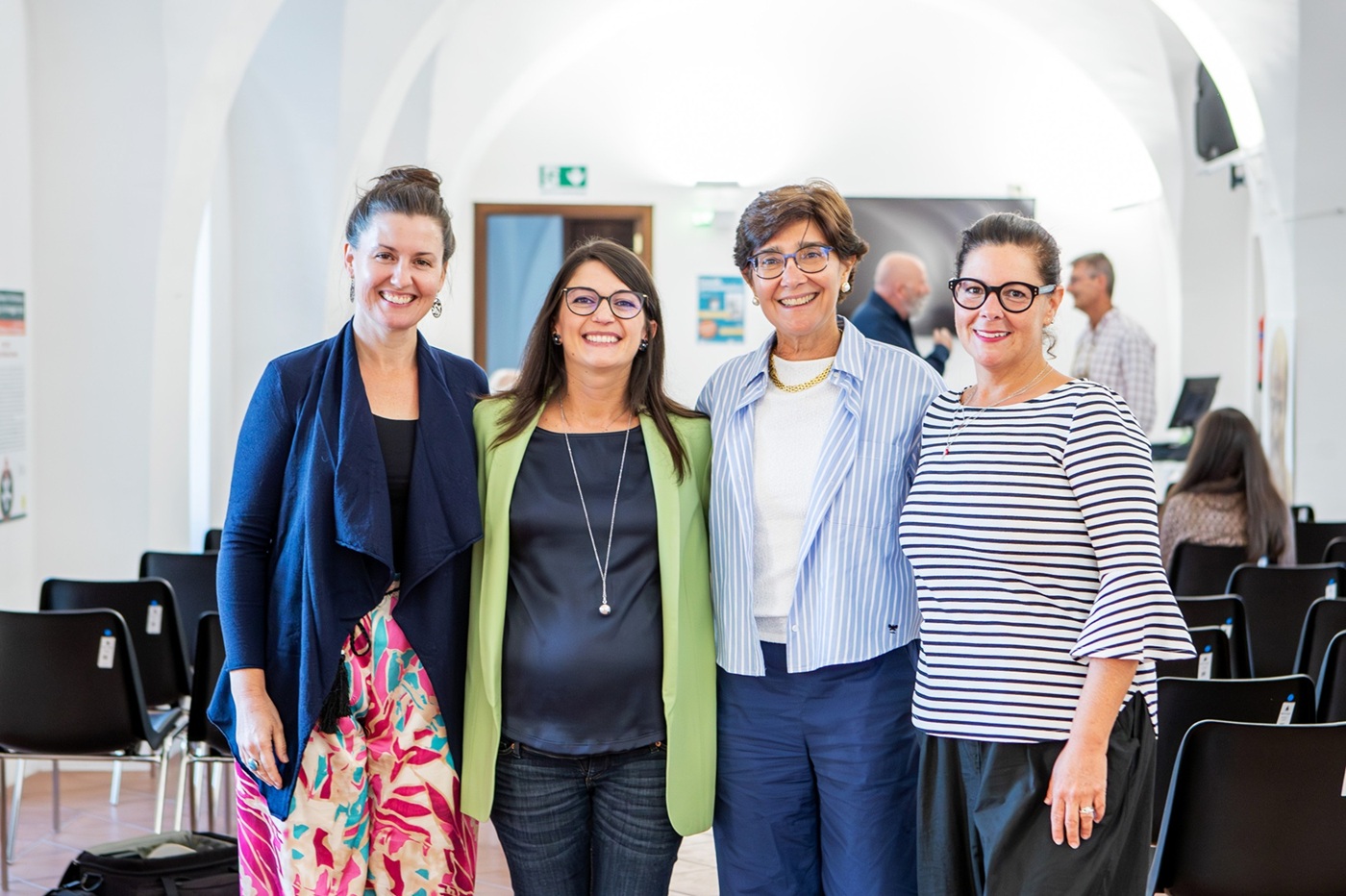
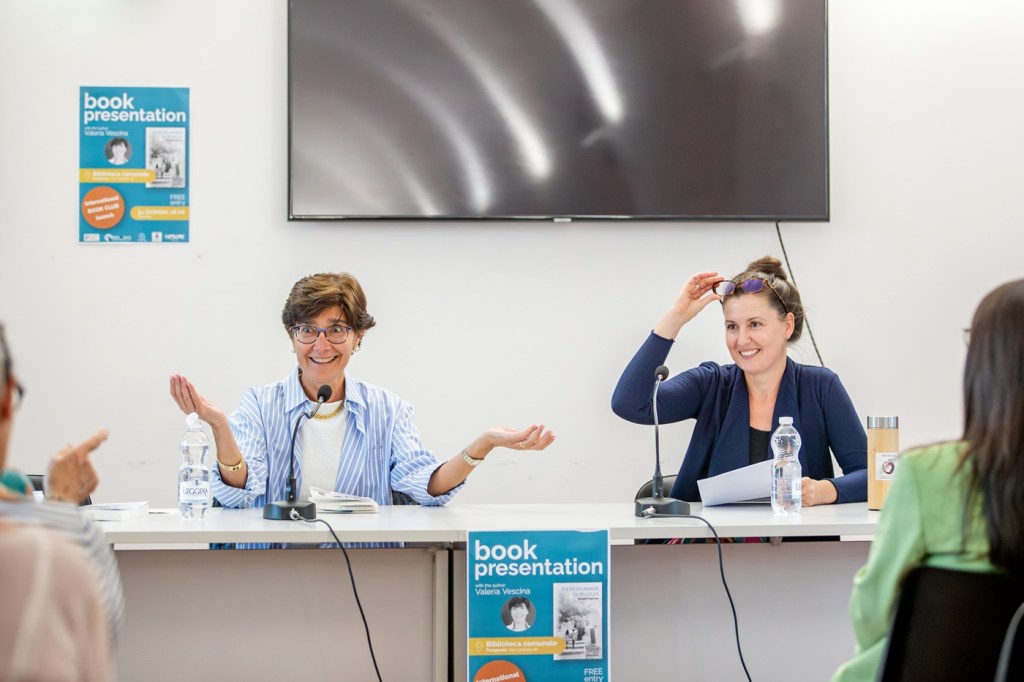
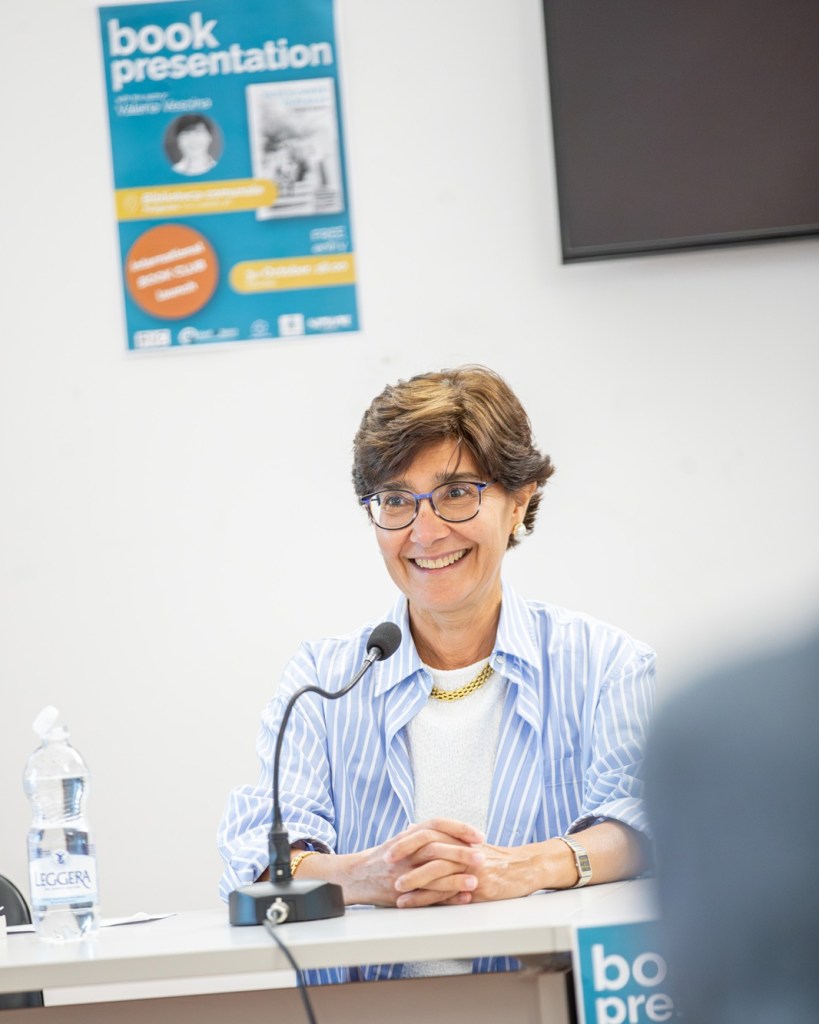
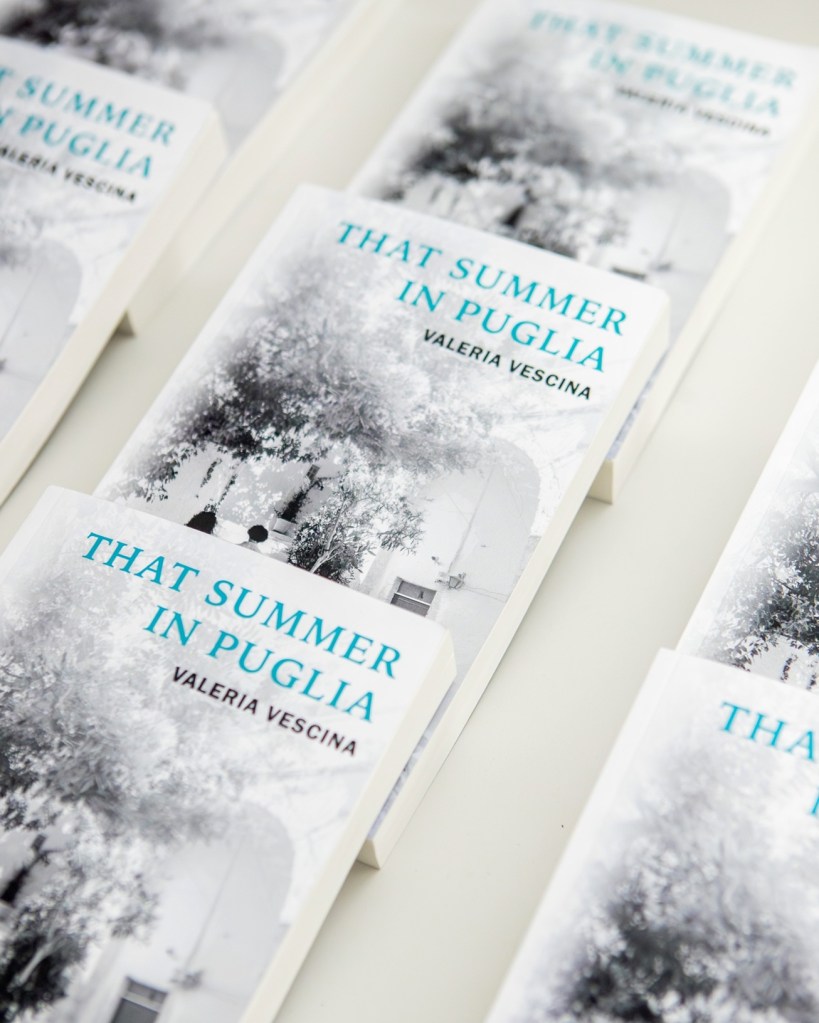
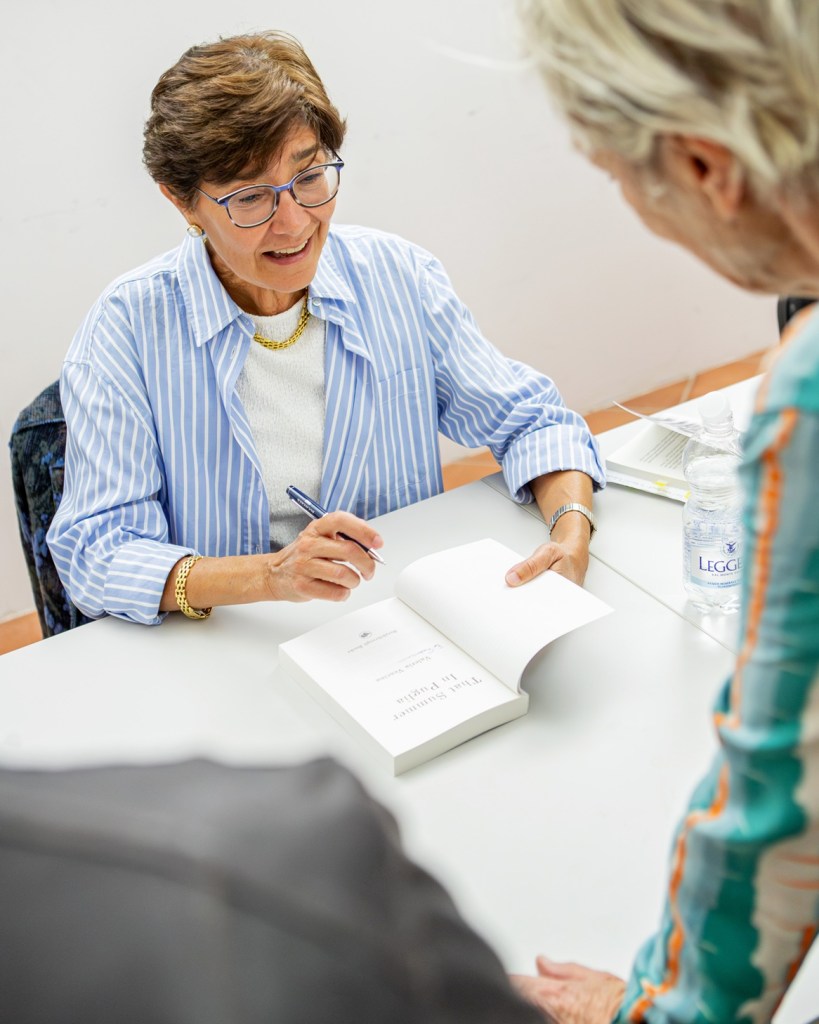
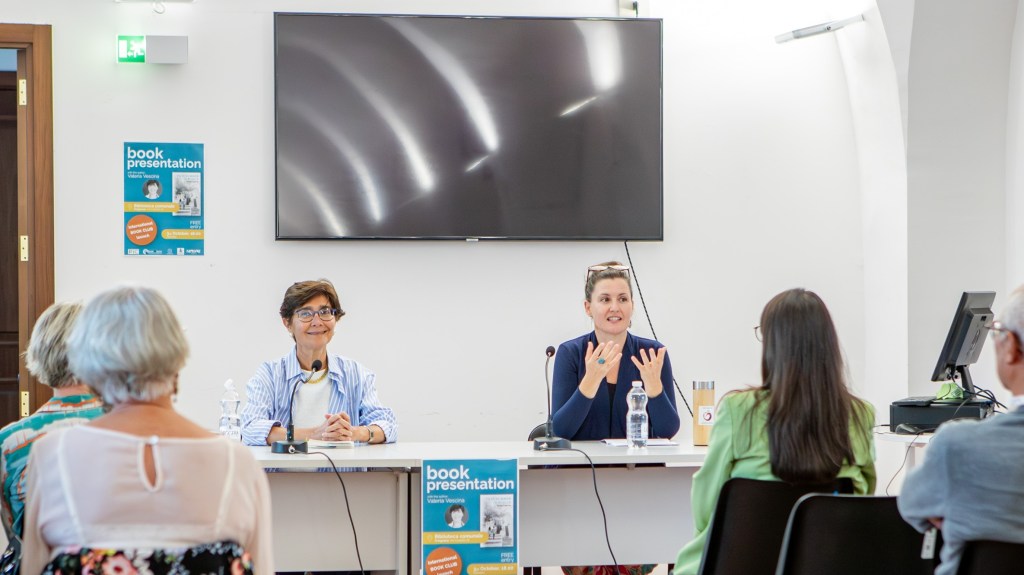
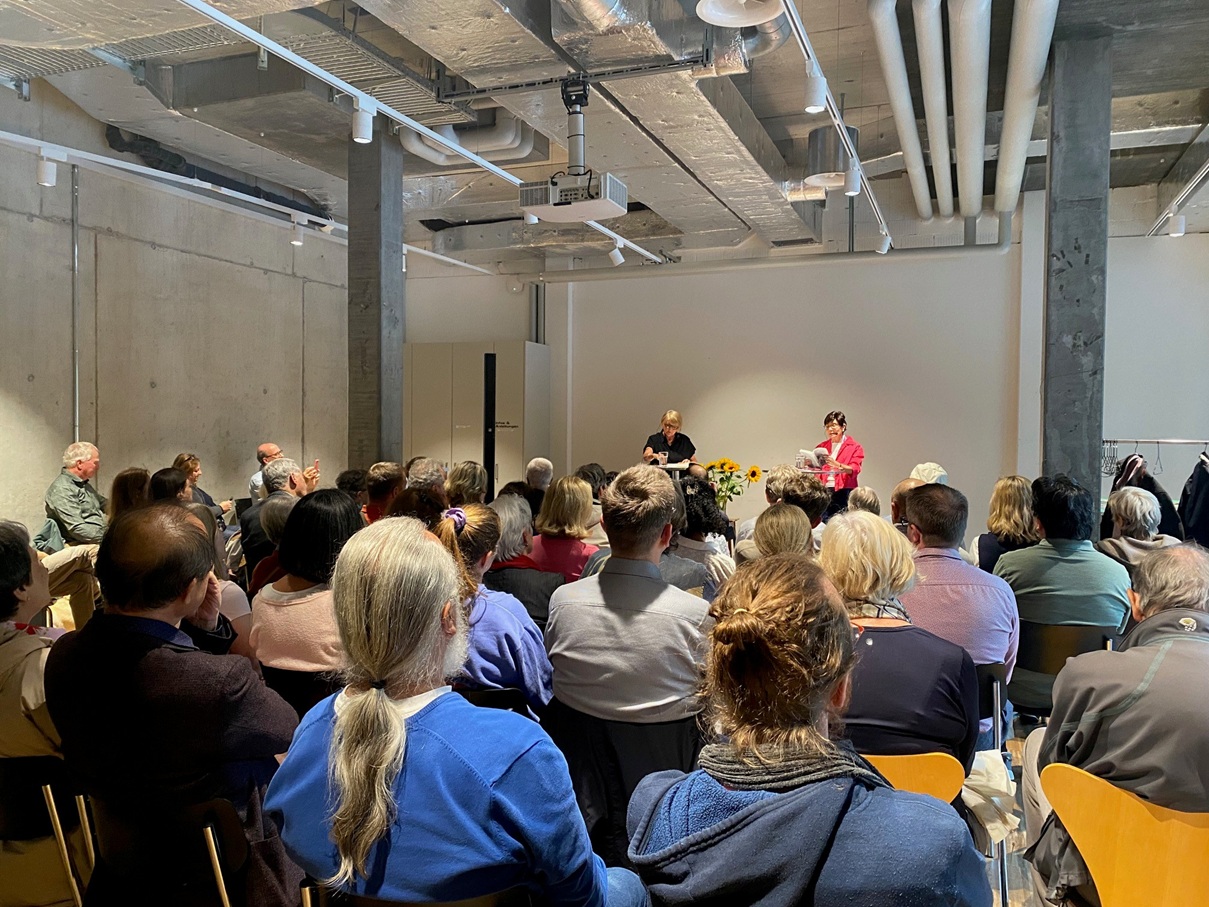
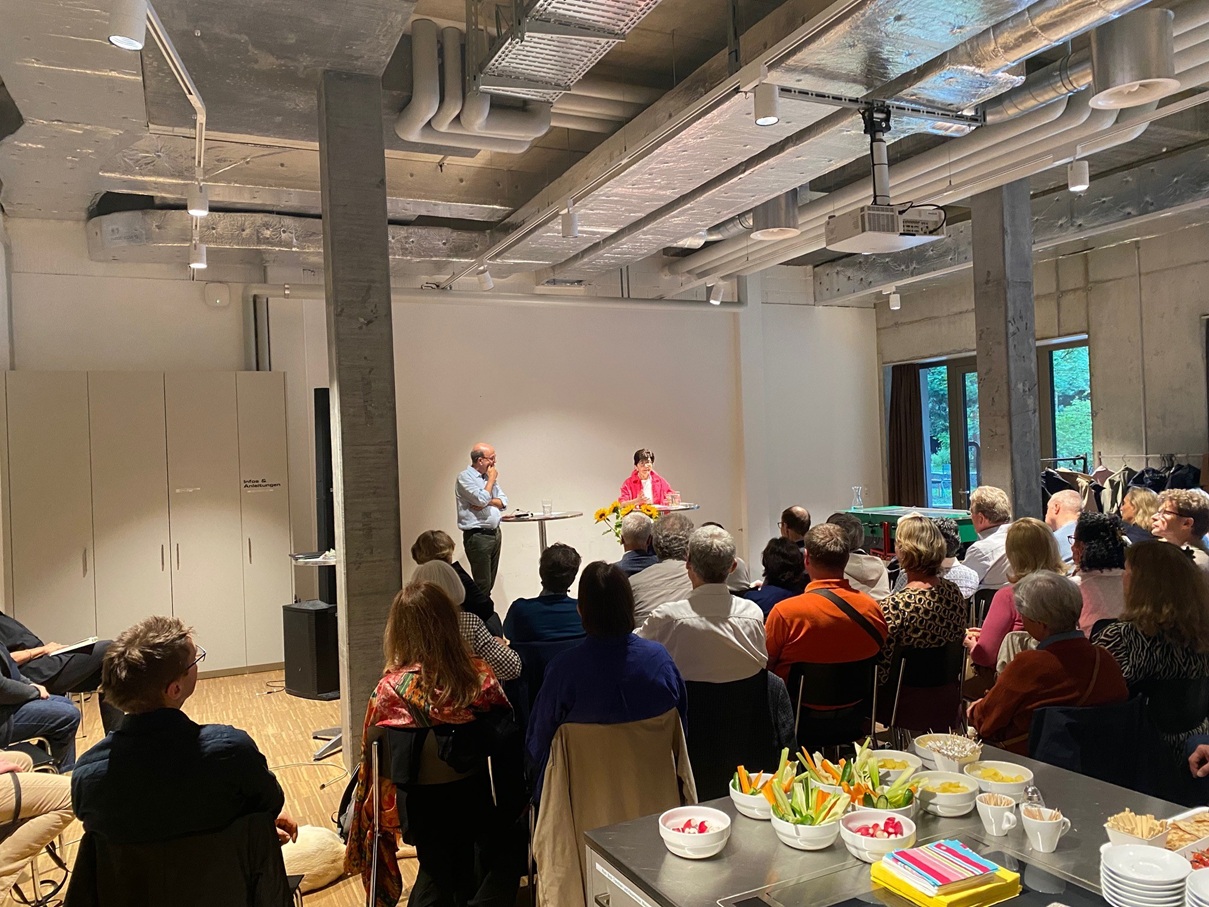
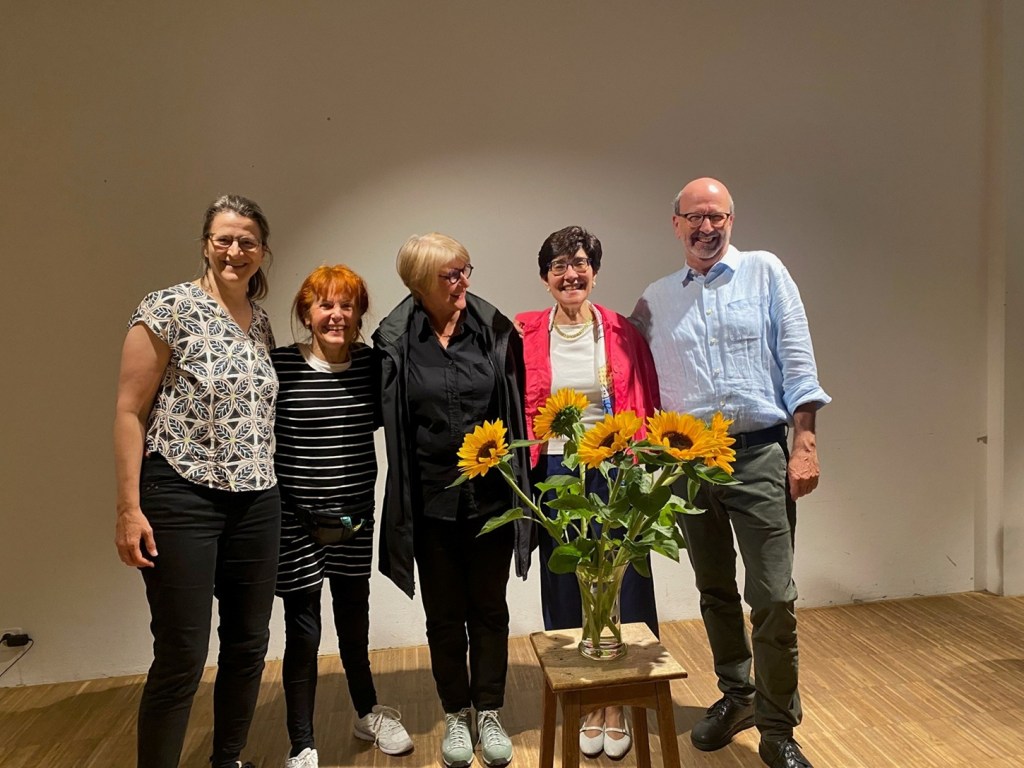
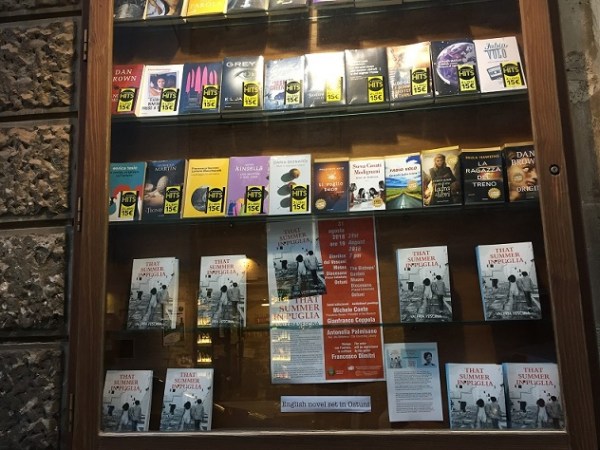
Yesterday I had the joy of an “in conversation” event in Putignano (Puglia) about That Summer in Puglia. The event was organised by the international community there, with the support of the historical library’s director and the Libreria Simone. Thank you, Maria, Ann-Maree and Anita for a memorable evening! I’m also honoured that you’ve chosen That Summer in Puglia as the first title for discussion by your international book club.
Readings of extracts from the novel were interspersed with questions from my interviewer Ann-Maree, and followed by a lively Q&A with the audience. My thanks to them all for a warm, engaged and rewarding discussion. Last but certainly not least, I’m grateful to Massimo Simone for being there with copies of the book.
It was wonderful to meet people from all over the world who have chosen to come and live in Putignano, and to discover their many countries of origin: Australia, Britain, France, Hungary, Indonesia, the Netherlands, South Africa… as well as other Italian regions. In discussions before and after the formal part of the event, I loved hearing about their backgrounds and what had brought them to Putignano. The beauty of this historic town and its environs, its lively year-round cultural offering, the quality of the food, the mild climate, and proximity to Bari and its airport all played a role.
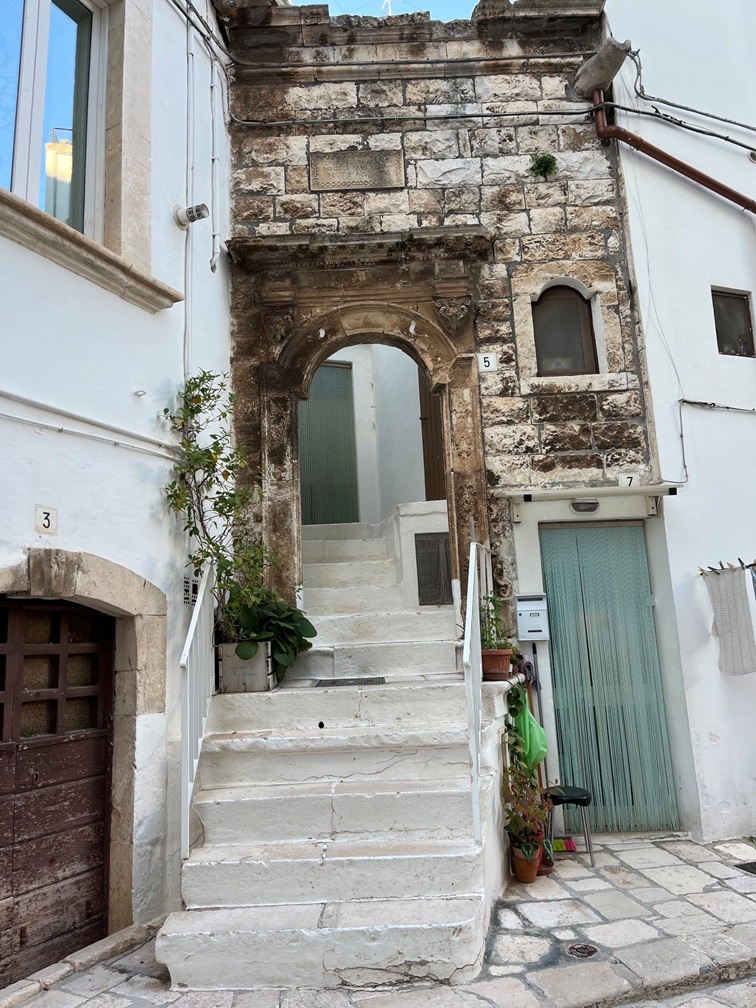
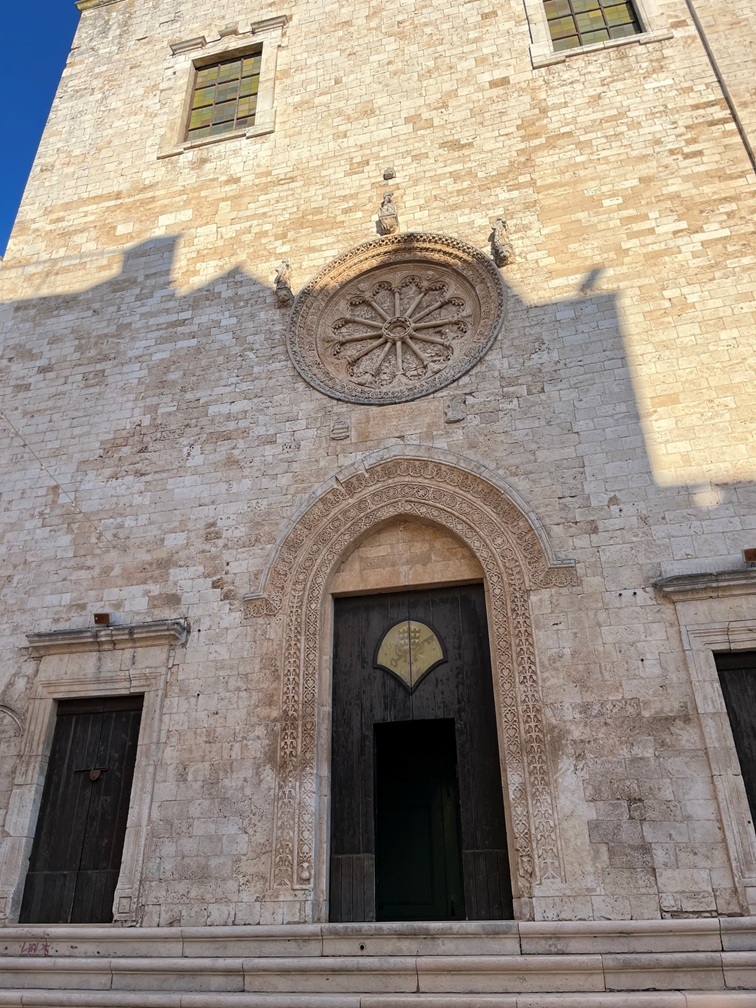
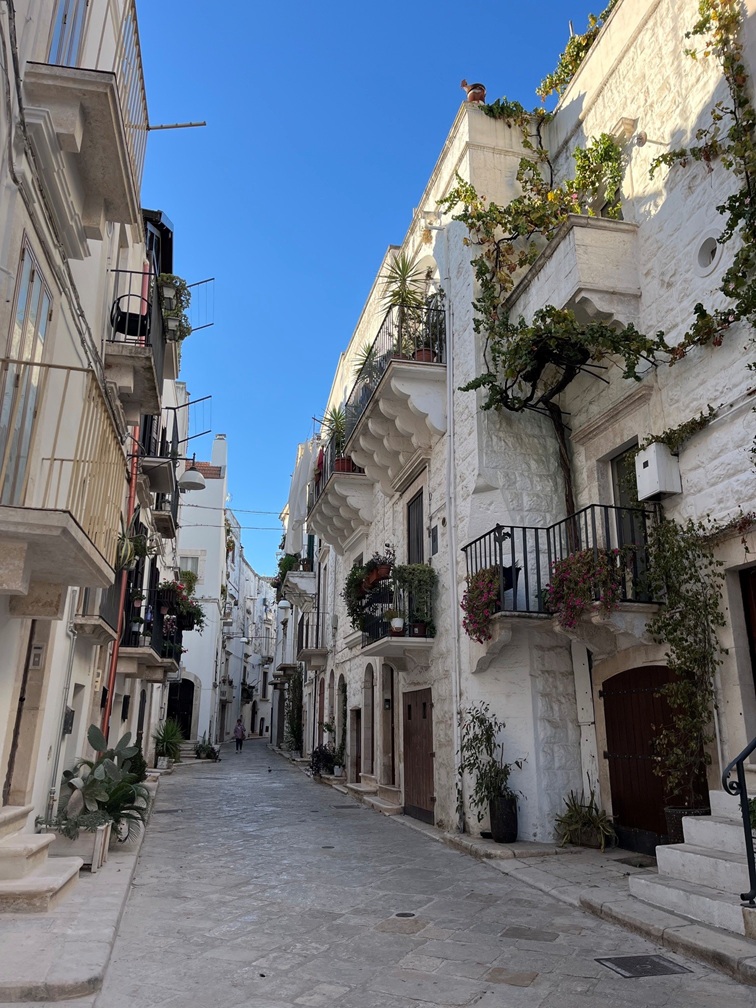
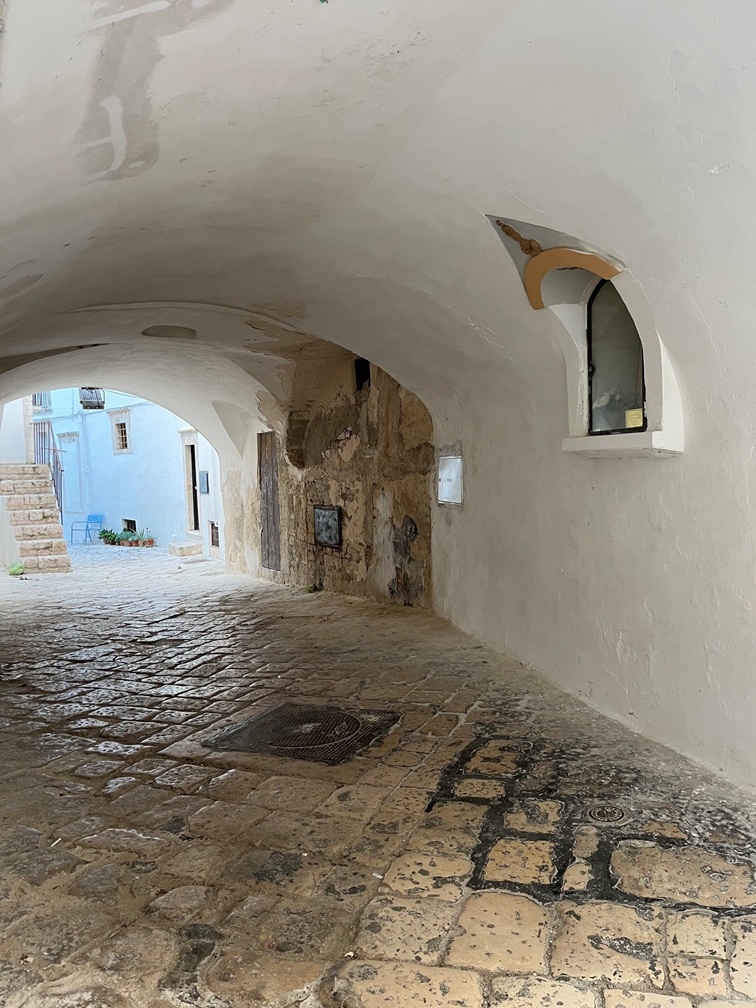
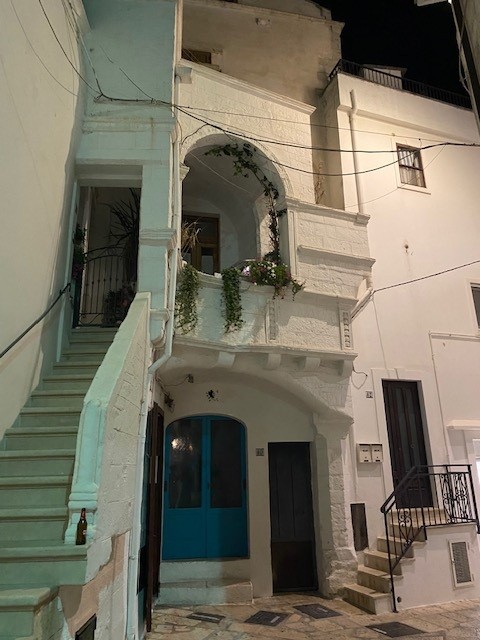
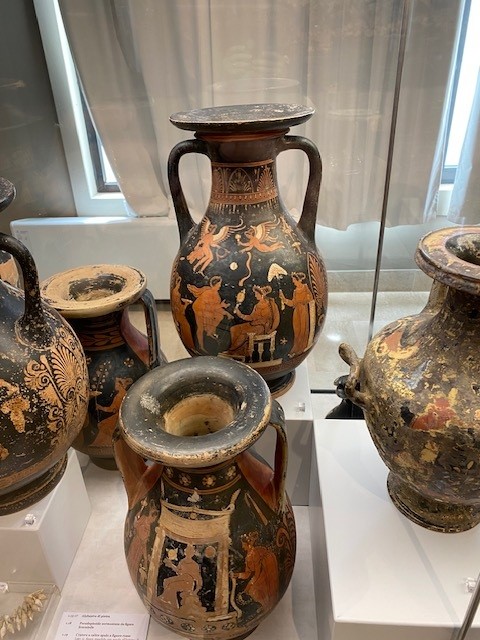
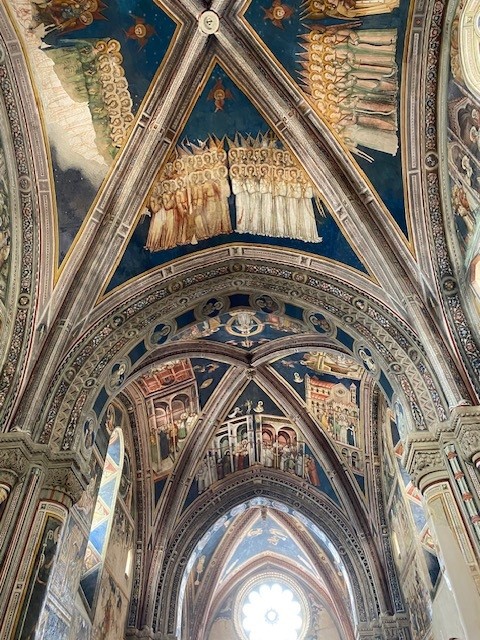
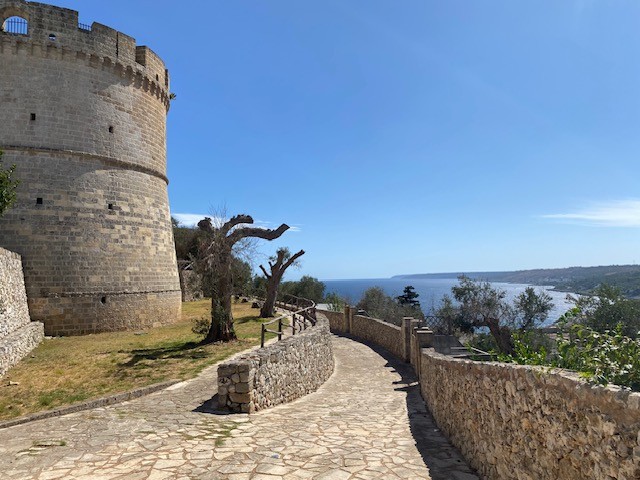
A house in PutignanoThe cathedralA Putignano streetAn alley
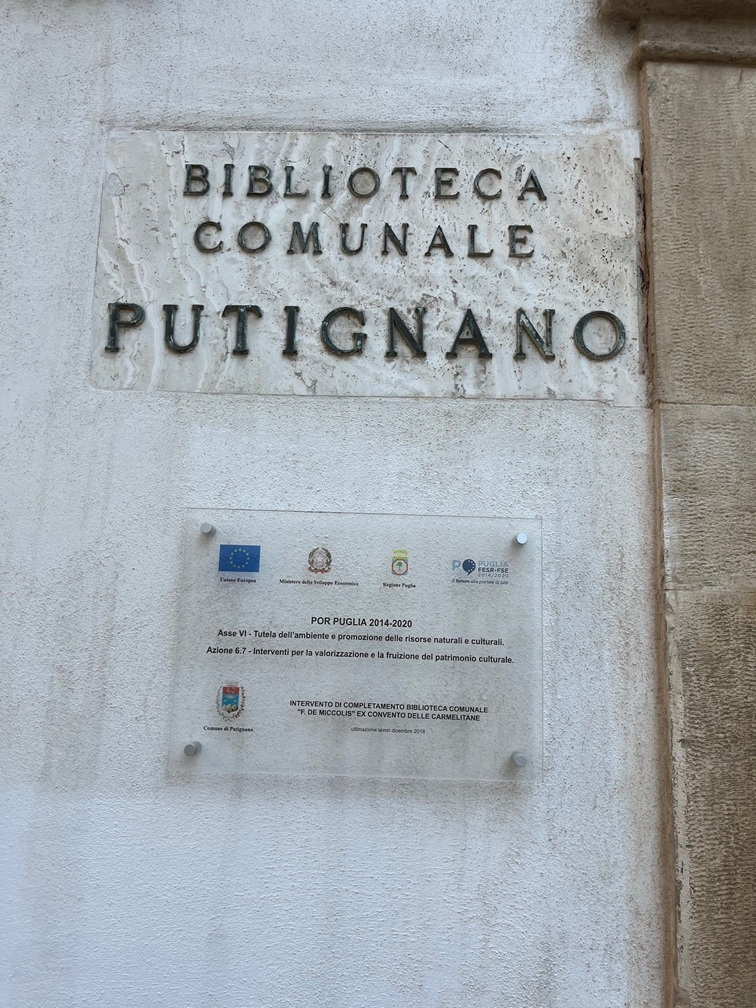
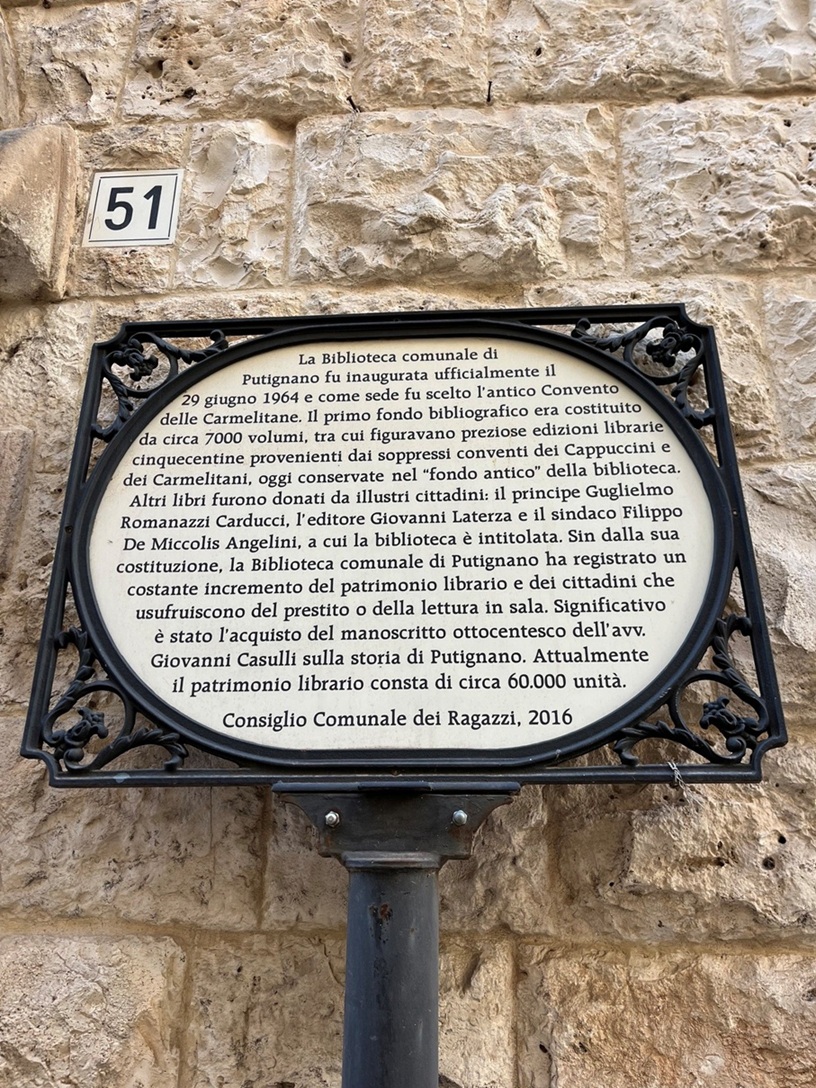
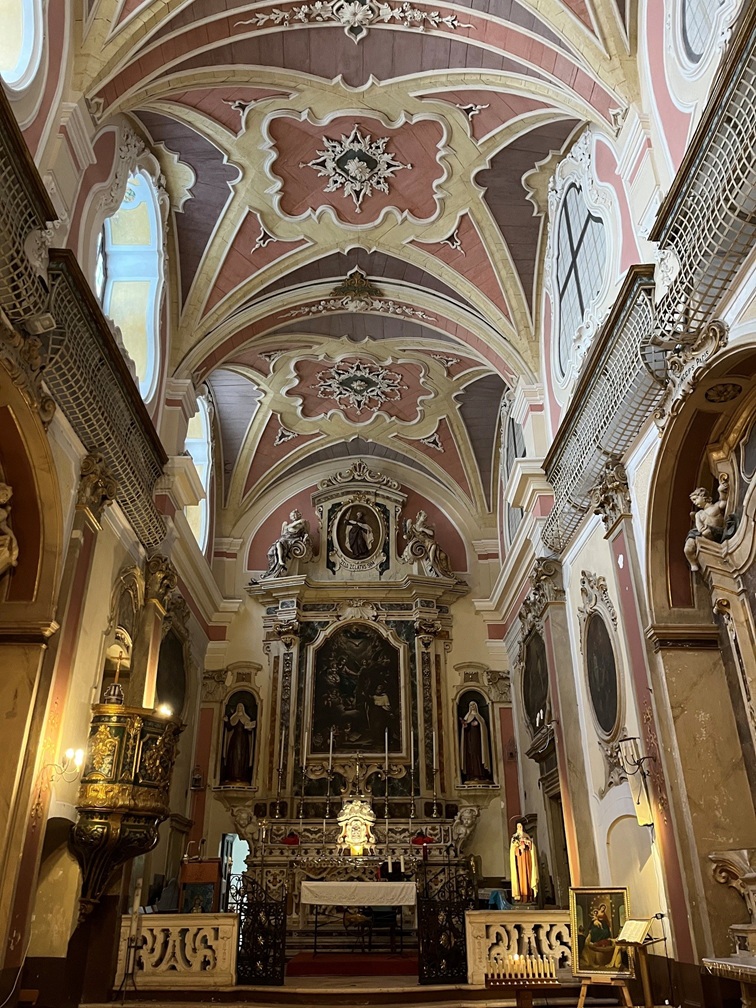
The venue for the event struck me as apt: the library is located in the former convent of the Discalced Carmelite sisters. It was built in the 16th century and houses an important collection of volumes from that era. I happen to be currently deep in the final revisions of my second novel, which is inspired by a true story of Apulian nuns during the Renaissance. It’s due for release in Spring 2027. So, maybe, Putignano, see you again soon…?
That Summer in Puglia is published by Breakthrough Books and is available worldwide from good bookshops and Amazon.
Image credits:
Photos of the event are by Milan Toth and are reproduced here with permission
Last Thursday I had the privilege of being interviewed by Helen Murray Taylor of the Women Writers Network about That Summer in Puglia. Helen writes both fiction and nonfiction. She’s the author of the immersive The Backstreets of Purgatory (Unbound, 2018) and the powerful Love Lay Down Beside Me and We Wept (Wilton Square, 2026). The Women Writers Network is an international community active on Bluesky (formerly on Twitter). Founded in 2017, it supports and promotes women’s writing. Its activities include a monthly author interview.
If you have a Bluesky account, you can access our conversation via the links below. If you’ve not discovered Bluesky yet, you’ll find a transcript of the interview further down this page. A few of the attendees also posed questions, which I’ve incorporated in the transcript.
Helen: Welcome, Valeria. To get things started, can you tell us a bit about yourself and your writing career to date?
Sure! I write novels, teach creative writing, and review books. I’m also proud to be a co-founder of the Women Writers Network! My first novel, “That Summer in Puglia”, debuted in 2018 at the Oxford Lit Fest. A second edition of it has just been released by Breakthrough Books, who will also publish my second book, a historical novel, this coming winter.
I graduated from the Goldsmiths Creative & Life Writing MA and since 2013 I’ve taught creative writing to people of all ages – from secondary-school pupils to university BA and MA classes. I run 2-3 writing retreats a year in Switzerland’s magical Bernese Oberland.
Breakthrough Books: Has teaching creative writing helped your own craft?
Undoubtedly! I learn something new every time.
Helen: I’ve seen pictures from your writing retreats. What an amazing setting. Can you provide the link?
I’ve also reviewed fiction in translation for the European Literature Network’s The Riveter, opera and lieder for Seen And Heard International, and arts & culture events for the School of Advanced Study’s Talking Humanities. I occasionally review books on my blog.
Helen: Do all these other activities feed into your own writing practice?
For sure! Teaching means that I keep learning, but also that I must keep both my intuitive and my critical faculties working in tandem, in a balance. Writing reviews is similarly enlightening: I owe it to the author to always read as a writer!
Stephanie Bretherton: What made you want to go with Breakthrough Books?
In a risk-averse publishing landscape, Breakthrough Books champions exciting, original, high-quality books. So, it’s a joy to be published by it!
Helen: Without giving too much away, can you tell us a little about That Summer in Puglia?
That Summer in Puglia is set in 1980s Puglia (chiefly in Ostuni) and present-day London. Tommaso has escaped discovery for thirty years – but a young private investigator, Will, has tracked him down in London. Tommaso asks him to pretend never to have found him. To persuade Will, Tommaso recounts the story of his life and his great love, Anna. In the process, he comes to recognise his true role in the events that unfolded long ago in Puglia, and the legacy of unresolved grief. Now Tommaso is being presented with a second chance – but is he ready to pay the price?
Rita E. Gould: Such a fascinating premise of what happened between the opening in present-day London and Puglia 30 years ago. What made you decide to use a frame tale?
It felt completely coherent with the story itself. It’s a long-overdue excavation by a man of his own past.
Rita E. Gould: I loved how it worked! He needed that outside impetus to stop retreating and to re-examine everything.
Helen: Yes, exactly that. Without it he would have hidden from his own story for the rest of his life.
Yes, exactly. I’m happy that you felt it worked. I wanted Tommaso to resist the push by the young PI to excavate his own past, and, at the same time, to slowly feel – as he narrates his life story – a sense of relief as he finally faces up to it.
Helen: The novel is infused with the sights, sounds, tastes and atmosphere of Puglia, which is delightful. Why did you decide to set the novel there?
I felt that my native Puglia offered an ideal setting: its layers of history are integral to Tommaso’s story. His memories of its sensuous colours, aromas and tastes, and of how it felt to love and be loved, and to grieve, eventually overwhelm him and help him open up to Will.
I love my native region and am glad to hear from readers that they feel transported to it. I’m proud that one of the endorsements said, “Here is the discovery through literature of Puglia”.
Helen: That is so true. I felt like I was discovering a region that I didn’t know. Does it sound strange to say that to me its (Puglia’s) presence was almost like another character in the novel?
Not strange at all! On the contrary, I’m glad you felt that. Also to me, Puglia in this book truly is a character in its own right, in that it shapes and tests the protagonists. People who’re not very familiar with Southern Italy often don’t realise just how diverse it is, both between and within regions. Puglia is particularly rich in culture, for historical reasons.
Stephanie Bretherton: I loved the evocative richness of the story. It really made me want to visit the area, and it made me hungry all time! Do you think the Italian part of yourself made the ability to bring all the senses alive in the book a little more natural?
Thank you for that lovely comment (and question!). Yes, it’s my native region, so I know it very, very well. That helps to bring the sensorial details to life – and they’re very important in a story of a man recollecting his long-lost past.
Stephanie Bretherton: Yes, the senses compel us into feeling fully present while also immediately summoning the past!
It’s true of all of us, so yes, it was particularly important for Tommaso’s story.
Helen: What are the main themes in That Summer in Puglia?
The novel has several interconnected themes. I did not set out to write to a theme (or two!), though, but discovered them while writing. That Summer is about all forms of love, and about compassion for others and oneself, as I think compassion is a thread running through them.
Helen: I think compassion is such an important theme, especially for our past selves. We can learn from Tommaso ‘s story. Better to face up to our mistakes because without that, we can’t be compassionate and forgiving to ourselves.
Exactly. Without compassion for ourselves and others, it’s so much harder to admit when we’re wrong and to learn from errors!
Rita E. Gould: I love that the compassion applies to everyone, including the PI! Tommaso listens to him and helps the investigator re-examine his pain.
Thank you for pointing that out. Indeed, I did mean it to hint at the fact that Tommaso was opening himself up to compassion, in the process!
That Summer is also about the necessity for dialogue, and the dangers of cutting oneself off from it. And it’s about the process that E.M. Forster called “connecting the fragments”: living with and bridging the contradictions in ourselves and others.
Rita E. Gould: I think communication is so key in this novel, both in the past and in the present.
Helen: You bring this out beautifully in the book. I was so frustrated with Tommaso at certain points because so much could have been avoided by proper communication.
Yes, that was central to the story.
Rita E. Gould: I also think it was quite true to the age of the protagonists — young enough to be impulsive and to believe the worst recklessly.
Ah, yes. Their age is totally bound up with their responses.
Helen: The story is presented as a dramatic monologue by Tommaso to a private investigator. Why did you decide to frame it in this way?
Tommaso narrates his story with the intensity that the resurfacing memories provoke in him. His narration is “framed” by moments with the young PI who has tracked him down. You don’t hear what the young man says but you infer it from Tommaso’s answers. That’s dramatic monologue. Browning used dramatic monologue for “My Last Duchess”, Camus for “The Fall”, Hamid for “The Reluctant Fundamentalist”. It’s not a form you see often, but it struck me as so appropriate for Tommaso’s story! I’ll explain why!
So, why dramatic monologue for “That Summer”? First, it breaks the intensity of Tommaso’s narration. Second, it conveys his isolation. Third, it’s a dialogue of which we hear only one side, and Tommaso caused a tragedy by refusing dialogue.
Rita E. Gould: It makes so much sense! Tommaso is the only who has to speak since he broke down the lines of communication.
The final reason for choosing dramatic monologue for That Summer is that the reader is placed in the position of identifying with the PI and so wavers between sympathy and judgment for Tommaso. That’s appropriate, as he’s an unwittingly unreliable narrator.
Helen: It is the perfect device for mirroring what is happening in the story. Did you decide to do it straight off or did it come as part of a rewrite or edit?
I decided to do it straight off. One of my MA tutors suggested I try also a different form, and I did, for experimentation. But the contrast between the two only proved that the intuition about dramatic monologue being ideal for this story had been correct!
Helen: Tommaso narrates the story in a second language that has become his first. He talks of being “caught out” by idioms. Italian words peppered throughout the novel add to the atmosphere. Could you tell us about this?
For Tommaso’s language, I drew partly on experience. I learned English as a child and have lived in English-speaking environments most of my life, so I’m fully bilingual. Tommaso, on the other hand, starts learning English only aged 19. I’ve therefore given him a recognizably Italian accent and have him being “caught out” by idiomatic expressions, as he has learnt much of his English from books. I also peppered Tommaso’s narration with Italian words. This can only be done sparingly, to avoid breaking the flow for the reader. So, Italian words appear either in particularly emotional moments, or to describe something especially Apulian.
Helen: You do this perfectly. Also, there is something singular and beautiful about your writing and I wonder whether you think it is influenced at all by being able to speak several languages?
Thanks for that lovely comment! I suppose being a linguist (I speak 4 languages) involves both a love of language and a heightened awareness of its structural and lexical possibilities. Maybe it’s bound to flow into a mixture of intuitive and conscious narrative choices.
Helen: What a wonderful gift for a writer to have the richness of four languages to work with. Very envious and impressed, Valeria.
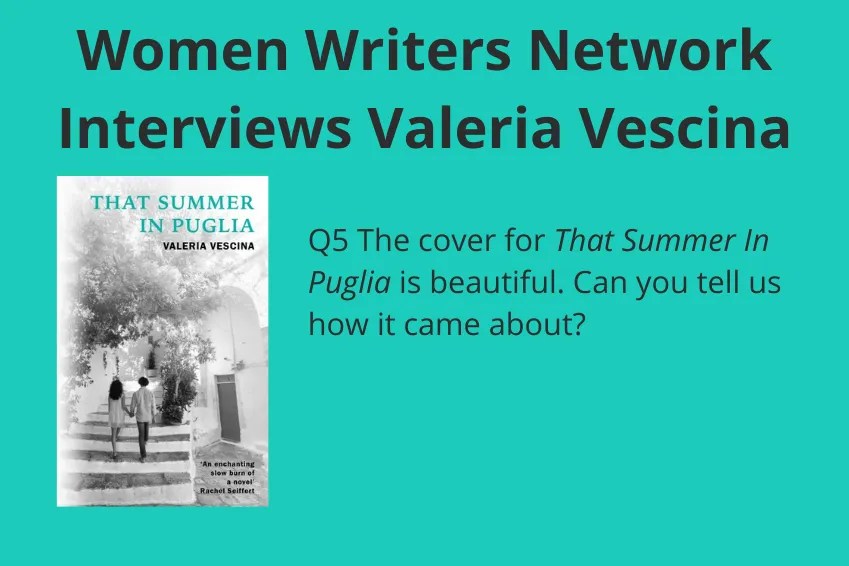
The cover for That Summer in Puglia is beautiful. Can you tell us how it came about?
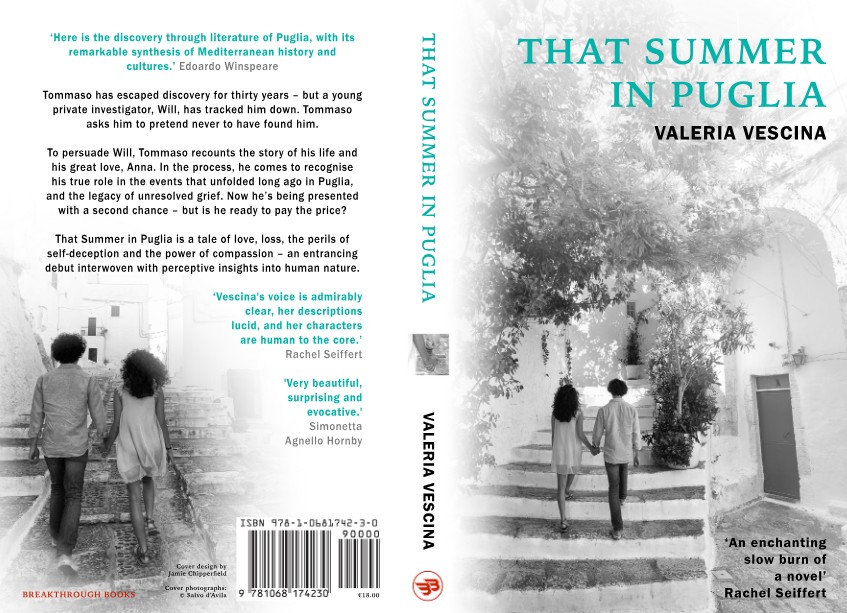
The cover photo was taken by photographer Salvo d’Avila as part of a shoot to capture the novel’s spirit. It shows a young couple in the old town of Ostuni, the novel’s main setting. It’s in black & white, and you see their backs. It conveys a sense of memory and nostalgia.
Breakthrough Books’ Jamie Chipperfield then designed the cover, and I love it. He heightened that sense of memory and nostalgia with a fading effect along the photo’s edges. And the blue-green of the title’s font evokes both the sea and the couple’s youth. I also like how dynamic Jamie Chipperfield made the back cover, with the blurb in black and the endorsements in the same blue-green of the title on the front.
Breakthrough Books: Jamie did such a good job! He really captured the spirit of young love, nostalgia, and a sense of the ‘unknown’ – it also has a timeless feel.
I agree! Not just a beautiful cover, but it captures so many aspects of the story!
Conveying the sense of nostalgia was important: it’s the nostalgia that Tommaso’s narration is infused with but that he refuses to acknowledge because it would mean recognising reality and therefore his responsibility in the events of years earlier. His nostalgia manifests by his selective recall of the beauty of Puglia: sights, sounds, aromas, tastes… They are all true, but he disregards the rest of a more complex reality. His refusal to acknowledge his nostalgia shows also in the way he depicts other protagonists. Almost until the end, Tommaso fails to acknowledge the humanity of people he casts in the role of villains, as he subconsciously fears opening a crack in his self-narrative. The PI forces him to excavate his past and to face up to his own role in the events of 30 years earlier.
Helen: The cover beautifully evokes this sense of nostalgia.
My thanks to designer Jamie Chipperfield and editor-in-chief Stephanie Bretherton at the wonderful Breakthrough Books for that!
Breakthrough Books: It was a joy to work on!
Helen: Where can we find out more about you and your books?
You can find me on my website (https://valeriavescina.com/) and on social media: Bluesky, Facebook, Instagram and LinkedIn. My second novel, Habit of Disobedience, will be forthcoming from Breakthrough Books this winter, and it too will be available from all good bookshops.
Breakthrough Books is an innovative independent press that emerged out of a collective of established authors. As I said earlier, in a risk-averse publishing landscape, it champions exciting, original, high-quality books. Being published by them is a joy. Here is a link to the Breakthrough Books website: https://www.breakthroughbookcollective.com/
Helen: Very exciting! Can’t wait to read it. We will have to have you back for another author interview when this one comes out. I am already anticipating lots of possible questions and I haven’t even read it yet!!
Rita E. Gould: I love a disobedient nun! I can’t wait to read this book.
Thank you, Rita! I’ve grown to love the “disobedient” 16th-century nuns who inspired the novel.
Helen: We are really looking forward to the release of Valeria’s second novel, Habit of Disobedience.
Thank you, Valeria, for chatting with us, and thank you to all who took part in tonight’s Author Interview. To find out about future events, make sure to follow us on Bluesky and the hashtag#WomenWritersNet.
Thank YOU, Helen Murray Taylor and the whole WomenWritersNet team, for this opportunity to chat with you at length about That Summer in Puglia! And thank you, of course, to all attendees and readers of our conversation!
Rita E. Gould: I’m so glad I came to tonight’s WomenWritersNet Author Interview! I think I love That Summer in Puglia even more after learning about all of the thought that Valeria Vescina put into this moving novel.
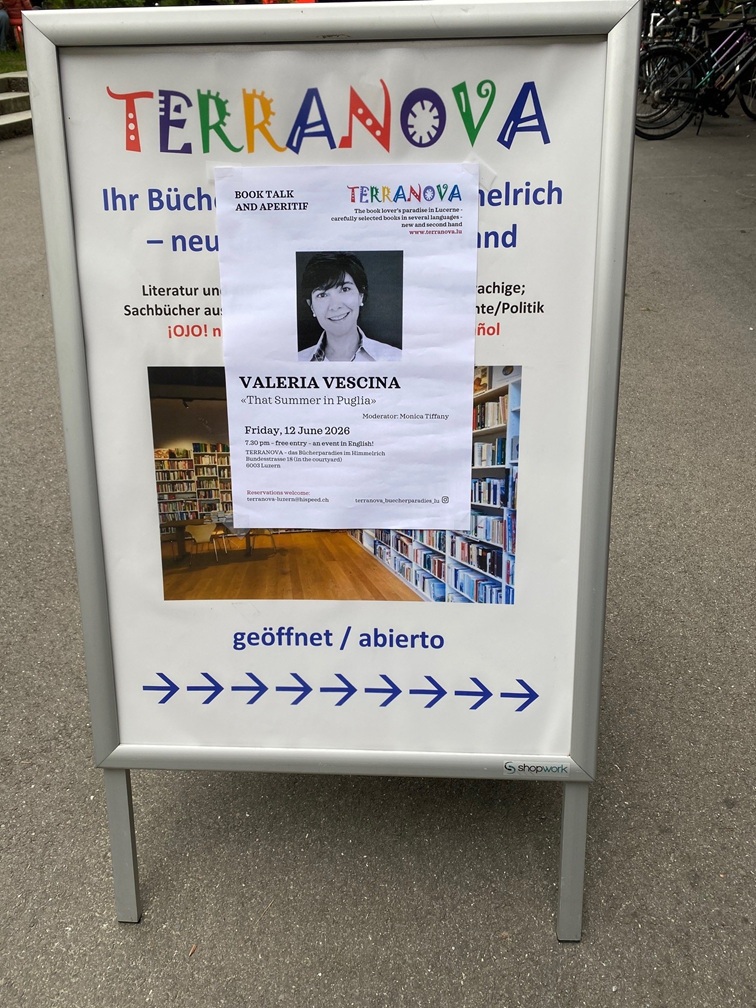
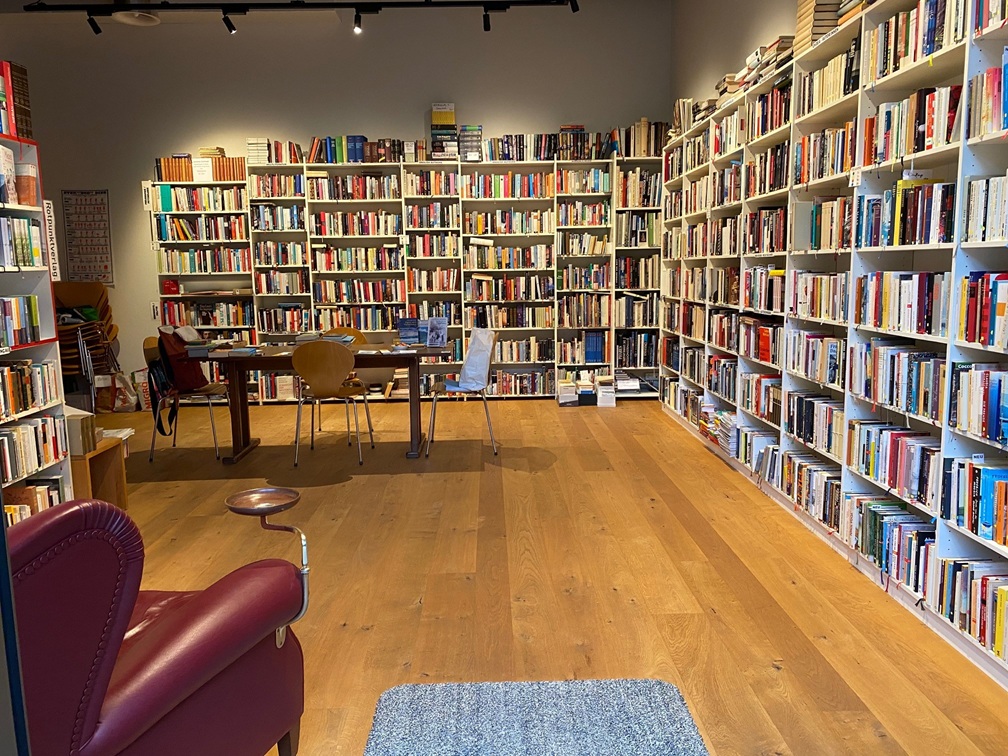
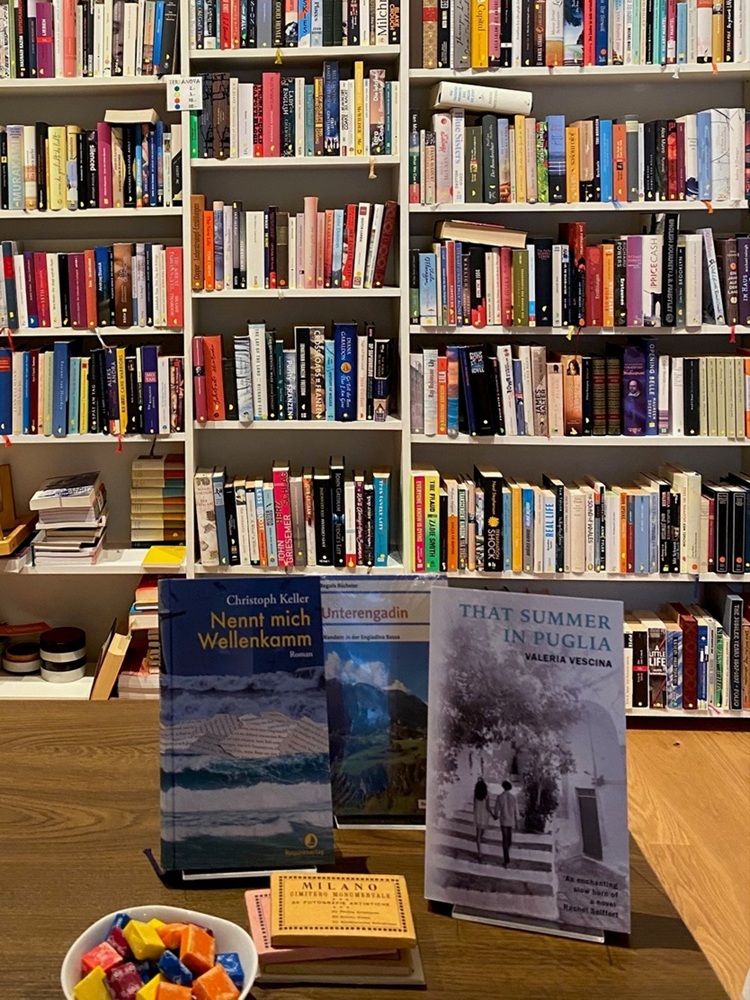
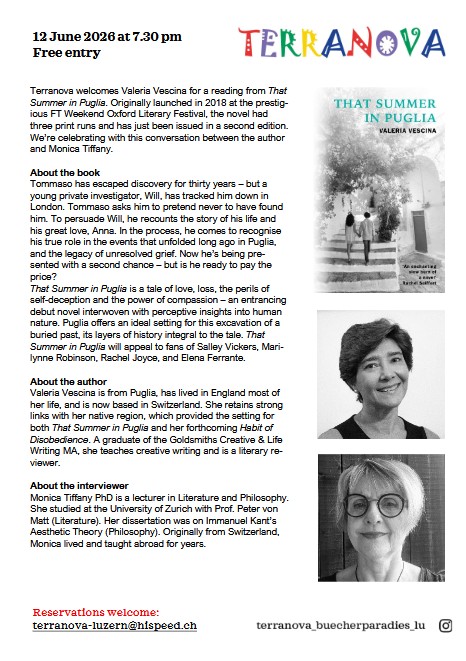
The recent event at the Terranova bookshop in Lucerne was among those I’ve enjoyed the most, out of all my readings from That Summer in Puglia. I had presented my novel widely when it first came out in 2018, and the event this June was to launch the second edition (Breakthrough Books). Having moved six years ago from London to the Lucerne area, I was especially pleased to be sharing my work with people in my new ‘home’. I’ve been reflecting on what else made the evening so special for me, and I think it’s down to a combination of factors.
The enthusiasm of Terranova’s Ottilia Lütolf and Markus Elsener meant that I felt warmly welcomed from the outset. They stock titles in several languages and in translation (another element that connected us, as I collaborated for years with the European Literature Network), and regularly organise fabulous literary evenings. This would be their first in English. They made the event’s promotion effortless for me, as they could rely on their experience and established channels. I added to it by reaching out to Lucerne’s international community.
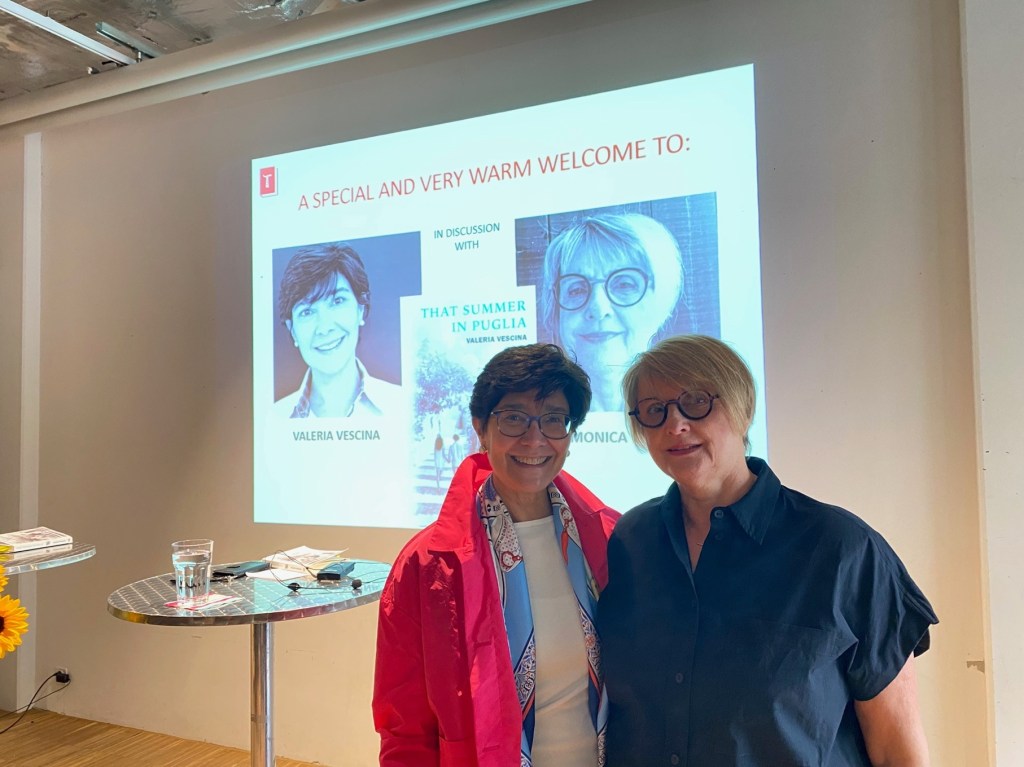
My interviewer, Literature and Philosophy lecturer Monica Tiffany, had read the novel with exceptional attention and sensitivity, so her questions and comments were incredibly thoughtful, as well as heartfelt. It made the conversation between us flow so naturally! We touched on the story, its themes, the characters’ arcs (while avoiding spoilers…), the centrality of the Apulian setting, the veiled references to philosophy, and narrative choices such as the use of the dramatic monologue form.
The public was wonderfully responsive. They asked lots of questions during the Q&A session, as well as afterwards when I was signing copies of the book. It was lovely to see friends in the audience, and lots of interesting people I had never met until that evening.
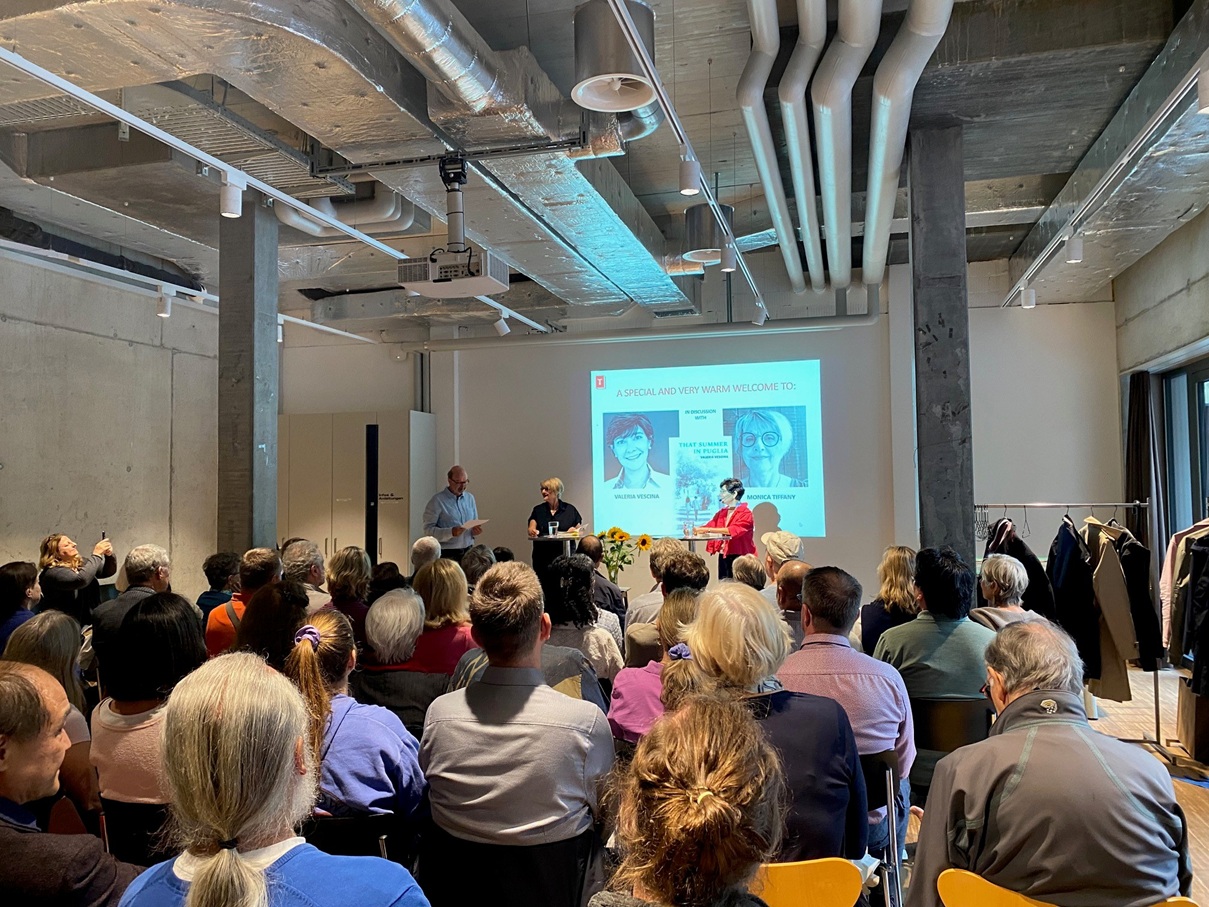
The event space also fostered this warm atmosphere. The conversation between Monica Tiffany and me had originally been meant to take place at the Terranova bookshop, an attractive and cozy place. Demand for seats, however, turned out to be higher than we had imagined. A substantial waiting list and the possibility that additional people might arrive on the night without having contacted the bookshop prompted a search for a larger venue. Markus was able to secure the Himmelrich events hall, just a few doors down, and so we were thankfully able to accommodate just over fifty people.
The drinks and snacks with which, after the talk, we celebrated the launch of That Summer in Puglia’s second edition created a veritable party feeling. People stayed at the hall until late into the evening. It was so enjoyable to meet everyone. What can I say? It really was a warm welcome for my novel… and for me in the country where I now live.
Maria, Ottilia, and Markus of Terranova, with Monica and me in the centre
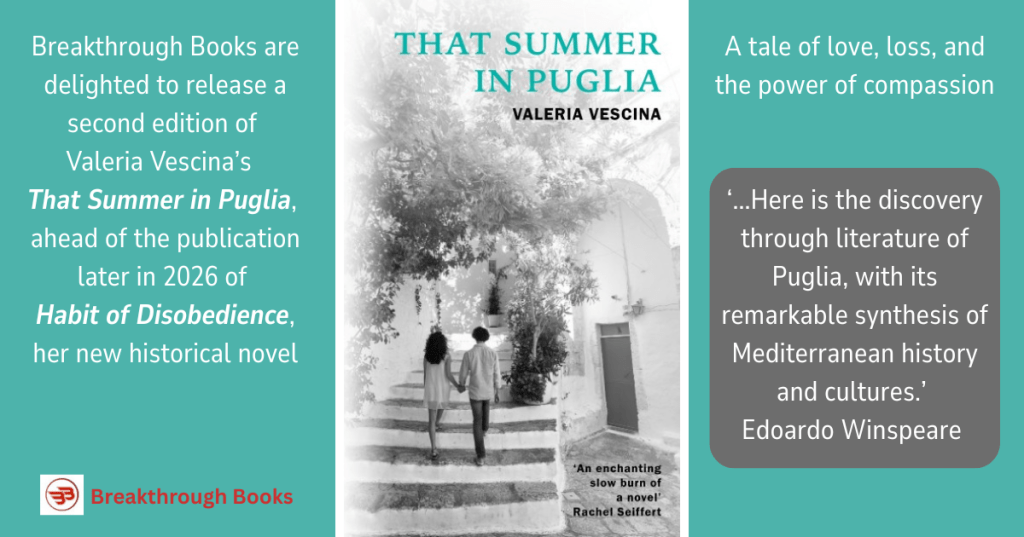
This weekend marks one month from Breakthrough Books’ release of That Summer in Puglia‘s second edition, in paperback and on Kindle. The first edition was launched in 2018 at the FT Weekend Oxford Literary Festival and had three print runs. I hope the book will continue finding its way into readers’ hands far and wide.
I’m grateful to Stephanie Bretherton, Breakthrough Books‘ editor, who is a joy to work with, and to Jamie Chipperfield for his gorgeous cover design, which captures the nostalgia of the narrating protagonist, Tommaso. Breakthrough Books will also be publishing my second book Habit of Disobedience, later this year – it’s a historical novel inspired by events that took place in Puglia in the 1500s.
Breakthrough Books held a ‘countdown’ for the release, on several social media. Here, a few images.
Other posts, including two short extracts from the novel, have followed over the last thirty days.
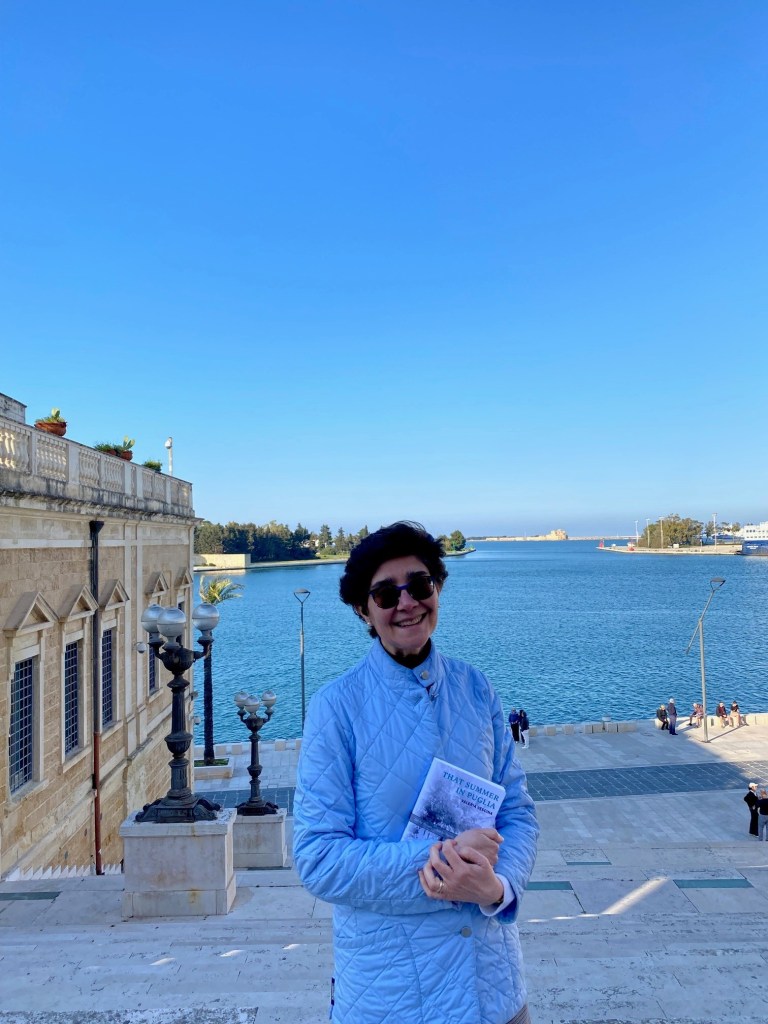
On publication day, I was… in my native Brindisi! That’s where a key section of the novel is set, while most of the story takes place in Ostuni, just 35 km up the Adriatic coast. Behind me in this photo you see Brindisi harbour: it isn’t just beautiful; it has also ‘seen’ major historic events over the last couple of thousand years (that would take a whole other blog post!). In this photo I’m the happy holder of a proof of the book! 😉
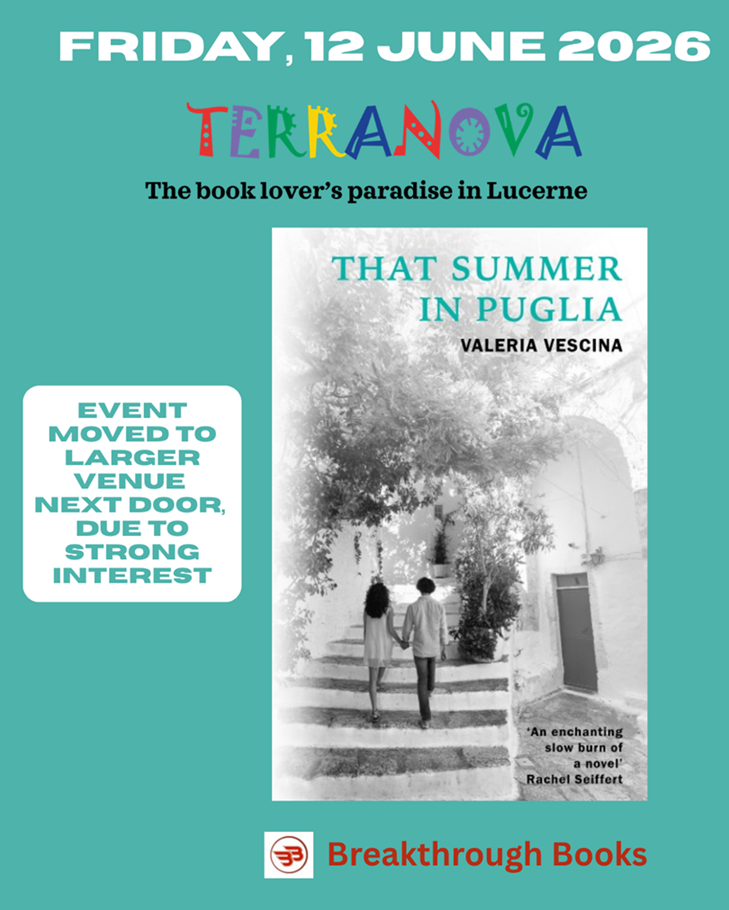
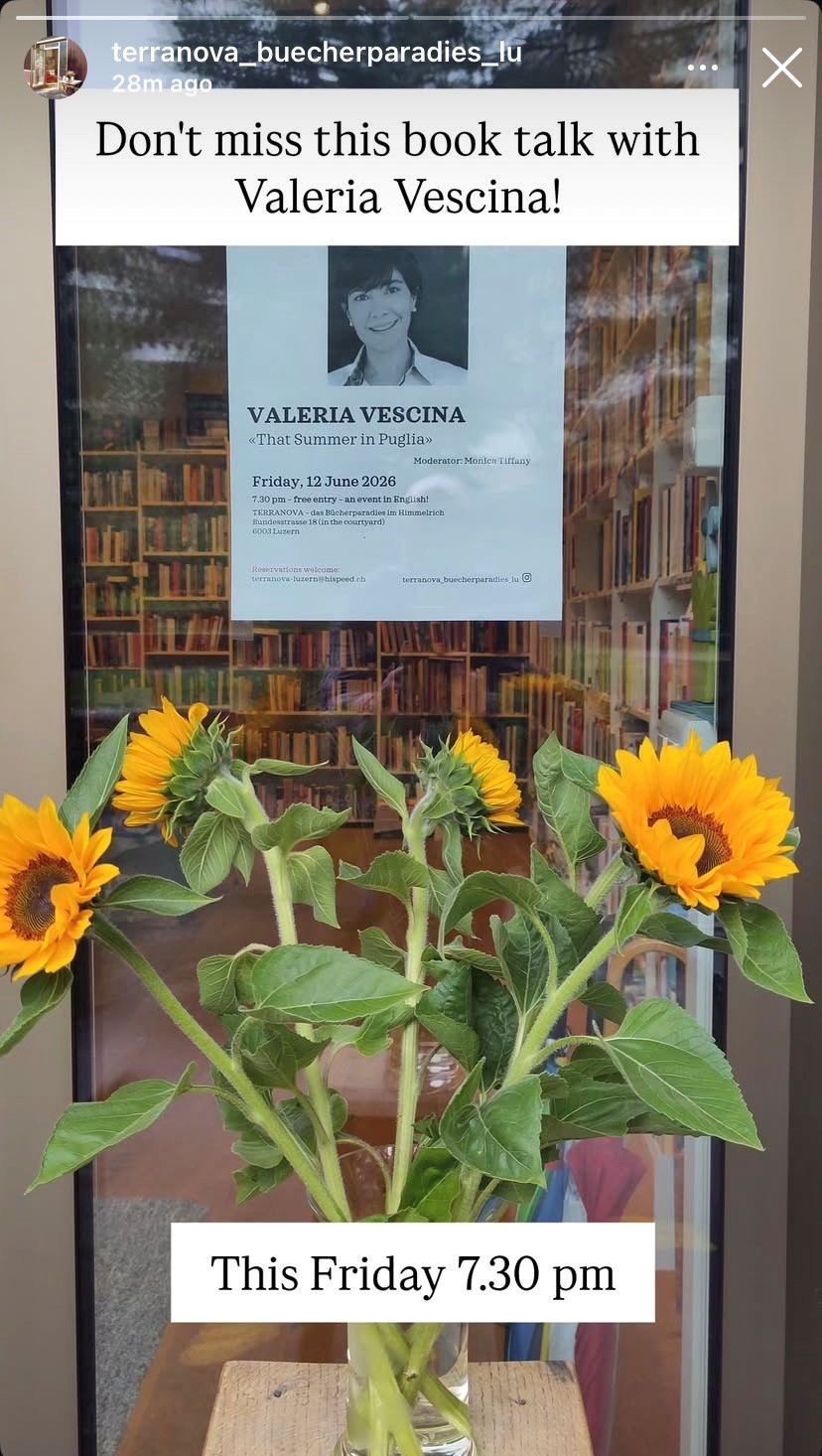
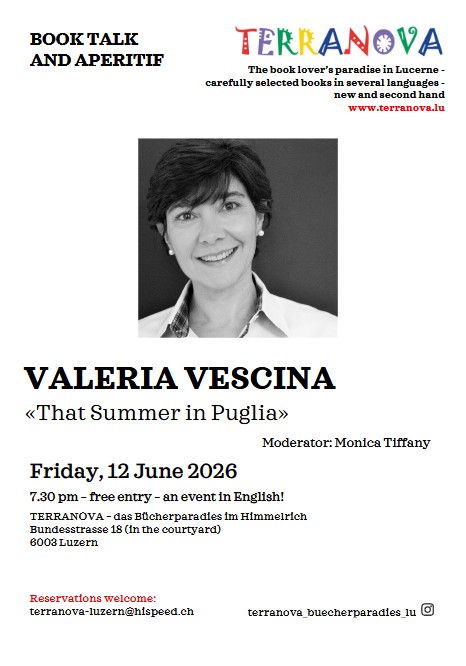
If you happen to be in or near Lucerne in Switzerland (where I now live), come to the event organised for 12 June by Terranova Bücherparadies, a super-lovely bookshop that stocks titles in several languages. My interviewer will be Dr Monica Tiffany, lecturer in Literature and Philosophy.
And if you’d like to get hold of the novel, you’ll find it wherever you usually buy your books! Here, just a few places:
Amazon (worldwide, from its country-specific sites)
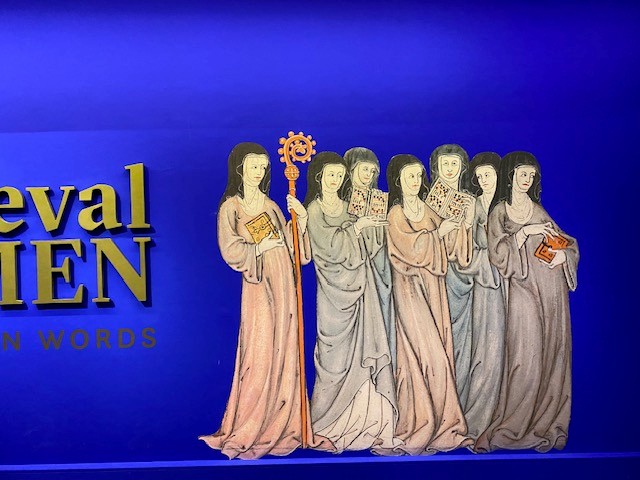
Whether you live in London or plan to visit, do not miss the ‘Medieval Women’ exhibition at the British Library. It has generated a phenomenal response, in terms of both praise and visitor numbers, and for good reason. The priceless documents on display offer a rare opportunity to view in one place the evidence of two long-term trends: the deep historical roots of women’s social and legal status; and women’s efforts to exercise agency despite them.
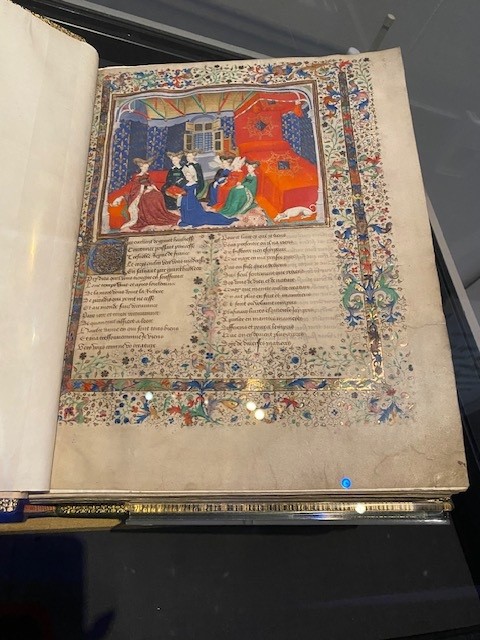
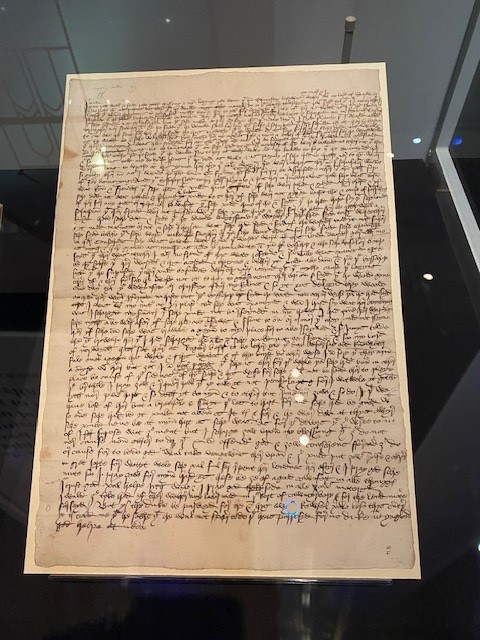
Some of the documents relate to famous figures: a letter signed by Joan of Arc, requesting munitions; the manuscripts of Julian of Norwich’s ‘Revelations of Divine Love’ and of Margery Kempe’s eponymous book; Christine de Pizan’s illuminated ‘Book of the City of Ladies’… The list is spectacular, but the context and detail provided by the items is what makes the whole an unmissable event – it’s not often that you get to ‘hear’ the words of ordinary women. The exhibits include books of treatments for women by women, texts on herbal cures and obstetrics manuals used by female practitioners, a petition by a female slave who refuses to be sold, embroidery and illuminated manuscripts signed by nuns, a woman’s treatise arguing that husbands and wives should enjoy equal rights, the first book printed by a woman… but also, a daughter disowned for marrying a family servant, nuns destined to the cloister since childhood, a queen who fends off male relatives’ attempts to dethrone her, the view of the female body as defective and disease-prone, the prayers to St Margaret for protection during childbirth, records showing women being paid less than men for the same work…
Through their selection of the items (around one hundred and forty), the curators have conjured a mosaic of medieval lives that is not only fascinating, but also offers insights into our own times, when women’s hard-won rights are coming under threat. As the curators explain: ‘Break free from traditional narratives and […] discover stories familiar to women today, from the gender pay gap and harmful stereotypes, to access to healthcare and education, as well as challenges faced by female leaders. Hear the words of medieval women from across the centuries, speaking powerfully for the thousands whose voices have not survived.’1
This sentiment of giving a voice to the unheard spurred my long quest to inhabit the forgotten lives of a group of Southern Italian women from a different era: sixteenth-century nuns. My second novel, which I’ve just completed, is inspired by their remarkable true story. For me, the catalyst was a set of archival documents penned in iron-gall ink: they spoke to enduring issues of power, control, and female resistance. I hope the book will quickly find a publisher, so that my characters may move readers as deeply as the terror, dilemmas, and resilience of the women I encountered in those archival documents moved me. Certain objects in the exhibition – manuscripts copied by scholarly nuns, a cellaress’s notes that probably stay quiet about the politics she often had to navigate, embroidery, a written protest against restrictions on what women could wear, a letter showing the risks of ‘marrying beneath oneself’ – touched me particularly, as they evoked some of my characters and their situations.
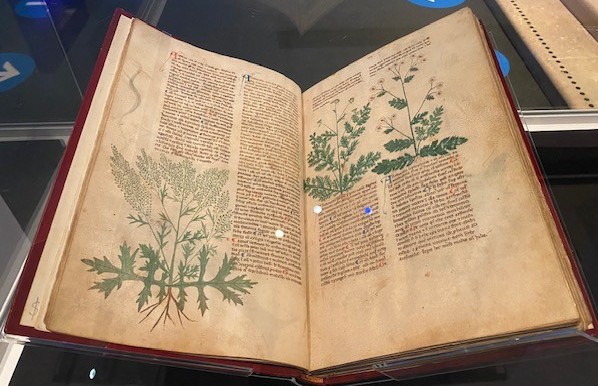
Below, some manuscripts originating in Southern Italy and displayed in the exhibition: Tractatus de herbis (‘Treatise on Herbs’, Southern Italy, c. 1300); De Curis Mulierum (‘Treatments for Women’, in a 13th-century manuscript from England) by Trota, a 12th-century female physician at the medical school of Salerno; and De Ornatu Mulierum (‘On Women’s Cosmetics’, England or France, 13th century, from the original Southern Italian 12th-century compilation), another text forming part of the Trotula.
The ‘Medieval Women’ exhibition runs until 2 March 2025. Learn more here. To book tickets, click here.
Valeria Vescina is a novelist, reviewer, creative-writing tutor, and literary director of an arts festival. She is a graduate of the Goldsmiths MA in Creative & Life Writing. Born in Southern Italy, she studied and lived in the UK most of her life, before settling in Switzerland.
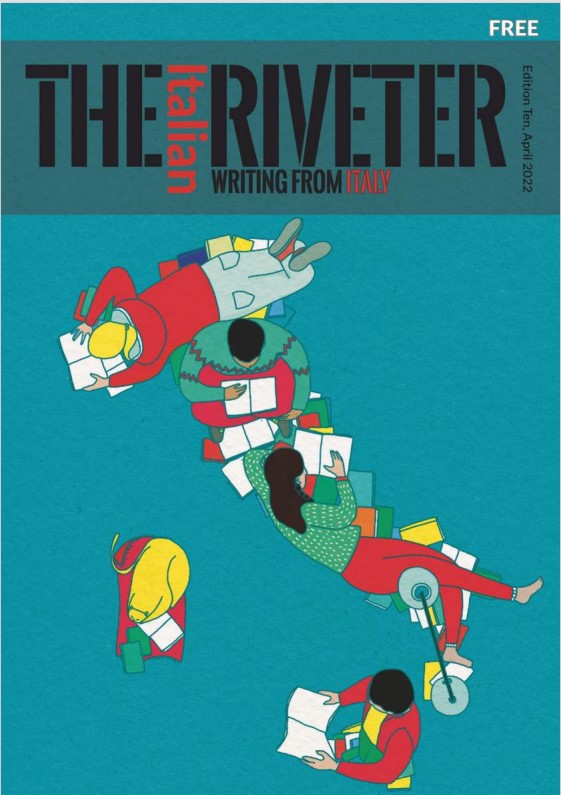
The European Literature Network has just released The Italian Riveter, an incredible resource for lovers of literature from Italy.
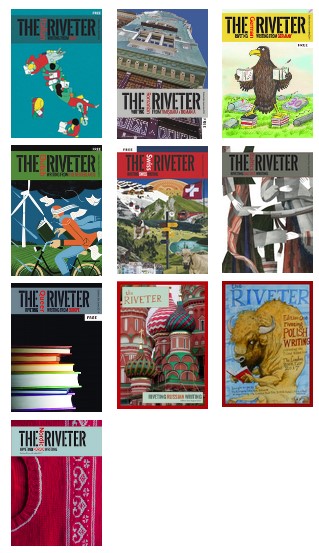
This is the tenth special issue of The Riveter, previous ones having focused on the literary output of Romania, Germany, Netherlands, Switzerland, the Baltics, queer authors, Russia, Poland and the Nordic countries. Click here to view them – they are free to download. Printed copies are available to order from newsstand.co.uk.
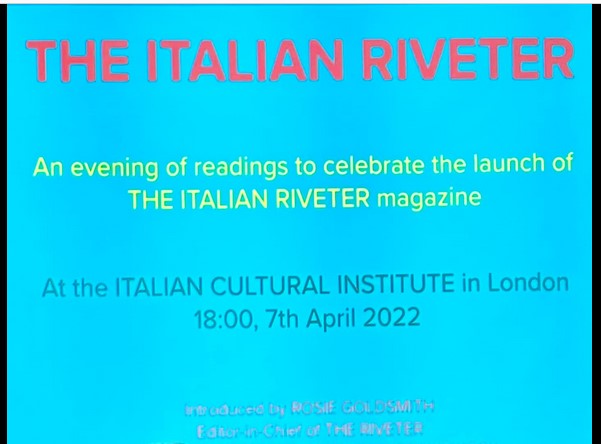
The Italian Riveter was launched at London Book Fair on 5 April and at the Italian Cultural Institute, London on 7 April 2022. The Italian Cultural Institutes of London, Dublin and Edinburgh sponsored its publication. ‘Why Italy? Why an Italian Riveter?’ Rosie Goldsmith, founder of the European Literature Network, answers those question in her introduction. Rosie, editor West Camel and design & production editor Anna Blasiak are indefatigable champions of literature in translation.
Contributors include many well-known novelists, poets, translators and critics from Italy, the UK and far beyond. So, The Italian Riveter offers the pleasure both of a superb read in its own right and of discovering new books to delve into. You’ll find exclusive interviews with the likes of Jhumpa Lahiri, Gianrico and Francesco Carofiglio and Tim Parks. Anna Blasiak delves into Italian poetry and Barry Forshaw into crime fiction. Paolo Grossi of New Italian Books talks about promotion abroad, and Diego Marani about the Italian ‘cultural mind’. Maria Teresa Carbone focuses on women’s writing, and Enrica Maria Ferrara specifically on Ferrante Studies.
Distinguished translators from Italian provide overviews of different genres, as well as reviews and extracts of books. For example, Howard Curtis covers lost Italian classics ripe for re-discovery, while Clarissa Botsford writes about the ‘new Italians’, including Cristina Ali Farah, Igiaba Scego and Nadeesha Uyangoda; Shaun Whiteside tells us about translating from Italian, and Ann Goldstein about translating Elena Ferrante; Denise Muir and Antonella Ranieri discuss children’s literature and children’s picture books, respectively; Katherine Gregor explains what differentiates the Italian historical novel and curates the section on untranslated Italian fiction.
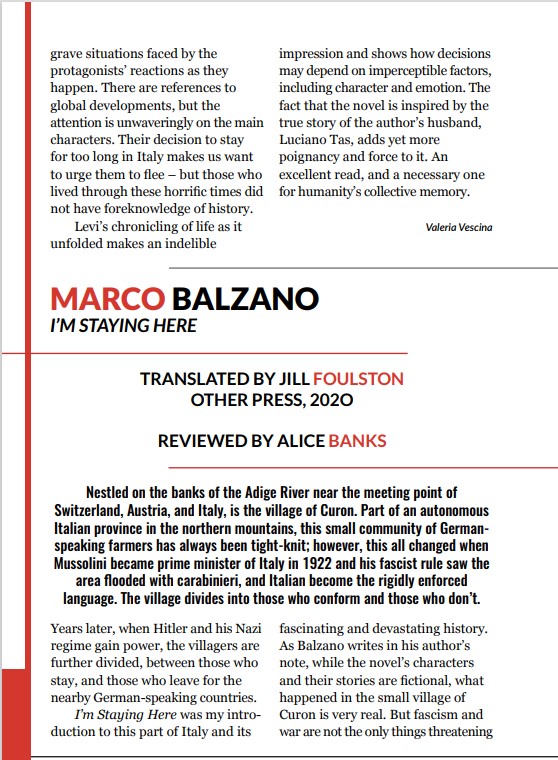
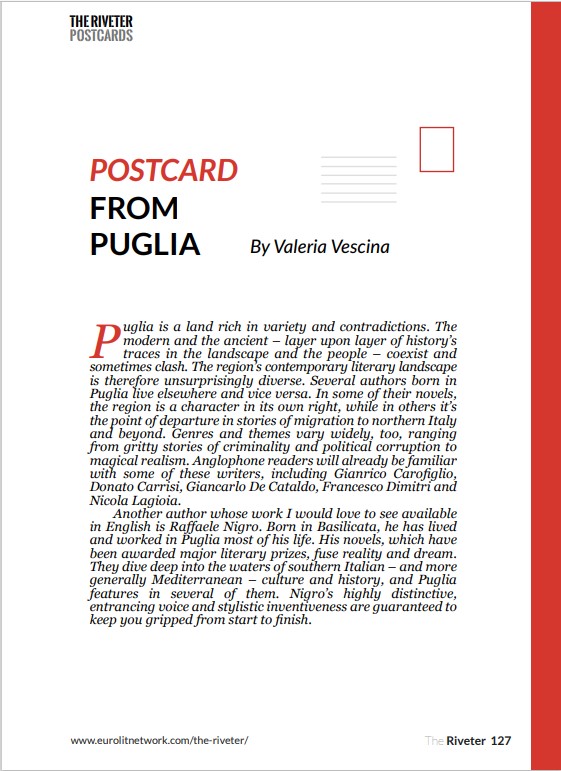
Every section includes different contributors’ reviews of works in the relevant genre. I was delighted to write about Lia Levi’s Tonight is Already Tomorrow, a work of historical fiction based on true events. The Italian Riveter is interspersed with pieces in the ‘Postcard from…’ series, to cover the literature of different regions, reflecting the diversity which characterises the peninsula. I was asked to write the ‘postcard’ from my native Puglia, and hugely enjoyed reading the ones from other parts of Italy.
Are you looking for great book recommendations? Or maybe researching contemporary Italian literature? Whatever your reason for landing on this post, you’ll enjoy and treasure The Italian Riveter.
The July 2019 edition of the European Literature Network‘s #Riveting Reviews is out today. My review is of Veronica Raimo’s “The Girl at the Door” (4th Estate). Bold stylistic choices give a sharp edge to this novel. This is unsettling, thought-provoking work.
The Girl at the Door is in tune with the concerns of the #MeToo movement, but Raimo began writing the novel years before its rise. The book is relevant also to other burning issues. It highlights the question of the failure to see clearly and to seek dialogue not only at a personal level but at a societal one, especially in the age of social media, when views of history and the present seem to polarise around extremes.
This is a book which challenges you to work hard and which amply rewards you for it: a gripping read in its own right, and fiction that enhances our engagement with the world. Highly recommended.
A review of That Summer in Puglia has just been published in the Winter 2018 edition of Ambassador Magazine, NIAF’s beautiful semi-annual publication. Washington-based NIAF – the National Italian American Foundation – is a key resource for the Italian American Community. It aims to preserve and promote the cultural heritage of Italian Americans, and to strengthen ties between the United States and Italy.
My thanks to NIAF and to Ambassador Magazine reviewer Kirsten Keppel for her fabulous piece on That Summer in Puglia.
Credits:
Article reproduced with kind permission of NIAF / Ambassador Magazine.
Levante italiano: Rino Caputo, Valeria Vescina, Tommaso Giartosio, Carlos Solito
The festival’s name suggests a focus on travel literature but its remit defies narrow definitions. It showcases different ways of narrating places and cultures: journalism, travel memoir, fiction, photography, music, television, comics, anthropology, history, politics, philosophy… It’s promoted and hosted by the Società Geografica Italiana (founded in 1867, it’s Italy’s equivalent of the Royal Geographical Society, for those of you in the UK) in the historic grounds of its headquarters, Villa Celimontana. Journalist and photographer Antonio Politano (La Repubblica, National Geographic and much more) is the Artistic Director. Writer and broadcaster Tommaso Giartosio (author of several books, journalist and presenter of Rai Radio Tre’s literary programme, ‘Fahrenheit’) co-ordinates the talks and interviews the speakers.
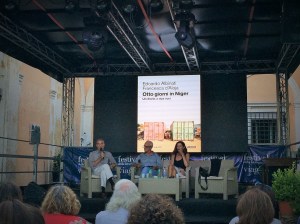
The festival’s byword being ‘openness’, its atmosphere is at once relaxed and challenging. The juxtaposition of some sessions emphasises the relevance and reach of world events. An example? In their presentation of Otto Giorni in Niger (Baldini + Castoldi) a memoir of days with the UNHCR in refugee camps in Niger, acclaimed authors Edoardo Albinati and Francesca D’Aloja spoke of how the experience affected their perspectives on issues ranging from degrees of hospitality and generosity, to the wisdom of young mothers whose babies were born of rape; their talk was followed by the award of the festival’s Navicella d’Oro Prize to Aboubakar Soumahoro, trade unionist, for his work against racism and the exploitation of migrants in Italy, and to Antonio Marchesi, President of Amnesty International Italy.
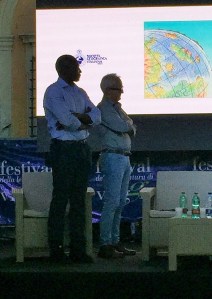
Aboubakar Soumahoro and Tommaso Giartosio
Edoardo Albinati, Tommaso Giartosio and Francesca d’Aloja
The novels presented at the festival tend to be connected by a strong sense of place. The session ‘Levante Italiano’ or ‘Italian Levant’, involved a discussion of three works set in Puglia: Omar Di Monopoli’s Uomini e Cani (Adelphi), Carlos Solito’s Sciamenesciá (Elliot) and my That Summer in Puglia (Eyewear). Rino Caputo, Professor of Italian Literature at Tor Vergata, University of Rome, put them in the historical context of literature from Puglia-born writers, highlighting the similarities and differences vis a vis the experience of earlier Sicilian authors. Tommaso Giartosio pointed to the strong thread connecting our individual visions of Puglia, despite our three widely differing styles: namely, the region’s contradictions, rooted in history, which still shape its present and our imaginations.
Rino Caputo, Valeria Vescina, Tommaso Giartosio, Carlos Solito and Omar Di Monopoli in ‘Levante italiano’
With fellow-writer Francesco Dimitri, my interviewer
Yesterday’s event in Ostuni was very special: after a journey begun in Oxford, my protagonist Tommaso “came home” to the beautiful city through which he and Anna “walk”.
Poster produced by the City of Ostuni
Article in La Gazzetta del Mezzogiorno
I have lots of people to thank for the success of this bilingual presentation to an audience consisting, in fairly equal parts, of Italian and native-English speakers:
The authorities who took the initiative of offering a literary event for both an Italian public and the sizeable Anglophone community resident in and around Ostuni. My thanks to Mayor Gianfranco Coppola, City Councillor Antonella Palmisano and Director of Museums Michele Conte, who gave the welcome addresses, and to their wonderful team, especially City Library Director Francesca Garziano and Press Officer Paola Loparco
Francesco, Paola and Ilaria Casanova of the Bottega del Libro bookshop, whose support at the event and in the weeks leading up to it was precious
Last but certainly not least, my wonderful interviewer Francesco Dimitri, another Apulian author living and working in London. Francesco writes in both Italian and English. His most recent titles include To Read Aloud and The Book of Hidden Things (which is set in Puglia) and he collaborates with The School of Life. I can’t wait for his That Sense of Wonder, which is due out in November 2018.
Mayor Gianfranco Coppola’s welcome address
Address by Museum President Michele Conte
Assessore Antonella Palmisano’s address
Francesco and I translated – from English into Italian and vice versa – everything we discussed. We had wondered how well this would work and were delighted to hear that people loved it and that many of them actively enjoyed the challenge of trying to understand what was being said in the other language before hearing the translation into their own tongue.
Francesco’s questions were insightful and stimulating, and those from the audience showed warm engagement with the novel. As always, it was so lovely, afterwards, to meet those present, to hear their thoughts on the book and to learn of their backgrounds.