Today I had the wonderful surprise of a review of That Summer in Puglia by video. It comes from the fabulous literary blogger Claire Lyons and you can watch it on her website, Mrs. Average Evaluates, by clicking here.
Some excerpts from the video-review of the novel:
“So carefully written and incredibly evocative.”
“A very passionate book.”
“Shakespearean mix-ups and misunderstandings and lack of communication…”
“…and it’s about youth, and about parenting, and about loss… It’s a super book.”
“I’d love you to read this. It’s a beautiful, beautiful book.”
I’m grateful to Claire Lyons for her warm, powerful words.
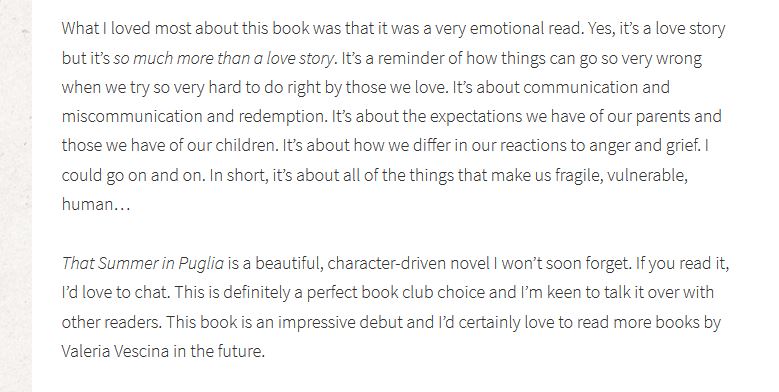
A beautiful review of That Summer in Puglia. My thanks to reviewer Ann Marie of NYC-based Lit Wit Wine Dine for communicating with such clarity and warmth her perceptive reading of the novel.
Below are images of short extracts of the review. I encourage you to click here to access the full article on this excellent literary blog site.
In April, the European Literature Network published The Baltics Riveter, a compendium of writing about contemporary fiction from Estonia, Latvia and Lithuania. Publication coincided with this year’s country focus on the Baltics at London Book Fair, where the magazine was widely distributed and enthusiastically received. It contains historical notes, reviews and extracts of some very exciting literature.
The Baltics Riveter is now available also in digital form here. This is the fourth of the European Literature Network’s Riveters. The first was devoted to literature from Poland, on the occasion of the 2017 London Book Fair’s Polish focus. The second, on literature from Russia, coincided with ELNet’s Russian events at the British Library. In The Nordic Riveter of October 2017, five countries were represented: Sweden, Norway, Denmark, Finland and Iceland.
I normally review English-language editions of novels originally written in Italian, German and French, the languages and cultures I grew up with. But the editor of The Riveter asked whether I might review Estonian author Kai Aareleid’s Burning Cities, translated by Adam Cullen (Peter Owen Publishers, 2018). I’m very grateful for the suggestion: the novel weaves a powerful domestic tale within the larger tapestry of seven decades of Estonian history; most of the story unfolds in the years during which the country was part of the Soviet Union. You can find my article on pp. 58 and 59 of the magazine, or here. I hope it will encourage you to discover Kai Aareleid’s work and more of the riveting literature from the region.
Image credits:
Images courtesy of The European Literature Network.
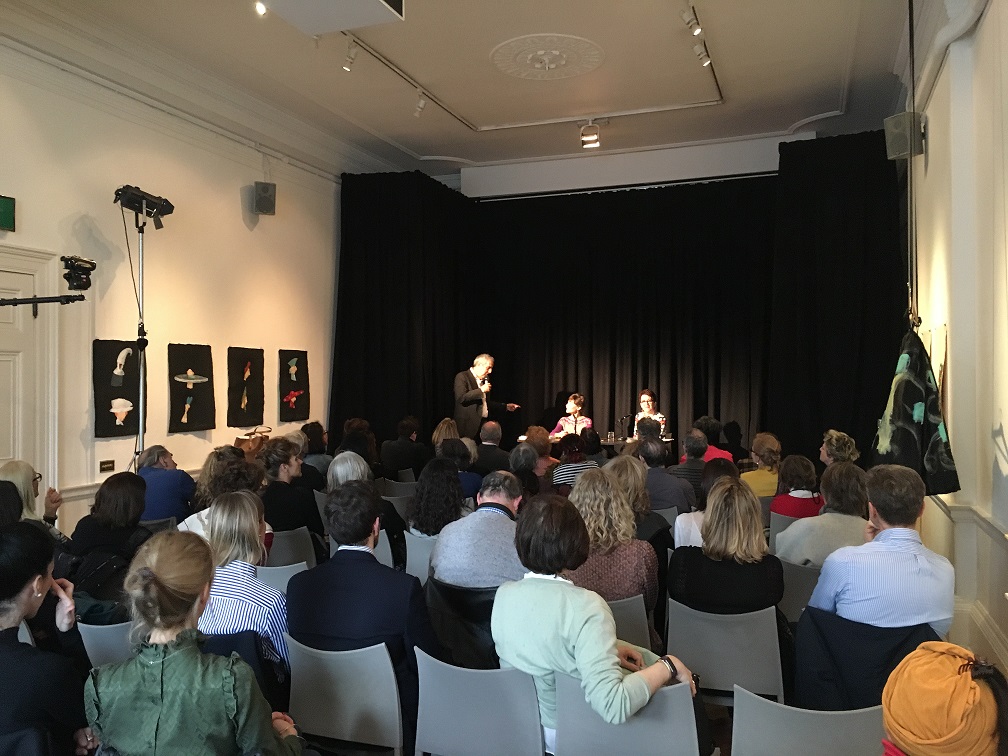
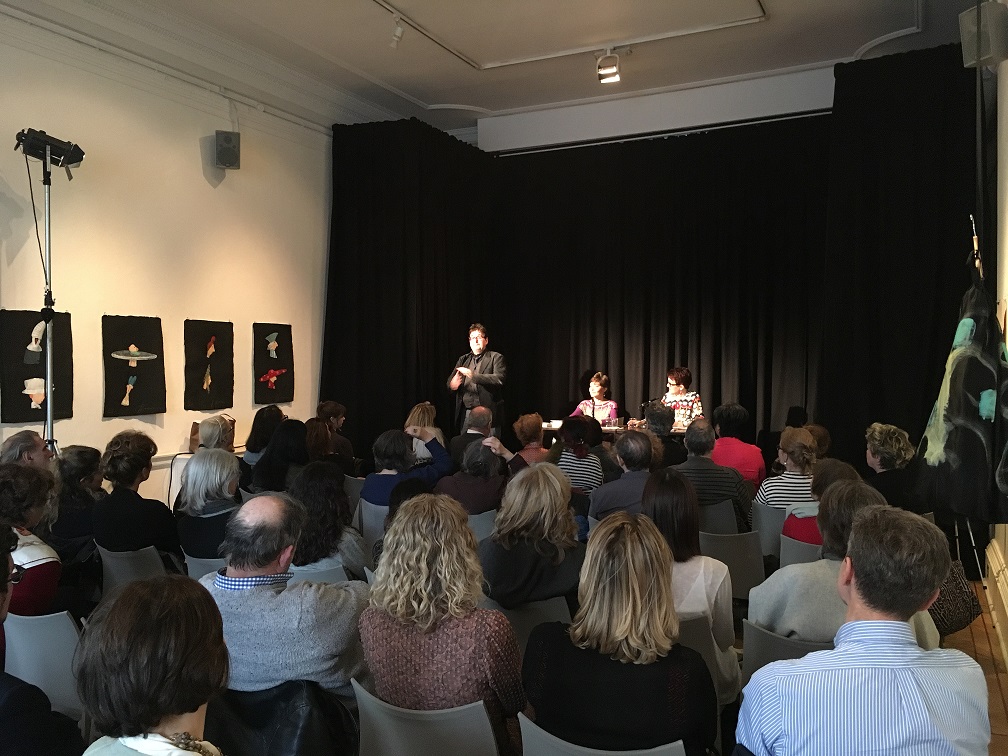
A presentation of That Summer in Puglia took place on 16 April in the elegant surroundings of the Italian Cultural Institute in Belgrave Square. The Institute is a governmental organisation dedicated to promoting knowledge of Italy’s language and culture and to encouraging cultural and scientific collaboration with England and Wales.
My interviewer was Rosie Goldsmith, the acclaimed journalist, presenter, literary critic, Chair of the EBRD Prize, and much more! I’m so grateful to Rosie for her perceptive, engaged and knowledgeable questions.
Our discussion was introduced by Marco Delogu, Director of the Institute, under whose stewardship the organisation has hosted an exciting line-up of events across the arts and sciences. Check out the Institute’s rich schedule of forthcoming and past events here. Guests on the Literature side of the programme have included Roberto Calasso, Sandro Veronesi, Domenico Starnone, Ali Smith, Elif Shafak, Ben Okri, Jhumpa Lahiri… to name but a few.
Todd Swift, Director of Eyewear Publishing, spoke briefly about That Summer in Puglia before leaving Rosie and me to discuss the book in detail. Our conversation touched on plot, characters, setting, themes and structure, but also on aspects of various literary traditions (English, yes, but also Italian, German and French) which have flowed into it because of my personal history.
Marco Delogu’s introductionTodd Swift’s introduction
Many of the questions from the public were focused on the cross-cultural aspects of the novel and on the writing process: why had Puglia inspired me? Why is it an ideal setting for this particular story? Where does my detailed knowledge of Ostuni stem from? Which language do I consider to be my “mother tongue” and why? Having grown up in various countries, what are my views on cultural identity? How long did it take me to develop the plot, and how did I go about it?
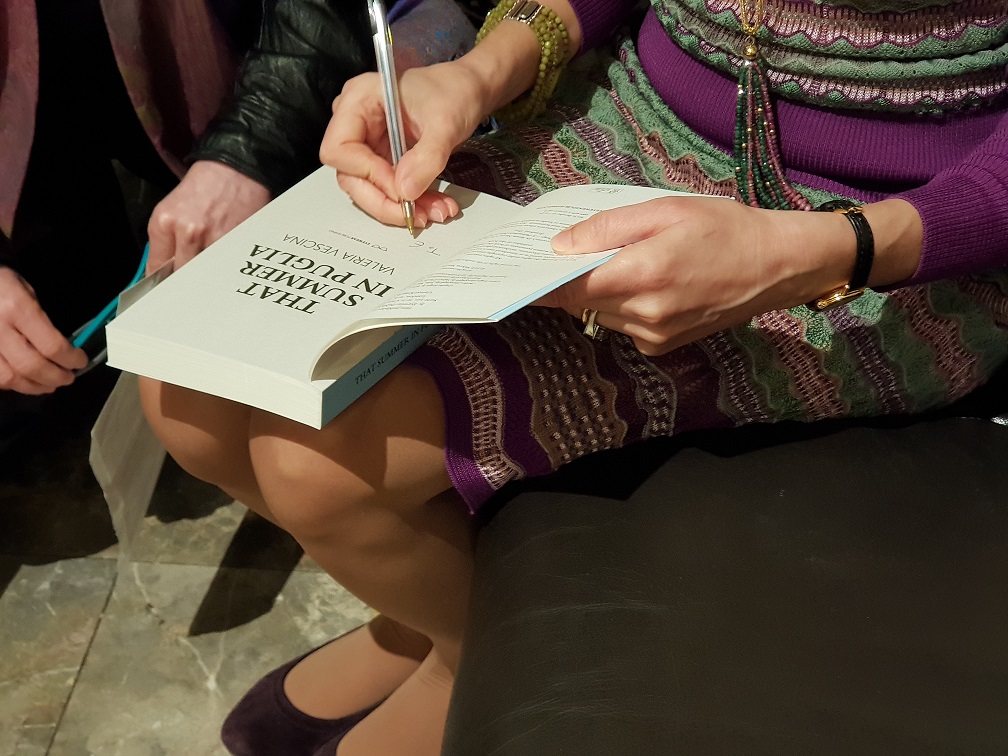
Meeting people after the talk was a real joy. It was lovely to discover the variety of emotional resonances the book has for different people. I had been prepared for the fact that each reader will respond to certain aspects of a story more than to others, but I hadn’t expected how warmly people would share profound reflections and anecdotes from their lives. I’m very grateful to them.
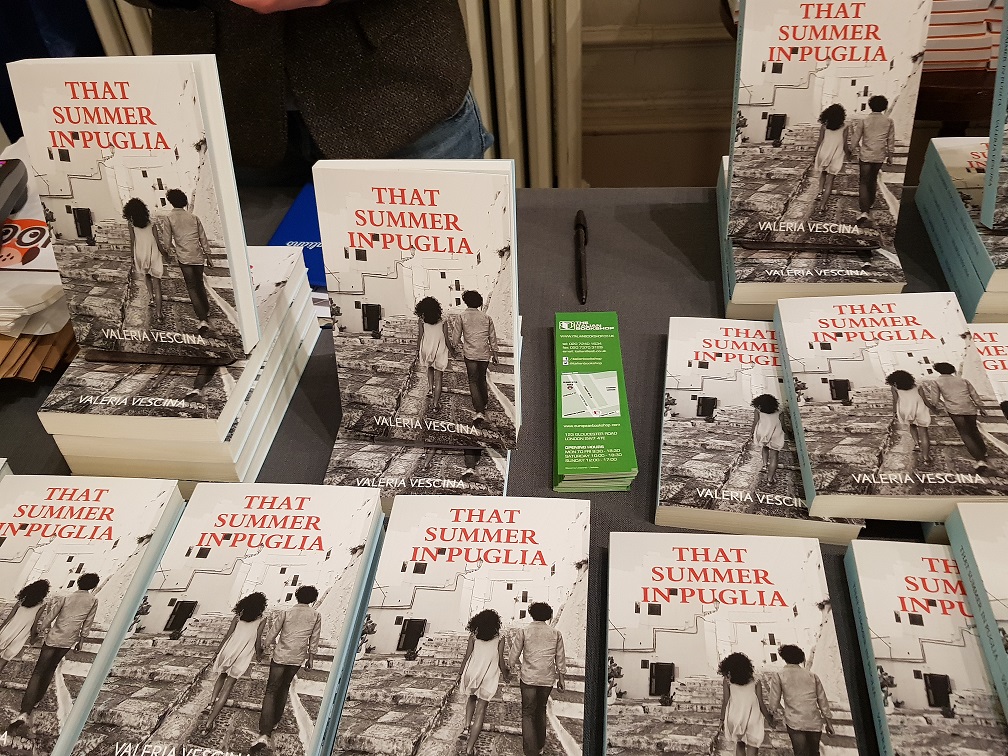
Signing booksBook display at the Institute by The Italian Bookshop
Image credits:
The photos ‘Valeria and Rosie’, ‘Signing books’ and ‘Book display at the Institute by The Italian Bookshop’ are courtesy of Rosie Goldsmith, and reproduced with kind permission.
Rights to the photos ‘Marco Delogu’s introduction’ and ‘Todd Swift’s introduction’ are my own.



 Valeria Vescina