Accuracy and authenticity in historical fiction

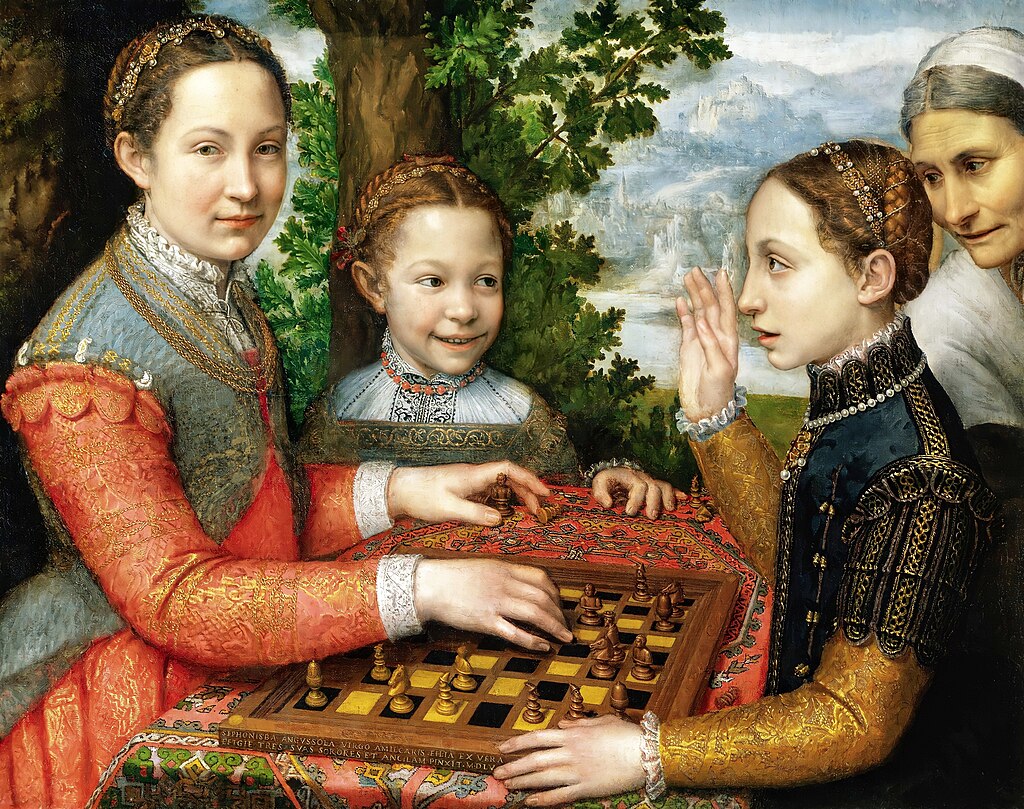
Sofonisba Anguissola’s The Chess Game (1555) is packed with meaning. Among other things, it’s a statement about women’s agency and about Sofonisba and her sisters’ exceptional education. The strategy game of chess was normally the preserve of men. Dama (le jeu de dames) was considered more appropriate for women.

Speak of accuracy and authenticity in historical fiction, and you’ll find writers agreeing on some things but not on others. “Shoulds” abound. Accuracy, you’ll often hear, is objective: it involves verifiable facts, from dates and places to furniture and dress. Authenticity, by contrast, is somewhat subjective: the reader must perceive the story’s world as faithful to the era in question.

Like many dichotomies, this clear-cut view of accuracy as objective and of authenticity as subjective is an over-simplification. The accurate details that authors of historical fiction work so hard to respect are unavoidably a selection, made from their own perspective and as a function of the story; conversely, readers may query the authenticity of well-documented elements that clash with widely held stereotypes and tropes. This matters because authors’ answers to these challenges lead to differing choices. It’s particularly important with respect to fictional re-imaginings of the female experience: recent decades of scholarly findings into ordinary women’s lives – whose legacy most impacts the present – now provide us with invaluable insights.

I’ve spent years researching and writing Habit of Disobedience, a novel inspired by real-life 16th-century women in Southern Italy. Scouring manuscripts, books, and articles in historical archives and libraries; attending history conferences; visiting museums of all kinds; corresponding with historians, in my search for missing details… You’ll gather my efforts at faithfulness – accuracy and authenticity – were not half-hearted. Still, since the key protagonists of my story are ordinary women, there are too many gaps to fully piece together the micro-history. I’m a novelist and tutor in creative writing, not a historian: my interest lay in attempting to inhabit the past until I could ‘see’ and ‘hear’ the characters in places that today convey only a faint echo of their struggles, joys, fears, and dilemmas. Where history left voids, I found doors I could open to fictional elements: characters and threads that capture people and the heartrending situations they experienced.

It’s the approach that felt right for this novel. The true events that inspired Habit of Disobedience are dramatic, and the fictional yarns I wove through them had to be highly consistent with their contemporary context. I’ve aimed to offer what Stephen Greenblatt expressed superbly in a 2009 article: for my protagonists to ‘carry the burden of a vast, unfolding historical process that is most fully realized in small, contingent, local gestures.’1
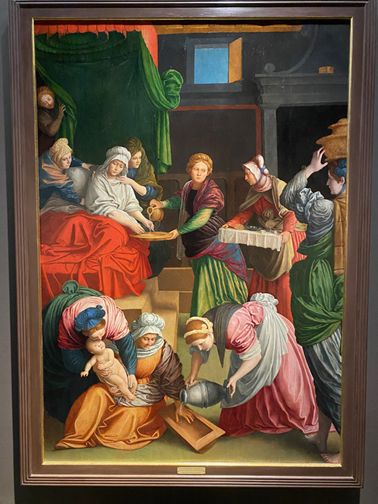
A realistic ‘women’s world’ in Gaudenzio Ferrari’s Birth of the Virgin (1541-43). The water from a baby’s first bath was thrown into the hearth for a girl and outside the front door for a boy.

There’s an additional reason why I’ve strived for faithfulness: I wanted to give a voice to these unheard women because of their relevance to the present day. The novel highlights their acquiescence in a system they thought they could not change, the areas of agency they carved out for themselves, and the trigger for their resistance. It holds a mirror to our times, without anachronisms. That’s also why I’ve aimed to immerse readers in the mentality of the time (to the extent available to me, five centuries later) – our value system affects how we frame and express our emotions in different eras and cultures.2 The more deeply readers let themselves be drawn into my protagonists’ worldview, the greater their surprise at how much of it persists today in changed forms.

Participants at a recent Women Writers Network discussion felt that most people today still live in a patriarchal society. The impact on women is obvious, but it is, ultimately, negative for everyone. It’s a framework of attitudes, beliefs, behaviours, and rules that most of us, no matter our gender, have absorbed and unwittingly sustain until we recognise them. Historical fiction can shine a powerful light on them.

As authors, we strive for accuracy and authenticity – seeking to shift perceptions, however slightly, away from stereotypes and tropes. In doing so, we can contribute much-needed nuance to the public discourse, making it more inclusive and less polarised.

In the words of Hilary Mantel: ‘What can historical fiction bring to the table? It doesn’t need to flatter. It can challenge and discomfort. If it’s done honestly, it doesn’t say, “believe this” – it says “consider this.” It can sit alongside the work of historians – not offering an alternative truth, or even a supplementary truth – but offering insight.’3

I look forward to telling you more about Habit of Disobedience as soon as it finds its publisher.


[1] https://www.nybooks.com/articles/2009/11/05/how-it-must-have-been/?utm_medium=email&utm_campaign=NYR-081124-news&utm_content=NYR-081124-news+CID_075386c07c1251a015e3b5bd8741dede&utm_source=Newsletter&utm_term=Stephen%20GreenblattHow%20It%20Must%20Have%20Been

[2] The academic field of history of the emotions was eye-opening in this respect, as was Arlie Russell Hochschild’s concept of ‘emotional labour’.

[3] The BBC Reith Lectures. Hilary Mantel’s Reith Lecture 2 – The Iron Maiden. https://www.bbc.co.uk/programmes/b08vkm52/episodes/player

Image credits:

Sofonisba Anguissola’s The Chess Game (1555). Photo by Mortendrak, reproduced under Creative Commons Attribution-Share Alike 4.0 international license.

Gaudenzio Ferrari’s Birth of The Virgin (1541-43). Photo by the author, taken at the Pinacoteca di Brera.  

Many disciplines, one opera

I recently wrote two articles which complement each other – imagine it as a diptych of sorts – on a contemporary opera, Kepler’s Trial:

  • the first is a review, for Seen And Heard International, of the work by composer Tim Watts (Cambridge and Royal College of Music)
  • the second focuses on the unusual inter-disciplinary effort behind the opera. The article, for Talking Humanities*, consists of an interview with Prof. Ulinka Rublack (Cambridge).

*curated by the School of Advanced Study, the UK’s national centre for the support and promotion of the humanities

Why write two articles about it? Because the Kepler’s Trial project is and does so much of what I think contemporary opera is capable of being and doing. It delves into the past to engage with the present.

For the review of Kepler’s Trial on Seen And Heard International, click here.

For the article in Talking Humanities on the unusual process behind the opera, click here.

Image credits:

Statue by Jakob Wilhelm Fehrle dedicated to Katharina Kepler in Eltingen (Leonberg, Germany). Reproduced under GNU Free Documentation licence.

Portrait of Johannes Kepler. Reproduced under Public Domain licence.

Image from Seen and Heard International website.

Image from Talking Humanities website.

Astonishingly modern 18th-century opera

piccinni-Aurelia
Barbara Massaro as Aurelia in Le Donne Vendicate

Recently I reviewed three operas for Seen And Heard International.  Two of them – one by Piccinni, the other by Vivaldi – date to the eighteenth century but are astonishingly modern in their questioning of gender stereotypes.  This is all the more striking, at a time when the gender pay gap at the BBC and a divisive memo by a Google employee about gender and diversity initiatives are making the headlines.

The two operas formed part of the engaged and engaging programming of the Festival della Valle d’Itria, one of Italy’s oldest opera festivals.  Located in Puglia and now in its forty-third edition, this year it adopted the theme ‘Love and Mars’ – not the more usual ‘Venus and Mars’ because one of the programme’s fils rouges was the querying of gender roles.  That querying was not an anachronistic re-interpreting of the relevant operas by their directors, but faithful to their texts and music.

The first of the two operas is Le Donne Vendicate (The Women’s Revenge) by Niccoló Piccinni (1728-1800), with a libretto derived from the Enlightenment playwright, Carlo Goldoni (1707-1793).  See review here.

S&HI Le Donne Vendicate 2The second is Orlando Furioso by Antonio Vivaldi (1678-1741), with a libretto by Grazio Braccioli (1682-1752) based on the eponymous work by the Renaissance poet Ludovico Ariosto (1474-1533).  See review here.

S&HI Orlando FuriosoBoth works are steeped in the experimentation and questioning of the Enlightenment (and, in Ariosto’s case, in that current of Renaissance humanism which sided with women in the Querelle des Femmes but lost out during the Counter Reformation), but periods of significant cultural ferment have, historically, alternated with others of retrenchment, resulting in historical discontinuities.
Both operas were born of a spirit of respect for the worth of all human beings, which by definition is irrespective of gender, social class, race or religion.  The Goldoni behind Le Donne Vendicate is representative of – whilst also being influential on – that aspect of his era.  In his oeuvre, morality rests not in time-honoured hierarchies, mores and tenets, but in a psychologically profounder sense of what is just, good and wise.  Meanwhile, the hero of Braccioli’s Orlando is Astolfo, whose blend of mildness and courage enable the overcoming of all manner of obstacles.  Maybe we should be rediscovering early operas more frequently, for the shock of the old to inform the new.

The third opera reviewed at the Festival della Valle d’Itria for Seen And Heard International is Margherita d’Anjou by Giacomo Meyerbeer (1791-1864) with libretto by Felice Romani (1788-1865).  See review here.

S&HI Margherita d'Anjou

Image credits:

Photo of Barbara Massaro as Aurelia in Le Donne Vendicate, courtesy of Festival della Valle d’Itria.

Photos of the town of Martina Franca (home of the Festival della Valle d’Itria) by the author. All rights reserved.

Images of reviews of Le Donne Vendicate, Orlando Furioso and Margherita d’Anjou from Seen And Heard International website.


The Renaissance – understanding its legacy

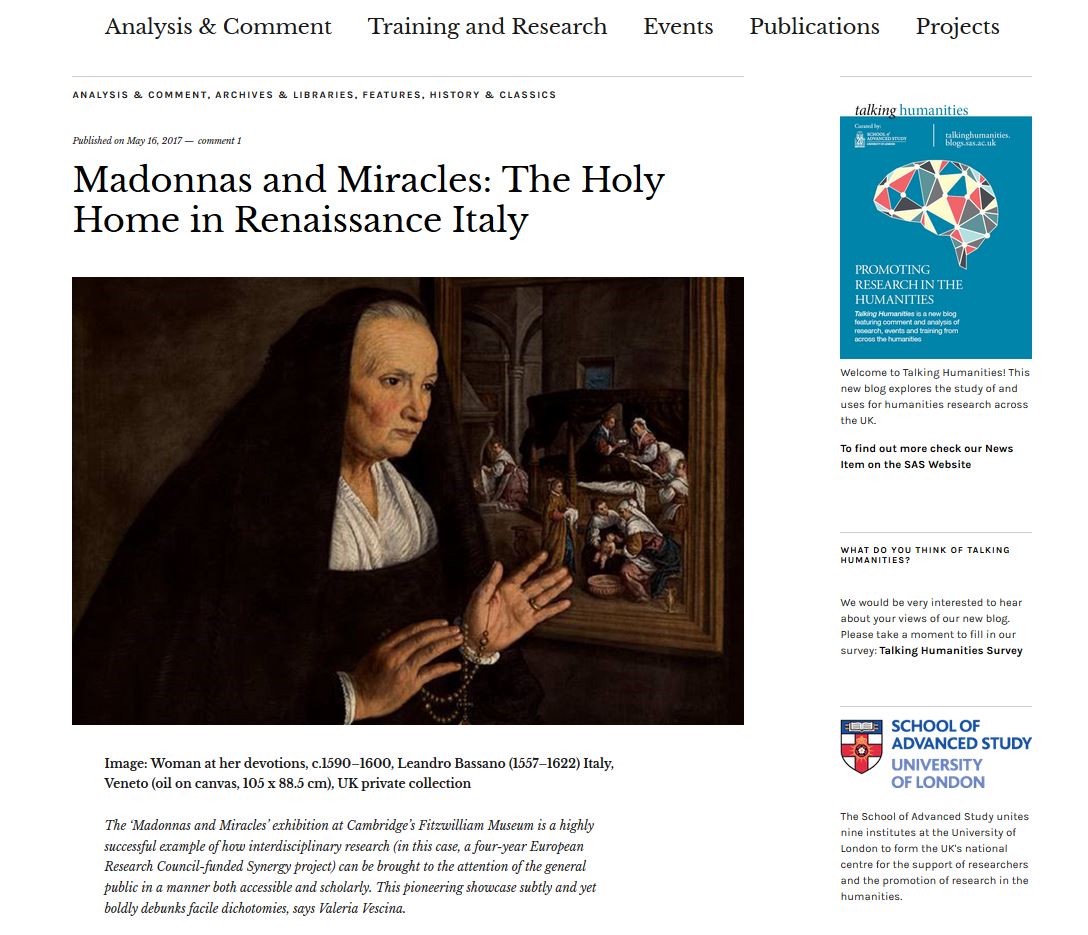
Madonnas and Miracles – The Holy Home in Renaissance Italy, at the Fitzwilliam Museum until 4 June, is one of the best exhibitions I’ve seen in years.  I recently wrote a review of it because it deserved shouting about.  It’s a model of what exhibitions should be and do: scholarly and yet approachable, painstakingly curated in structure and detail, it subtly and yet boldly debunks facile dichotomies.  It’s a highly successful example of how the outcomes of interdisciplinary research (in this case, a four-year European Research Council-funded Synergy project) can be brought to the attention of the general public.  The catalogue, too, combines rigorous learning and an accessible tone.  You can access my article on the Talking Humanities website of the School of Advanced Study, the UK’s national centre for the support and promotion of research in the humanities.

Review of Madonnas and Miracles

I’ve been fascinated by the Renaissance for years, but in the last two my studies have focused particularly on women and Southern Italy during this period.  My second novel will in fact be set in Puglia during the late 1500s.  When I first mentioned my project to an acquaintance, the response was, “But surely, the South didn’t have a Renaissance.”  Delving into historical research, including primary sources, swiftly disproves that and other common misconceptions.  I’m hopeful that my novel will be a tiny step in that direction.  It matters not least because the Renaissance’s legacy extends to the present day in realms and manners on which we don’t usually pause to reflect.

As an example, take the apocryphal story of The birth of the Virgin, a common subject in churches as well as on birth trays and bowls given to new mothers during the Renaissance.  In the Madonnas and Miracles exhibition, it is on view in a painting (c. 1440) by the Master of the Osservanza, as well as (though it may be a ‘birth of the Baptist’) in an arresting one by Leandro Bassano.  The latter’s Woman at her devotions (c. 1590-1600) shows a widow at her kneeling-stool with a string of rosary beads and a book of hours, in contemplation of a depiction of St. Anne (or St. Elizabeth) attended by other women while her new-born is about to be bathed.  The subject had deep meaning for a woman.  During pregnancy and labour, she would have prayed to the Virgin – and to St. Margaret, patron saint of childbirth.  As in the painting, she too would have been sustained by female relatives, friends and neighbours until the midwife’s arrival and again after the baby’s birth.  She would also have recognised the bath in which the baby was to be washed: for a new-born girl, its water would be tipped over ashes from the hearth, and for a boy, thrown outside the house, in a gesture symbolic of their required gender roles.  Similarly, a painting such as Pinturicchio’s Virgin and Child with St. John the Baptist (c. 1490-1495), also in the exhibition, reflected and reinforced mothers’ responsibility for their children’s religious education.  The roots of societal expectations about men and women’s lives went back centuries – some remain entrenched to this day.


Image credits:

Image of Madonnas and Miracles review from the Talking Humanities website.