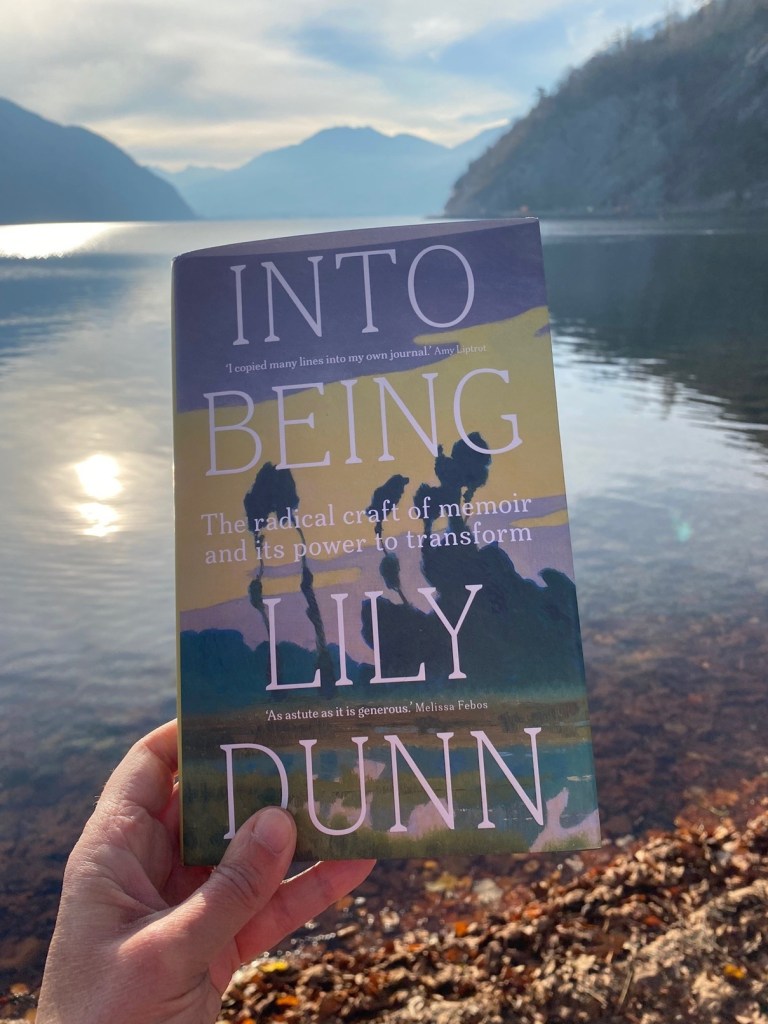
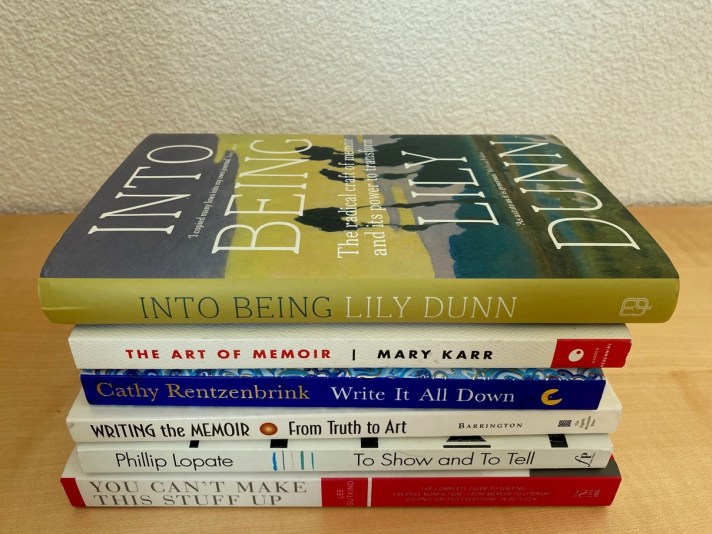
I’ve read many titles on the craft of memoir, but Into Being is about so much more than the craft. I can’t recommend it strongly enough. Lily Dunn’s focus on the transformative power of the process, her handling of philosophical questions, the generosity with which she shares her experience, the inclusion of other writers’ insights, and the voice – which blends authority and wisdom with modesty and empathy – make for a powerful mixture that I’m sure will be invaluable to memoirists for a long time to come.
I love how Lily conveys ‘the dance between writing and gaining in self-understanding in life, and how intimately connected they are.’ Her view of memoir-writing has a remarkable life-enhancing quality. ‘We are touching on questions not only of how to write better, but also how to live better, to be more self-aware and honest as we move through the world. The best memoirs, I believe, evolve alongside their authors who gain in understanding and wisdom […].’
In January, I had the privilege of interviewing Lily on behalf of the Women Writers’ Network. We discussed how she balances her work as a memoirist, teacher, and mentor; her aims for the book; how to nurture the ‘gift of noticing’; approaches to concerns over protecting oneself and others; degrees of emotional distance; finding clarity of both vision and voice; unearthing the best shape for one’s memoir.
You can read the interview of 22.1.2026 by clicking on the six questions below. Happy reading!
‘Undercurrents’ (Broken Sleep Books) by Richard Skinner
What a breath of fresh air this slim volume is: a collection of uncompromisingly thought-provoking essays, and the variety of topics so stimulating. It feels like listening to a friend talking about subjects that deeply matter to him but that are also universal, and that he handles as only someone both knowledgeable and passionate about them can.
Richard Skinner is an author of literary fiction, life-writing, essays, non-fiction and poetry, and a highly regarded creative-writing tutor. In Undercurrents, he brings together essays about books, the writing craft, films and music, his own life experiences, as well as interviews with poets. Naturally, the tone varies as a function of each essay’s topic: from the more analytical one for a review, to the reflective and intense one about two beloved friends’ deaths.
Skinner’s thoughts on the link between Eisenstein’s ‘montage of attractions’ principle and making connections in one’s writing intrigued me. I enjoyed the expansiveness with which an essay about Talking Heads’ Remain in Light takes in Isiah Berlin, Marcel Proust and the ancient Greek chorus. The description of the state of ‘self-emptying’ and ‘belonging’ to the landscape while on a long hike resonated. The reflections on friendship, death, and acceptance of the unknowable, with regard to the death of dear friends, were relatable and made me think.
This is a rare gem in the current publishing landscape. All credit to the author, and to Broken Sleep Books for its ambitious publishing programme.
Any one-liner for describing what this memoir is about would do it an injustice: it could not encompass its range. It’s about depression, attempted suicide, surviving it, recovering, building a new life… About societal expectations and how they shape us. About our system of mental healthcare. And it’s very much about love.
‘Love Lay Down’ is an important book. Helen Murray Taylor shares with generous openness and formidable eloquence her story of depression’s vortex and of her recovery. Her memoir is vivid, raw, at many points heartbreaking. At the same time, it’s infused with wit, with her ability to perceive the surreal and the outright comedic in some of the worst circumstances. She lets us into her intense emotions and thoughts at the time, as well as into her capacity for looking back at them now with hard-won distance.
Love blazes a luminous, life-saving path throughout this memoir: the love between Helen and her husband; that of family; of friends, colleagues… The whole book strikes me also as a real act of love by its author towards readers: as a gift of hope – and of feeling seen and heard – to sufferers from depression; and as a gift of understanding to all. ‘I hope that no one who reads this has ever found, or will ever find, themselves being dragged under by the force of their depression. But if that is you, […] please, please, call out for help. The help when it comes might not steer you to dry land but it might be the lifejacket that lets you turn on your back and float, the thing that lets you rest awhile, that keeps you afloat a little bit longer. Survival isn’t always about kicking against the waves. Tomorrow the tide might turn and wash you ashore.’
‘It was my father who made the arrangements. My uncle helped, since he lived down south, where all this kind of business is carried out.’
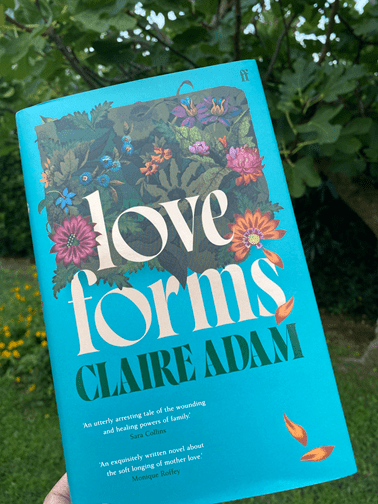
The opening of ‘Love Forms’ sets the tone for the whole novel: a voice that immediately draws you in with its fresh, direct, familiar cadence; and ‘the arrangements’ at the heart of the story. These arrangements see the then sixteen-year-old protagonist, Dawn, whisked off from her home in Trinidad to Venezuela, where she must give birth in secret and surrender her baby for adoption. The reason? ‘She made a mistake and brought shame to her family.’
It’s not long before Dawn realises that the real mistake – whether really hers or her parents’ – was to give up her daughter. The intense longing to find her again impacts the rest of Dawn’s life. Though she goes on to graduate in medicine in the UK, work, marry, and raise two beloved sons, her yearning for the lost child becomes an ever-present, aching part of who she is. When she’s fifty-eight, we witness one of her many attempts to track down her daughter – a search that plays out as a roller coaster of emotions.
Dawn feels so real, that I was absorbed by her evolving feelings and her growing understanding of herself, of her family, and of the changing world around her. This is partly thanks to Claire Adam’s sensitive psychological portrayal of her main character, and partly because of the three-dimensionality she lends to the places – Trinidad, Tobago, Venezuela and London – and times the protagonists inhabit. The dialogue across generations – between Dawn and her parents, siblings, and children – is deeply affecting, as powerful in its silences as in its words. These exchanges and the characters’ actions sustain a taut narrative tension: I often found myself wondering about the consequences of certain conversations – and discovered their outcomes in the novel’s final chapters.
It’s all there in the title: ‘Love Forms’ is about different kinds of love (starting with that of a mother for her child), and about the ways it’s kindled, grows, is challenged, changes… and how it changes us in turn. It’s a poignant, beautifully written novel, and one of the finest I’ve read in a long time. I couldn’t recommend it more highly.
“The Fire In Their Eyes” is a breath of fresh air: a thriller that keeps you hooked right up to the end, it’s boldly original, unafraid to experiment with form, and courageous in its engagement with urgent issues. It reveals the interconnections between these issues, while weaving a narrative that is both emotionally gripping and intellectually engaging. If you crave fiction that does more than entertain – stories that challenge you to think and that spark meaningful conversation – this book is for you. Structured across dual timelines, the novel follows three female protagonists, all of them gripped by a strong sense of impending danger. Each woman fights, with grit and intelligence, to prevent a catastrophe. Though separated by time and geography, the threats they face are connected. In the Arctic, geneticist Eloise races against time at a scientific research station to neutralise a fresh danger to humanity. What is its link to the DNA of “Sarah,” a woman whose 74,000-year-old remains were discovered on Mt. Kenya? Meanwhile in Manchester, psychiatric nurse Jessica – whose husband Max unearthed Sarah’s remains – is experiencing a heightened sense of threat. What is the cause of this change in her? And how will it affect her deep, tender bond with Max? In a lush Kenyan valley 74,000 years ago, the shamanic Old Woman – Sarah’s daughter – perceives an impending danger that could annihilate her people. It falls to her to discern the precise nature of the threat and devise a way to combat it. Stephanie Bretherton’s novel is underpinned by meticulous research. Complex scientific ideas – particularly in biology, genetics, and virology – are conveyed with clarity and precision and linked back to some of the most profound questions of our time. For example, the author draws links between globalisation, climate change and other environmental issues, rising population density, and the emergence of new pathogens. She also explores the spiritual and philosophical questions raised by natural disasters, political opportunism, and the consequences of human actions. One question resonates especially strongly: from one generation to the next, how do we pass on the best of what it means to be human? The power of all forms of love to help us meet the toughest challenges is one of the novel’s connecting threads. This is not, however, a didactic book. Each of its three narrative strands is as gripping as a thriller, with high stakes and expertly controlled pacing. The tension builds steadily towards an emotionally resonant climax. I found Jess and Max’s story particularly moving – an honest, tender portrayal of love and the difficulties it must overcome. The novel’s intricate structure is beautifully handled. You always know exactly where you are and feel secure in the hands of a confident storyteller. Each of the three protagonists is surrounded by sharply drawn secondary characters: family, friends, and colleagues who feel fully alive. The integration of emails, text messages, and unsent letters lends further realism and emotional depth. The settings are equally immersive: Eloise’s sterile research facility and the bleak beauty of the Arctic; Jess at the psychiatric hospital where she works, in the swimming pool where she finds release, and in the quiet refuge of memory – drifting back to a long-ago dive among minnows; and the Old Woman’s tribal village – rich with ritual and community – and its wild surroundings. This is a novel of gripping storytelling, literary substance, and lasting insight – one I wholeheartedly recommend. “The Fire In Their Eyes” is the second book in “The Children of Sarah” series, and I already look forward to its sequel.
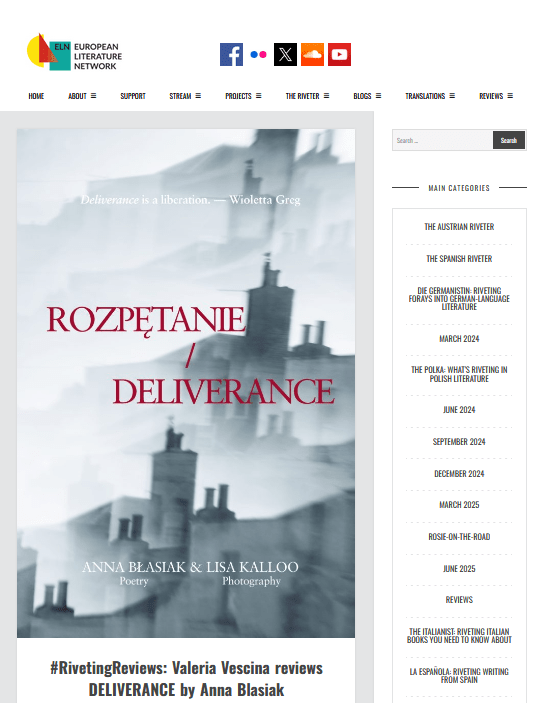
The European Literature Network’s latest Riveting Reviews include one from me on Anna Błasiak’s Deliverance (Holland House Books). It’s a moving poetry collection about growing up queer in Poland and gradually attaining one’s full identity. Its superbly inventive blend of art forms holds rich layers of meaning that thoroughly reward attentive reading. I felt privileged to be asked to review this memorable collection.
Here is the link to the article, and here one to the book publisher’s website.
If you’re looking for exciting content and discussion – including book recommendations – about European literature (especially, but not only, in English translation), take a look at all that the European Literature Network‘s website has to offer – it’s a real treasure trove!
‘Poor Uncle Mike,’ I say, slightly surprised at how easy it is to slip into Gramma Ruby’s ways.
So says Lucy, one of several narrators in a collection of stories about the lives of women across three generations of an extended family. We’re in an area of Ontario close to Detroit, ‘a great location […] equidistant from Chrysler’s (the engine plant) and Ford’s Foundry with its medium industrial blue smoke stacks that would one day be shut off for good.’ The protagonists live in cheap post-WW2 housing in need of fixing – ‘tight living, that’s for sure.’
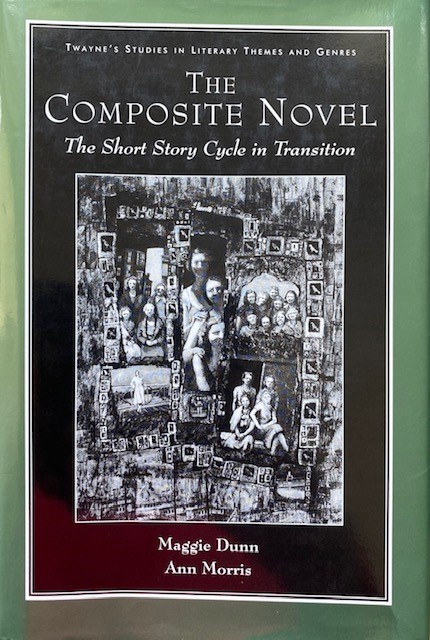
The short stories in Industrial Roots can stand autonomously – indeed, several were published as single pieces – but, taken together, they achieve a coherent whole. Canadian writer Lisa Pike harnesses the potential of this literary form, which is often referred to by different labels (not all synonymous[1]), such as: integrated short-story collection, short-story cycle, inter-related stories, composite novel. Examples include Eudora Welty’s The Golden Apples, William Faulkner’s Go Down, Moses and Alice Munro’s Who Do You Think You Are? / The Beggar Maid.
The author gives us a choral narration, through which we encounter repeatedly some of the characters at different points in their existence, filtered through various consciousnesses: their own and those of mothers, daughters, grand-daughters, nieces, and cousins, so that they acquire increasing depth and complexity. Their lives are linked by place and patterns of experience, starting with that of unhappy marriages to men who drink, gamble, and are violent towards their wives and children. ‘Some women took to drinking themselves, you know, to cope.’ Intergenerational trauma haunts the living: the first ‘Stella’ in the family was a little girl shot dead in 1920, in a pogrom during the Polish-Soviet War. She and other ancestors live on in the present, with ‘each branch of the family having at least two or three Stellas, Walters and Wandas among them.’
Roots grow deep, spread, and interlace; some surface, and become visible through oral and embodied memory. So, one of the characters drizzles North American dressings onto salads, but also makes pierogi the old-fashioned way her mother and grandmother taught her. She is a repository of the family’s history, one ‘who knew the stories. The one who bothered to hear them and remember them, fix them in her mind the same way the old woman [her grandmother] had them fixed in hers’. Cancer takes away several family members, including one who does not tell her colleagues she’s ill, because ‘They’re going to say: ‘See! And she was such a health nut! Just goes to show you!’ as if getting cancer were her fault, punishment for thinking she was so great, eating healthy and exercising and all.’ Funerals become occasions to grieve, make peace with, reflect on, and – in one case – even meet, relations for the first time.
Some in the younger generation seek to escape the pull of their industrial roots through education, but they grow disillusioned. One of them, debt-laden, recalls Chomsky’s ‘call for change, resistance’ during her university days and concludes she’s living ‘the pragmatics of his prophecy,’ ‘the wearing down of the intellectual, of those people who saw the bigger picture of things, […] how PhDs were now living on food stamps.’ Another earns more by writing essays for students than from her precarious post as a lecturer. She sees the higher-education system operating like an industry and treating her like a mere productive resource. Her outbursts against it, ‘ad-libbing about things like the psychology of advertising, the dismantling of the welfare state […]’], fall on students’ uncomprehending ears.
The book raises questions about numerous aspects of family connectedness. How does family impact us? How do we show care? Do we ever know those near us as well as we believe? Another major theme is mortality – and therefore the sense of a life’s meaning and purpose. ‘A death every few years. Coming to a certain point in life when you realise a funeral could arrive at any moment and it’s just better to have a designated outfit, there, hanging at the back of the closet, ready to go. […] You may as well pick out the outfit you want to be buried in, along with a photo […] A sense of hope for the family, the picture letting them believe that life had been good and happy and worthwhile.’ The quote which precedes the book seems doubly significant: it’s from Faulkner’s ‘As I Lay Dying’, which also handled these themes, while his ‘Go Down, Moses’ broke new ground in this literary form.
Lisa Pike’s characters and sense of place linger in the mind. Separate voices distinguish the protagonists, through their narration and dialogues across different tones and registers. Their environments and possessions are used to delineate them, their relationships, and circumstances with gripping specificity. So, a woman’s perception of her grandmother’s wish to leave a chipped platter to another granddaughter is quietly heart-breaking: ‘Wanda (daughter), of all people, did not deserve the worn, discoloured, beautiful, rose-patterned platter with the two deep chips on the right-hand side.’
Lisa Pike’s love of, and playfulness with, language enables her to pull off this ambitious work. She was awarded the Canada Council for the Arts Grant and received support from the Ontario Arts Council and the Banff Centre for Arts and Creativity to complete the book. All credit to Heloïse Press for bringing this Canadian author and Industrial Roots to readers’ attention.
Industrial Roots is published on 11 April 2023.
[1] Dunn, M., Morris, A. (1995). The Composite Novel – The Short Story Cycle in Transition. New York : Twayne, Macmillan Publishing
So, what to consider when reviewing a work of fiction? Here are my top ten tips.
Begin with a gripping line or paragraph which conveys your overall opinion. It could be phrased as (a) a statement or (b) a question. As an alternative, you could begin with (c) a quote from the book which encapsulates its themes. An example of each:
The title says it all: smoking kills – though in the case of this novel, the victim is not the smoker but those he kills (‘and not through passive smoking,’ he clarifies) in order to enjoy the pleasures of a cigarette. We’re firmly in humour noir territory: the book’s incisive, satirical take on modern-day life offers a succession of laugh-out-loud moments.[1]
What might drive a left-wing intellectual to espouse xenophobic views and defend the indefensible? How might the community around him react? How would you react if he were your father? In Autopsy of a Father, Pascale Kramer poses uncomfortable questions and tests your tolerance of disquiet.[2]
‘“Fate,” said Arthur. “The capital letter F. But chance is a powerful force, and suddenly you acquire a Fate that was never assigned to you. Some kind of accidental fate. It happens in a flash.”’[3]
Give us a reason why we should read the book / why it should spark our curiosity
E.g.: One of the most original novels I’ve read in a long time, The Core of the Sun is set in an alternative present – in the “Eusistocratic Republic of Finland”.[4]
In your plot summary, tell us about the protagonist(s)’ approach to the key issue/conflict/mystery
E.g.: Caterina’s process of reconstruction involves acquiring that part of herself which she left to her twin. […] But as she learns to take care of their elderly mother, of Olivia’s son and of a young neighbour who has lost her little girl, she understands that it was too simple for her and others to rely on Olivia.[5]
What questions does the story raise?
Does it interrogate and challenge any stereotypes? Or the opposite?
Does it prompt us to read relevant books?
An example of questions raised: Raimo leaves readers to judge: was there any love at all on his part, or only desire, fetishism, possession and the drive to dominate, self-justified with theword ‘love’? Can any of these ever coexist with love, or do they often taint it, but only to hardly perceptible and therefore unrecognised degrees?[6]
Tell us how the book makes you feel
What, if anything, will move us? Or amuse us, etc?
What causes that response? It could be an episode, or the language, or…
E.g.: It would be incorrect to infer too much neatness from the symmetries in the book’s structure. The subtle play of balance and counterbalance constantly engages the reader, while offering a reassuring framework to explore the chaos of complex issues with no easy answers.[7]
What might this book add to readers’ lives?
E.g.: ‘A Whole Life’ attests to the enduring value of just this kind of ‘lightness’ – a lightness of touch which offsets the depth of Robert Seethaler’s themes, distilling them into thoughts and images that linger in the reader’smind.[8]
Select your quotes carefully
The ones you choose should illustrate your points
Try to find one or two that are representative of the book as a whole
E.g.: He possesses the ability to capture the joy of the earth warmed by the sun under his “night-damp feet”, the wood which “had stored the warmth of the last days of summer and smelled of dry moss and resin”, and the coolness of a flat rock on which he lies down.[9]
Analyse the author’s (and the translator’s, if it’s a foreign work in English) treatment of the most relevant elements of writing, such as:
individuality of voice (style, language…)
characterisation
sense of place
structure
E.g.:
The writing alternates wit and humour with darkness and melancholy, dramatic tension with aphorisms, the real with the surreal, poignant observation with optimism. The rhythm of the prose is thus pleasantly engaging, and the plot suspenseful – not least due to some ethically questionable choices on the protagonist’s part – but more compelling still is the development of the themes over the story’s arc. Antoine Laurain succeeds in creating a first-person narrator who is whimsically and yet realistically unaware of the full depth of his unhappiness until he has distanced himself from it.[10]
Authors of intimate stories that reflect the course of a country’s historical fortunes face a challenge: to create fictional protagonists we’ll care about without their writerly imagination being clipped by the magnitude and details of nationally significant events. Aareleid deftly overcomes that challenge, giving us believable human beings through the eyes of…[11]
You can mention relevant novels or short stories by other writers
E.g.: The themes may bring to mind Margaret Atwood’s The Handmaid’s Tale, but it would be a disservice to both authors to insist on comparisons.[12]
Ensure your review’s ending addresses your central idea
E.g.: This is a book which challenges you to work hard and amply rewards you for it: a gripping read in its own right, and fiction that enhances our engagement with the world we inhabit.[13]
It’s a pleasure to reblog, below, the Women Writers Network’s Favourite Reads of 2018. They’re recommendations of books authored by women, chosen by WWN founder members among the ones read in 2018. They’ve been collated and beautifully put together by our fellow network member Helen Taylor, author of “The Backstreets of Purgatory”. Thank you, Helen!
My thanks to Tiziana Sforza for her extensive coverage of That Summer in Puglia in her article for Radici Future Magazine. She includes intriguing facts about tourism and foreign property investment in Puglia and a discussion of books which offer insights into this beautiful Southern Italian region. Click here to read.
Un sincero grazie a Tiziana Sforza per la bella segnalazione di That Summer in Puglia nel suo articolo per Radici Future Magazine. Cliccare qui per leggere l’articolo.










 Valeria Vescina