‘Medieval Women: In Their Own Words’ – a British Library exhibition

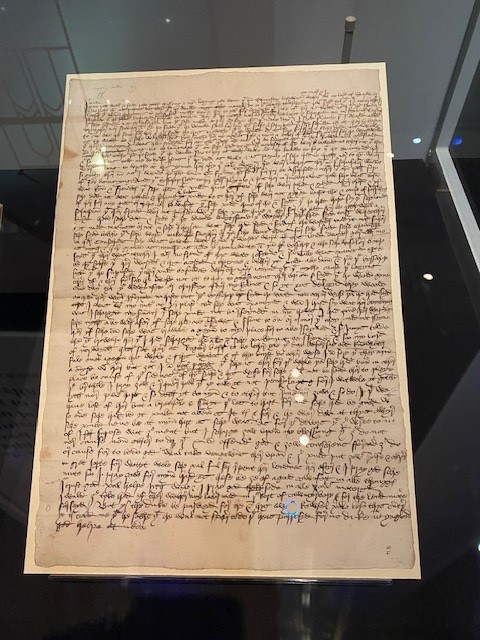
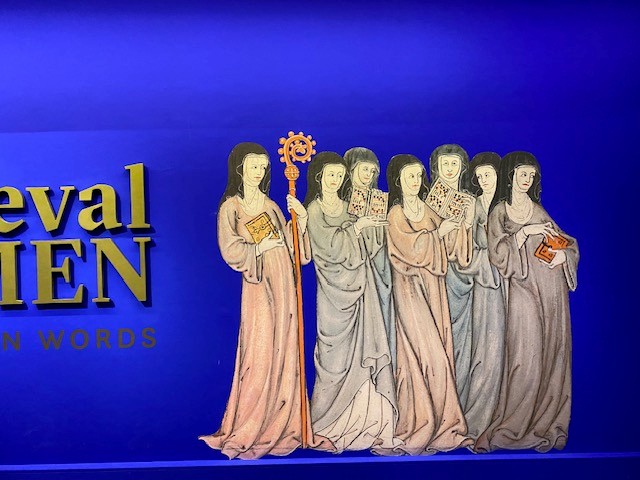
Whether you live in London or plan to visit, do not miss the ‘Medieval Women’ exhibition at the British Library. It has generated a phenomenal response, in terms of both praise and visitor numbers, and for good reason. The priceless documents on display offer a rare opportunity to view in one place the evidence of two long-term trends: the deep historical roots of women’s social and legal status; and women’s efforts to exercise agency despite them.

Some of the documents relate to famous figures: a letter signed by Joan of Arc, requesting munitions; the manuscripts of Julian of Norwich’s ‘Revelations of Divine Love’ and of Margery Kempe’s eponymous book; Christine de Pizan’s illuminated ‘Book of the City of Ladies’… The list is spectacular, but the context and detail provided by the items is what makes the whole an unmissable event – it’s not often that you get to ‘hear’ the words of ordinary women. The exhibits include books of treatments for women by women, texts on herbal cures and obstetrics manuals used by female practitioners, a petition by a female slave who refuses to be sold, embroidery and illuminated manuscripts signed by nuns, a woman’s treatise arguing that husbands and wives should enjoy equal rights, the first book printed by a woman… but also, a daughter disowned for marrying a family servant, nuns destined to the cloister since childhood, a queen who fends off male relatives’ attempts to dethrone her, the view of the female body as defective and disease-prone, the prayers to St Margaret for protection during childbirth, records showing women being paid less than men for the same work…
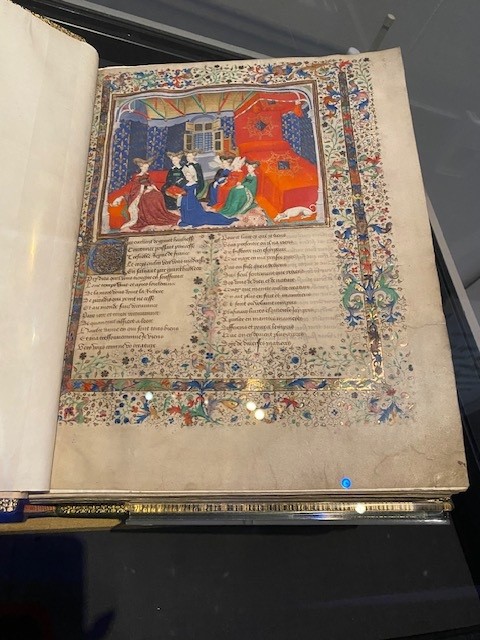
Through their selection of the items (around one hundred and forty), the curators have conjured a mosaic of medieval lives that is not only fascinating, but also offers insights into our own times, when women’s hard-won rights are coming under threat. As the curators explain: ‘Break free from traditional narratives and […] discover stories familiar to women today, from the gender pay gap and harmful stereotypes, to access to healthcare and education, as well as challenges faced by female leaders. Hear the words of medieval women from across the centuries, speaking powerfully for the thousands whose voices have not survived.’1

This sentiment of giving a voice to the unheard spurred my long quest to inhabit the forgotten lives of a group of Southern Italian women from a different era: sixteenth-century nuns. My second novel, which I’ve just completed, is inspired by their remarkable true story. For me, the catalyst was a set of archival documents penned in iron-gall ink: they spoke to enduring issues of power, control, and female resistance. I hope the book will quickly find a publisher, so that my characters may move readers as deeply as the terror, dilemmas, and resilience of the women I encountered in those archival documents moved me. Certain objects in the exhibition – manuscripts copied by scholarly nuns, a cellaress’s notes that probably stay quiet about the politics she often had to navigate, embroidery, a written protest against restrictions on what women could wear, a letter showing the risks of ‘marrying beneath oneself’ – touched me particularly, as they evoked some of my characters and their situations.

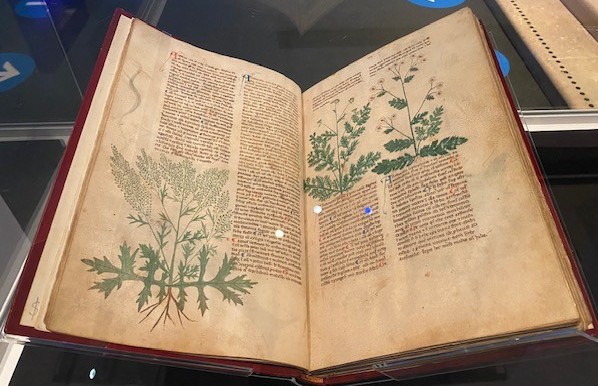
Below, some manuscripts originating in Southern Italy and displayed in the exhibition: Tractatus de herbis (‘Treatise on Herbs’, Southern Italy, c. 1300); De Curis Mulierum (‘Treatments for Women’, in a 13th-century manuscript from England) by Trota, a 12th-century female physician at the medical school of Salerno; and De Ornatu Mulierum (‘On Women’s Cosmetics’, England or France, 13th century, from the original Southern Italian 12th-century compilation), another text forming part of the Trotula.
The ‘Medieval Women’ exhibition runs until 2 March 2025. Learn more here. To book tickets, click here.

Valeria Vescina is a novelist, reviewer, creative-writing tutor, and literary director of an arts festival. She is a graduate of the Goldsmiths MA in Creative & Life Writing. Born in Southern Italy, she studied and lived in the UK most of her life, before settling in Switzerland.

CREDITS

1 Source: https://medievalwomen.seetickets.com/timeslots/filter/medieval-women-in-their-own-words

Images: author’s own photos of the exhibition.
Italian, English, or both?

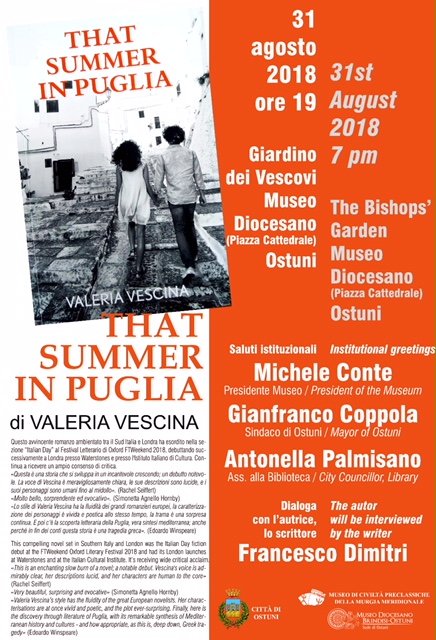
Publicity material for the talk - from the City of Ostuni

The City of Ostuni, where That Summer in Puglia is set, will host a presentation of the novel on the 31st of August in the magical surroundings of The Bishops’ Garden (Il Giardino dei Vescovi) of the Diocese’s Museum (Museo Diocesano).

Several things make this talk special for me: it feels as if my fictional protagonist, Tommaso, has ‘come home’; the venue opens onto the square through which he and his great love, Anna, ‘walk’ and where they ‘sit’ on the steps of the historic Cathedral; I’ve known and loved Ostuni all my life; and… the talk will be in English and Italian, something made possible by my wonderful interviewer, fellow-author Francesco Dimitri (To Read Aloud and The Book of Hidden Things, which is also set in Puglia), another Apulian living in the UK.

What could be more appropriate for this book than a bilingual presentation in Ostuni? A work of fiction written in English (my literary mother-tongue) and set in London and Puglia by a dual-nationality author will be discussed with an Italian- and an English-speaking public. I was so pleased that the Mayor, his team and the President of the Museo Diocesano were keen to organise an event of potential interest to the sizeable Anglophone local community.

Past and future presentations of the book include some with a notably bicultural angle: That Summer in Puglia had its debut at the FT Weekend Oxford Literary Festival on Italian Day, which showcases Italian literature and culture; the Italian Cultural Institute in London hosted a discussion focused on the cross-cultural aspects of the novel and of the writing process; and one of my upcoming talks – for the Book to the Future Festival at the University of Birmingham – will be specifically on multilingualism and multiculturalism with reference to That Summer in Puglia.

During the Q&A at the talks, I’m often asked whether I feel Italian or British. The question is valid and the answer is that for me it’s not an “either/or” but an “and”: I am both Italian and British, and more broadly European.

Acknowledgments:

Image of publicity material: courtesy of the Comune di Ostuni.

Special thanks to the Comune di Ostuni’s Press Officer, Paola Loparco, and to the Director of the Library, Francesca Garziano.

That Summer in Puglia – review in Radici Future Magazine

My thanks to Tiziana Sforza for her extensive coverage of That Summer in Puglia in her article for Radici Future Magazine. She includes intriguing facts about tourism and foreign property investment in Puglia and a discussion of books which offer insights into this beautiful Southern Italian region. Click here to read.

Un sincero grazie a Tiziana Sforza per la bella segnalazione di That Summer in Puglia nel suo articolo per Radici Future Magazine. Cliccare qui per leggere l’articolo.

Headline from Radici Future Magazine

Ostuni - view of the coast from the town walls - V. Vescina ©2017


Image credits:

Headline: from Radici Future Magazine.

View of the sea from Ostuni: ©2017 Valeria Vescina.

That Summer in Puglia – views from the blog tour

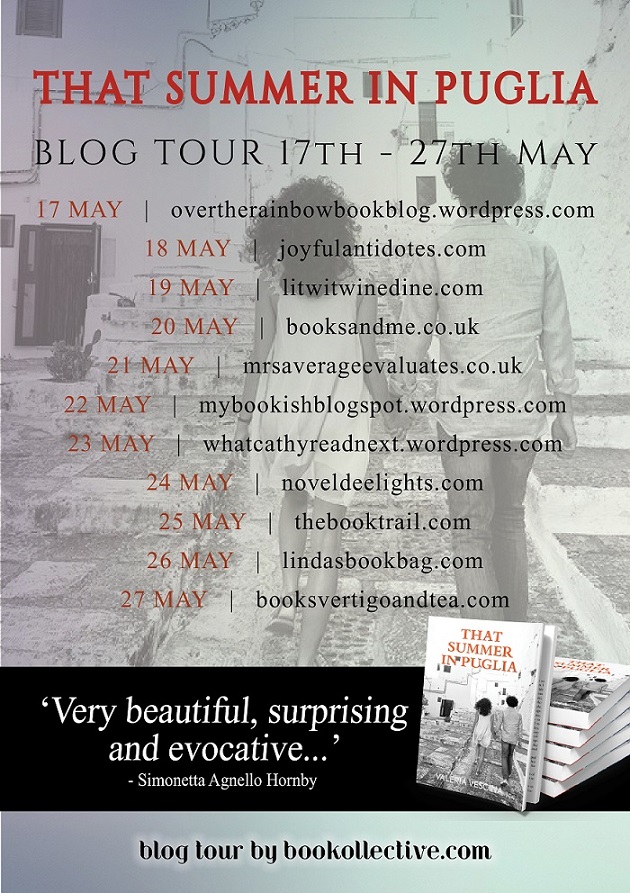
That Summer in Puglia blog tour

What a delight the blog tour of That Summer in Puglia has been! All authors are a little apprehensive about how their book will be received, and I was no exception: ‘Will the reviewers like my novel?’ ‘Will they care for the aspects which I care most deeply about?’ ‘Will the characters and the places transport them…?’  The answers, happily, were yes, yes, yes…

I’m grateful to those who hosted a stop on the tour and to their fellow bloggers who made the reviews travel far and fast. Literary bloggers give freely of their time. No-one can mandate their emotional engagement or their final verdict. Their chief motivation? Love of reading, writing, learning and sharing. I’d like to thank them by selecting extracts from their reviews. But first, my thanks to Aimee Coveney and Helen McCusker of Bookollective for organising the tour and to Eyewear for publishing the book.

I hope the quotes from the tour will give you a flavour of the novel. You can read additional reviews here.


Jo Park kicked off on 17 May by hosting an extract from That Summer in Puglia on her Over the Rainbow Book Blog. A stop with a different blogger followed each day until 27 May.

Joy Corkery, Joyful Antidotes

“I have an absolutely great recommendation for you today, one that will melt your heart. […] This is a stunningly beautiful story, made even more wonderful by having Tommaso as the narrator. […] I cried, I rejoiced, I held my breath – and they are just some of the ways That Summer in Puglia hit me.”

Ann Marie Palladino, NYC-based Lit Wit Wine Dine

“Valeria Vescina writes beautifully. She creates an unbelievable sense of atmosphere and nostalgia. Her depictions of the landscape and architecture of Puglia have made me want to visit this region I’d heard little of but am now slightly obsessed with. […]

What I loved most about this book was that it was a very emotional read. Yes, it’s a love story but it’s so much more than a love story. It’s a reminder of how things can go so very wrong when we try so very hard to do right by those we love. It’s about communication and miscommunication and redemption. It’s about the expectations we have of our parents and those we have of our children. It’s about how we differ in our reactions to anger and grief. I could go on and on. In short, it’s about all of the things that make us fragile, vulnerable, human… […] A perfect book club choice. This book is an impressive debut and I’d certainly love to read more books by Valeria Vescina in the future.”

Karen Mace, Books and Me!

“I found this to be a totally absorbing debut and loved spending time with the character Tommaso as he recounted the story of his life and loves to a PI who has tracked him down 30 years later. […] The attention to detail was exquisite and the sights and sounds are brought vividly to life through the pages. It had a lovely gentle feel to it throughout and I can’t wait to read more from this author in the future.”  

Claire Lyons, Mrs. Average Evaluates

This review is in video form.

“So carefully written and incredibly evocative… A very passionate book… Shakespearean mix-ups and misunderstandings and lack of communication…

…And it’s about youth, and about parenting, and about loss… It’s a super book. I’d love you to read this. It’s a beautiful, beautiful book.”

Amanda Duncan, My Bookish Blog Spot

“It was Tommaso that stole my heart…  Vescina’s writing is brimming full of emotion and tenderness.

The vibrancy of the town square, the winding backstreets, and Tommaso’s villa and its gardens, conjured up such vivid and vibrant images. I could almost smell the flowers in the beautiful gardens and my mouth watered at the descriptions of the amazing food cooked by Concetta. The whole setting was beautifully atmospheric and so befitting of this amazing love story…

I loved this novel. It had everything you want in a love story. It had passion, betrayal, grief, and loss but most of all it was about the capacity we have in all of us to forgive, to make amends and make the best of what life has to offer. […] A sumptuous, evocative and totally enthralling novel… It is just beautiful.”

Cathy Johnson, What Cathy Read Next

“As intense as the heat of an Italian summer. […] As Tommaso and Anna roam the maze of narrow streets that make up the Old Town of Ostuni, taking delight in small things and shared places, there are beautiful descriptions of the ancient town, full of light and shade.

That Summer in Puglia provides a devastating portrait of how love can, in a moment, turn to hate if fuelled by insecurity, jealousy and an inability to trust.  And how what often follows just as quickly is regret, guilt, despair and hopelessness. It also shows how a single action, even if done for what is thought are the right reasons, can have unintended and long-lasting consequences, but that sometimes there may be the opportunity to make reparation. The emotional power of Tommaso’s story and the effortless, flowing writing of Valeria Vescina are what will stay with me about That Summer in Puglia.”  

Eva Merckx, Novel Deelights

“The beautiful descriptions transported me straight there, from the olive trees to the scent of the flowers. […] At its heart, That Summer in Puglia is a love story but it’s so much more than that. It’s a relatable character study full of complexities that oozes atmosphere.

Hindsight is a wonderful thing. The way we react to certain things in the heat of the moment can have a huge effect. It isn’t until later on, that we maybe think “I could have” or “I shouldn’t have”. As a nineteen year old boy, Tommaso makes some dubious decisions… Did he make the right choices? That’s up to you to find out when you read this novel.

With beautiful descriptions and well-developed rich characters, Valeria Vescina takes us on a moving journey through Tommaso’s life. That Summer in Puglia is a brilliantly written, poignant, thought-provoking character-driven story about young love, loss, grief, family and second chances. An absolutely wonderful debut.”

Susan Heads, The Book Trail

“It’s a tale touched with sadness and poignancy, tragedy and loss but also one of self-discovery and second chances…  At first sight, it’s a simple tale of boy meets girl, but pull back those layers and it’s so much more – Puglia plays its role in being a mix of old and new, white architecture and old town – mixing two worlds which seem separate but which on closer inspection are very similar. The writing was very lyrical, like an ode to a time gone by, a memory – and of course this story is told by the one person who can tell it all as it happened, or at least how he thinks it all took place…”

The Book Trail also features an interview with me on its Authors on Location section. They’re creating an online guide to the real-life places in the novel, too.

Linda Hill, Linda’s Book Bag

“Today I’m delighted to be celebrating That Summer in Puglia by bringing you an interview with Valeria…” 

Interview topics include: the perfect reader of That Summer in Puglia, books I’m reading, my writing habits, creative inspiration and future plans.

Danielle Nolan’s Books, Vertigo & Tea was the final stop on the tour, which it fittingly closed the way it had begun: with another extract from the novel.

I love hearing from readers, so do contact me with your personal responses to That Summer in Puglia. The Q&A section of my website contains resources for anyone curious to gain more insight into it.

The novel is available in bookshops throughout the UK, as well as online from Amazon and others in the UK and abroad.


Image credits:

Blog tour banner – courtesy of Bookollective

Photo with Rosie Goldsmith at Italian Cultural Institute launch of That Summer in Puglia – courtesy of Rosie Goldsmith

All other images – all rights reserved.

Review of That Summer in Puglia on Novel Deelights

“With beautiful descriptions and well-developed rich characters, Valeria Vescina takes us on a moving journey through Tommaso’s life. That Summer in Puglia is a brilliantly written, poignant, thought-provoking character-driven story about young love, loss, grief, family and second chances. An absolutely wonderful debut.”

Thank you, Eva Merckx, for your amazing review of That Summer in Puglia!

Oxford Literary Festival debut of ‘That Summer in Puglia’

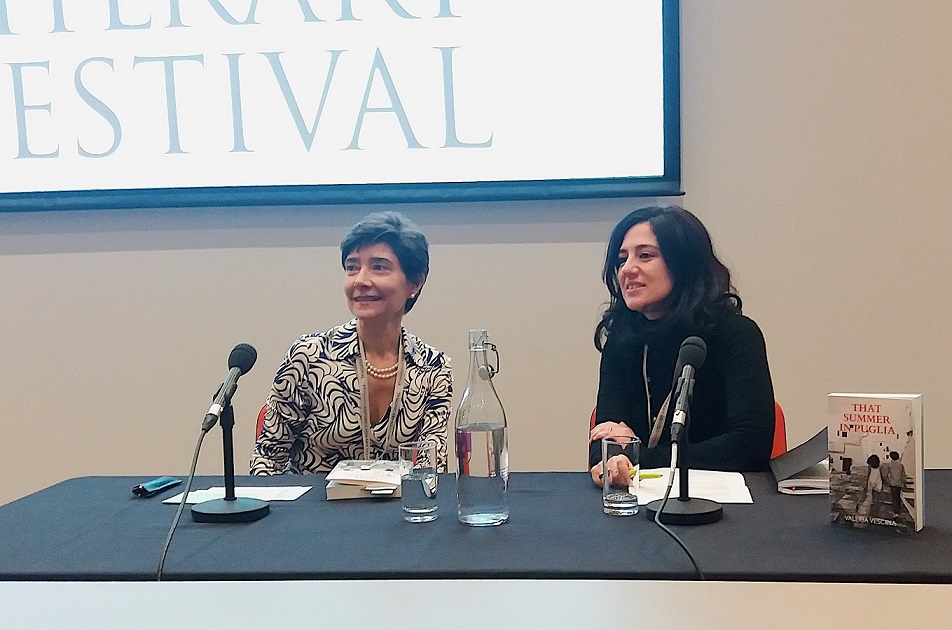
Valeria Vescina and Teresa Franco
Author Valeria Vescina and interviewer Teresa Franco

That Summer in Puglia had its debut at the FT Weekend Oxford Literary Festival on 23 March. This was Italian Day, when the Festival – in co-operation with the Embassy of Italy and the Italian Cultural Institute – annually showcases Italian culture. My interviewer at St. Cross College was University of Oxford academic and Il Sole 24 Ore Arts & Culture contributor Teresa Franco – sensitive, knowledgeable and insightful. We were introduced by poet Todd Swift, Director of Eyewear Publishing. The audience was large, warm and engaging.

The day closed with a memorable Italian Gala Dinner at Lincoln College, hosted by the Director of the Festival, the College Rector and the Italian Embassy. The latter was represented by Minister Counselor Vincenzo Celeste and Head of Culture Federico Bianchi, both of whom had attended the launch of That Summer in Puglia, an honour for which I’m grateful. The Gala Dinner menu was devised by acclaimed chef and cookery writer Eleonora Galasso.

I wrote That Summer in Puglia in English, my literary mother tongue, but the story is set mostly in Puglia (southern Italy), where I was born and grew up. I was educated in Switzerland and the UK, and today live and work in London, but I’ve spent the holidays with family in my native region every year.

Puglia offered an ideal setting: its visible layers of history are integral to the story, a man’s excavation of his past. The region’s distinctive culture provided a framework for testing the characters and exploring the main themes: the role of all forms of love in human life; and the relationship between love and virtue.

I also hope the novel will help readers discover the cultural richness and variety within Southern Italy, by immersing them in an authentically Apulian atmosphere. In Puglia, traces of the past surface in unexpected ways: from the art of its early, Hellenised Illyrian settlers, to Byzantine paintings, Norman churches, and the palaces and fortifications built under the Anjou, the Aragonese, the Venetians and the Spanish. The region’s cuisine and inhabitants bear living testimony to the passage of all these cultures.

The moment of That Summer in Puglia’s debut is also one of gratitude for and to all those who have sustained me throughout the process of writing the novel: family, friends, colleagues, teachers… and the authors and publisher who have encouraged and championed my work. To you all, my deepest thanks. A book about the importance of all forms of love would not have been possible without you.

Press enquiries: please email publicist Helen McCusker, Booked PR (tel: +44 (0) 7951 078388), or you may contact me here.

Foreign rights enquiries: please contact Eyewear Publishing.


Image credits:

Julia Warszewski, all rights reserved.