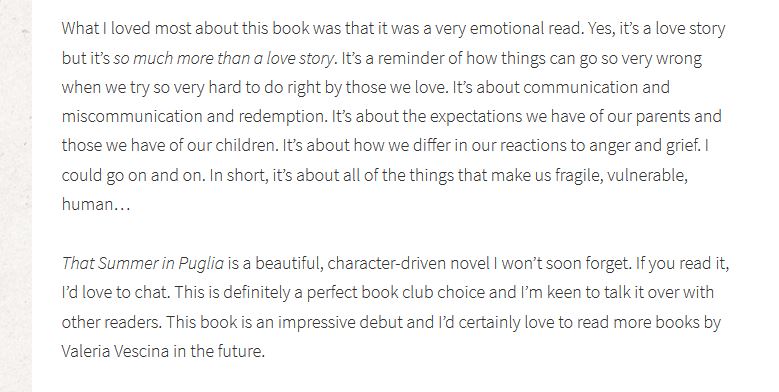
“As you can probably guess from my gushing review, I loved this novel. It had everything you want in a love story… but most of all, it was about the capacity we have in all of us to forgive, to make amends and make the best of what life has to offer. If you want a sumptuous, evocative and totally enthralling novel… then it has to be That Summer In Puglia. It is just beautiful.”
Thank you, Amanda Duncan, for your powerful words.
That Summer in Puglia by Valeria Vescina Eyewear Publishing March 1st 2018
Tommaso has escaped discovery for thirty years but a young private investigator, Will, has tracked him down. Tommaso asks him to pretend never to have found him. To persuade Will, Tommaso recounts the story of his life and his great love. In the process, he comes to recognise his true role in the events which unfolded, and the legacy of unresolved grief. Now he’s being presented with a second chance – but is he ready to pay the price it exacts? That Summer In Puglia is a tale of love, loss, the perils of self-deception and the power of compassion. Puglia offers an ideal setting: its layers of history are integral to the story, itself an excavation of a man’s past; Tommaso’s increasingly vivid memories of its sensuous colours, aromas and tastes, and of how it felt…
Today I had the wonderful surprise of a review of That Summer in Puglia by video. It comes from the fabulous literary blogger Claire Lyons and you can watch it on her website, Mrs. Average Evaluates, by clicking here.
Some excerpts from the video-review of the novel:
“So carefully written and incredibly evocative.”
“A very passionate book.”
“Shakespearean mix-ups and misunderstandings and lack of communication…”
“…and it’s about youth, and about parenting, and about loss… It’s a super book.”
“I’d love you to read this. It’s a beautiful, beautiful book.”
I’m grateful to Claire Lyons for her warm, powerful words.
A beautiful review of That Summer in Puglia. My thanks to reviewer Ann Marie of NYC-based Lit Wit Wine Dine for communicating with such clarity and warmth her perceptive reading of the novel.
Below are images of short extracts of the review. I encourage you to click here to access the full article on this excellent literary blog site.
“I found this to be a totally absorbing debut and loved spending time with the character Tommaso.”
Thank you, Karen Mace, for your warm recommendation of That Summer in Puglia.
Fiction. Tommaso has escaped discovery for thirty years but a young private investigator, Will, has tracked him down. Tommaso asks him to pretend never to have found him. To persuade Will, Tommaso recounts the story of his life and his great love. In the process, he comes to recognise his true role in the events which unfolded, and the legacy of unresolved grief. Now he’s being presented with a second chance – but is he ready to pay the price it exacts? THAT SUMMER IN PUGLIA is a tale of love, loss, the perils of self-deception and the power of compassion. Puglia offers an ideal setting: its layers of history are integral to the story, itself an excavation of a man’s past; Tommaso’s increasingly vivid memories of its sensuous colours, aromas and tastes, and of how it felt to love and be loved, eventually transform the discomforting…
“This is a stunningly beautiful story, made even more wonderful by having Tommaso as the narrator. […] I cried, I rejoiced, I held my breath – and they are just some of the ways That Summer in Puglia hit me.”
Thank you, Joy Corkery, for your beautiful review of That Summer in Puglia on Joyful Antidotes.
Do you know what every summer needs? A bit of romance. In the form of a book, of course. I have an absolutely great recommendation for you today, one that will melt your heart.
That Summer in Puglia by Valeria Vescina is narrated by Tomasso who has been located by a private investigator thirty years after leaving Puglia. Tomasso asks PI Will to pretend he never found him, which prompts Tomasso to recount his life story, including that one fateful summer that led to a great love and a great loss.
This is a stunningly beautiful story, made even more wonderful by having Tomasso as the narrator. The parts where he speaks to PI Will directly make Tomasso so real and ultimately set him up as a likeable character, a character whom the reader worries about and wants the best for. There are other characters in this book but none…
A description and an extract of “That Summer in Puglia” on the “Over The Rainbow Book Blog” today. My thanks to Jo Park for kicking off the Bookollective blog tour!
Tommaso has escaped discovery for thirty years but a young private investigator, Will, has tracked him down. Tommaso asks him to pretend never to have found him. To persuade Will, Tommaso recounts the story of his life and his great love. In the process, he comes to recognise his true role in the events which unfolded, and the legacy of unresolved grief. Now he’s being presented with a second chance – but is he ready to pay the price it exacts? That Summer In Puglia is a tale of love, loss, the perils of self-deception and the power of compassion. Puglia offers an ideal setting: its layers of history are integral to the story, itself an excavation of a man’s past; Tommaso’s increasingly vivid memories of its sensuous colours, aromas and tastes, and of how it felt to love and be loved, eventually transform the discomforting tone with…
In April, the European Literature Network published The Baltics Riveter, a compendium of writing about contemporary fiction from Estonia, Latvia and Lithuania. Publication coincided with this year’s country focus on the Baltics at London Book Fair, where the magazine was widely distributed and enthusiastically received. It contains historical notes, reviews and extracts of some very exciting literature.
The Baltics Riveter is now available also in digital form here. This is the fourth of the European Literature Network’s Riveters. The first was devoted to literature from Poland, on the occasion of the 2017 London Book Fair’s Polish focus. The second, on literature from Russia, coincided with ELNet’s Russian events at the British Library. In The Nordic Riveter of October 2017, five countries were represented: Sweden, Norway, Denmark, Finland and Iceland.
I normally review English-language editions of novels originally written in Italian, German and French, the languages and cultures I grew up with. But the editor of The Riveter asked whether I might review Estonian author Kai Aareleid’s Burning Cities, translated by Adam Cullen (Peter Owen Publishers, 2018). I’m very grateful for the suggestion: the novel weaves a powerful domestic tale within the larger tapestry of seven decades of Estonian history; most of the story unfolds in the years during which the country was part of the Soviet Union. You can find my article on pp. 58 and 59 of the magazine, or here. I hope it will encourage you to discover Kai Aareleid’s work and more of the riveting literature from the region.
Image credits:
Images courtesy of The European Literature Network.
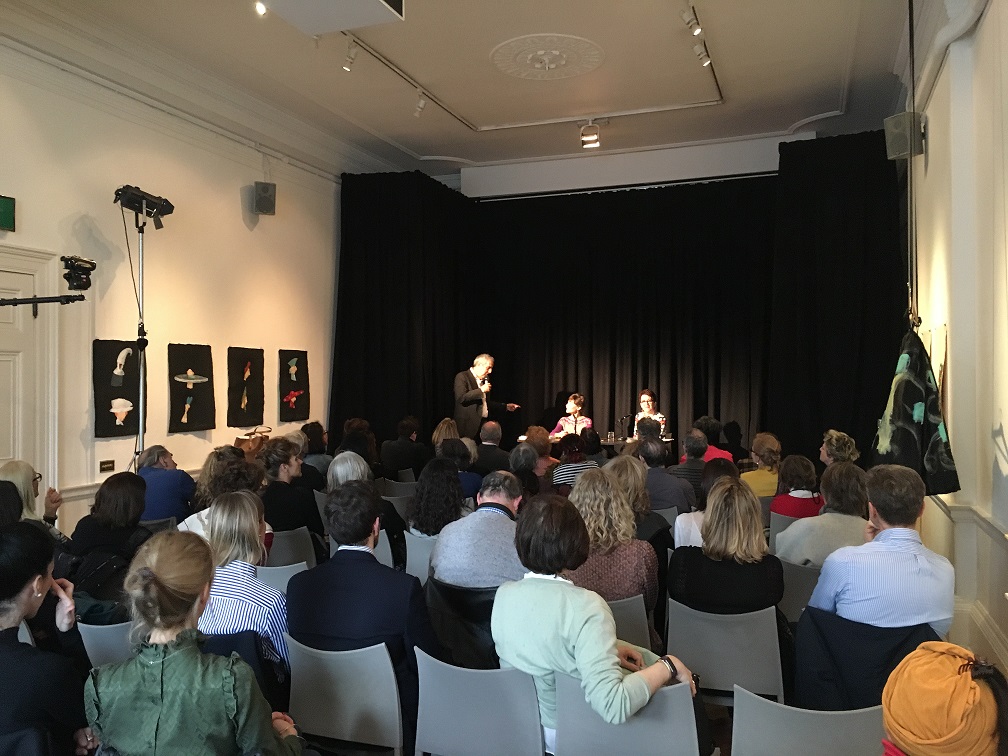
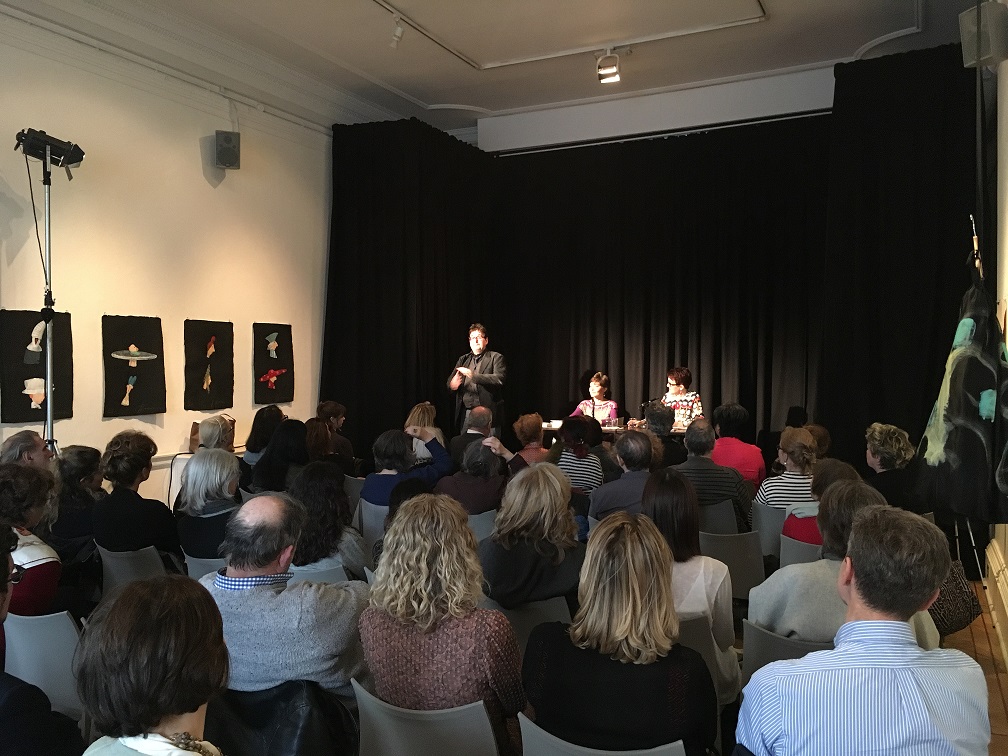
A presentation of That Summer in Puglia took place on 16 April in the elegant surroundings of the Italian Cultural Institute in Belgrave Square. The Institute is a governmental organisation dedicated to promoting knowledge of Italy’s language and culture and to encouraging cultural and scientific collaboration with England and Wales.
My interviewer was Rosie Goldsmith, the acclaimed journalist, presenter, literary critic, Chair of the EBRD Prize, and much more! I’m so grateful to Rosie for her perceptive, engaged and knowledgeable questions.
Our discussion was introduced by Marco Delogu, Director of the Institute, under whose stewardship the organisation has hosted an exciting line-up of events across the arts and sciences. Check out the Institute’s rich schedule of forthcoming and past events here. Guests on the Literature side of the programme have included Roberto Calasso, Sandro Veronesi, Domenico Starnone, Ali Smith, Elif Shafak, Ben Okri, Jhumpa Lahiri… to name but a few.
Todd Swift, Director of Eyewear Publishing, spoke briefly about That Summer in Puglia before leaving Rosie and me to discuss the book in detail. Our conversation touched on plot, characters, setting, themes and structure, but also on aspects of various literary traditions (English, yes, but also Italian, German and French) which have flowed into it because of my personal history.
Marco Delogu’s introductionTodd Swift’s introduction
Many of the questions from the public were focused on the cross-cultural aspects of the novel and on the writing process: why had Puglia inspired me? Why is it an ideal setting for this particular story? Where does my detailed knowledge of Ostuni stem from? Which language do I consider to be my “mother tongue” and why? Having grown up in various countries, what are my views on cultural identity? How long did it take me to develop the plot, and how did I go about it?
Meeting people after the talk was a real joy. It was lovely to discover the variety of emotional resonances the book has for different people. I had been prepared for the fact that each reader will respond to certain aspects of a story more than to others, but I hadn’t expected how warmly people would share profound reflections and anecdotes from their lives. I’m very grateful to them.
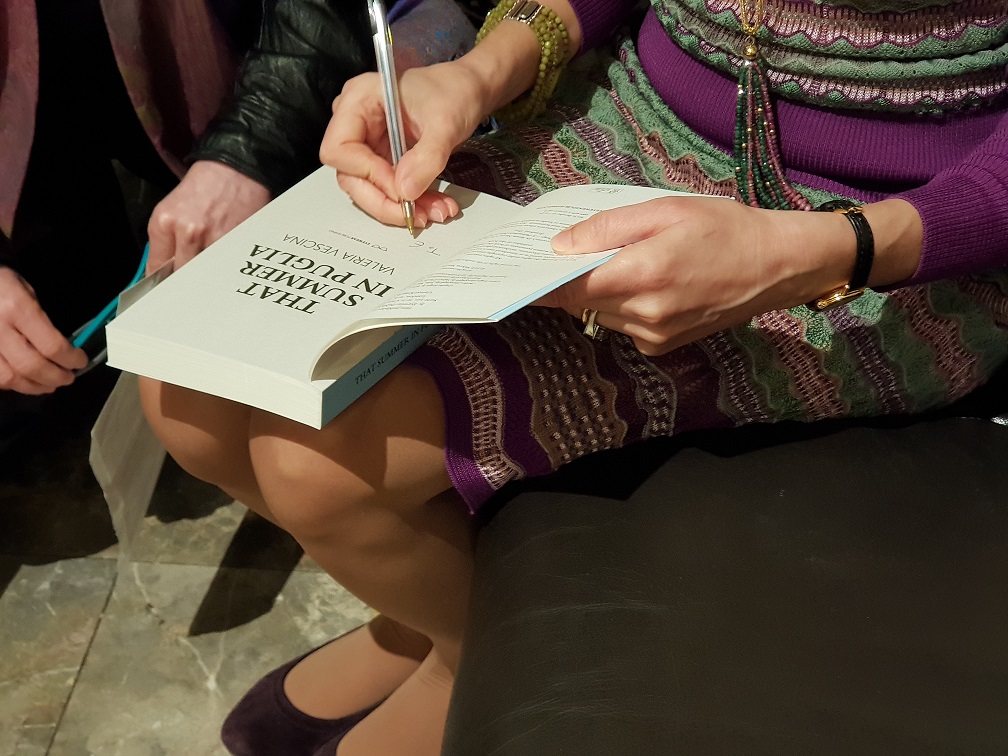
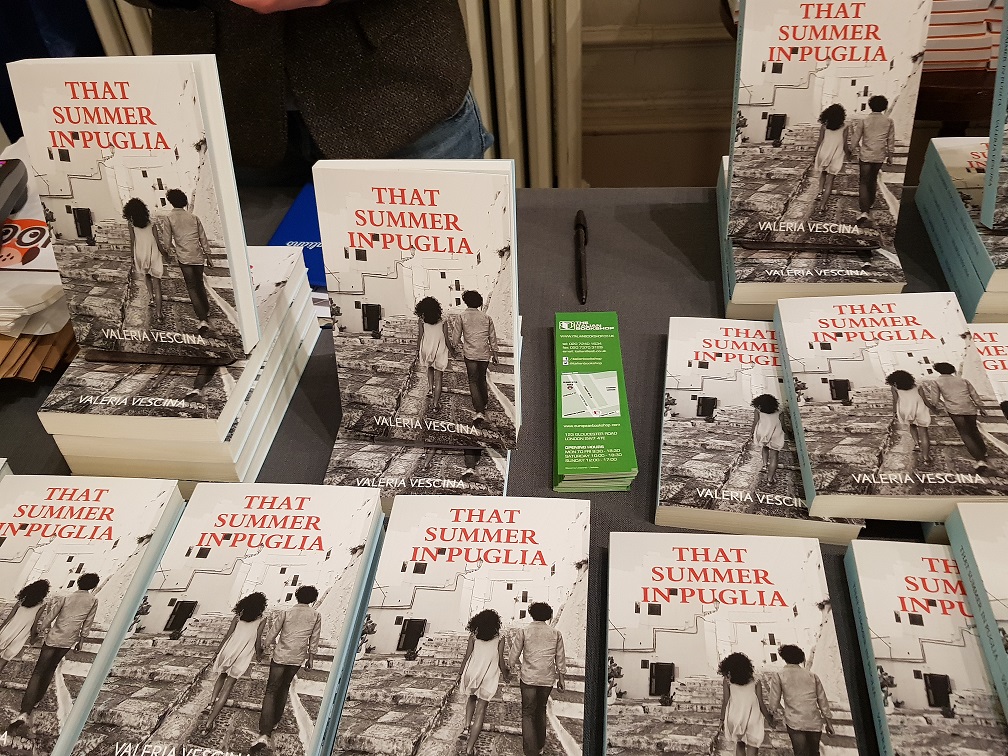
Signing booksBook display at the Institute by The Italian Bookshop
Image credits:
The photos ‘Valeria and Rosie’, ‘Signing books’ and ‘Book display at the Institute by The Italian Bookshop’ are courtesy of Rosie Goldsmith, and reproduced with kind permission.
Rights to the photos ‘Marco Delogu’s introduction’ and ‘Todd Swift’s introduction’ are my own.
Waterstones Kensington launch – Valeria Vescina and Rachel Seiffert
Valeria Vescina and Rachel Seiffert in conversation
Waterstones, Kensington, hosted the London launch of That Summer in Puglia on 27 March, just four days after the Oxford Literary Festival debut. The launch took the form of a conversation with award-winning author Rachel Seiffert (A Boy in Winter, The Dark Room, The Walk Home), after an introduction by Alexandra Payne, Managing Editor of Eyewear Publishing. I’m very grateful to Rachel for her support: one of my tutors on the Goldsmiths MA in Creative Writing, she saw the novel develop from its early stages.
Her interview centred on three extracts from That Summer in Puglia, to introduce the audience to the principal characters and their relationships as well as to the book’s style and themes. Our discussion flowed naturally from there. The public contributed questions, comments and personal experiences. The book is set in the southern Italian region of Puglia, but its themes are universal: the perils of unresolved grief; the importance of all forms of love; the relationship between love and virtue.
Launch of ‘That Summer in Puglia’ at Waterstones, Kensington
Waterstones window for ‘That Summer in Puglia’
The Waterstones event being only the second on my schedule, it was heartening to spot in the audience a great number of familiar faces: friends, and Goldsmiths MA faculty and colleagues. I’m so grateful to them all for sustaining me during the process of writing the novel. The Mayor of the Royal Borough of Kensington and Chelsea, Cllr. Marie-Thérèse Rossi, and Cllrs. Addenbrooke and Pascall attended in their official capacity, as a gesture of civic gratitude: I was touched, as I’ve taught creative writing workshops at Kensington Central Library since 2013 on a pro bono basis, but hadn’t expected special thanks. I’m grateful also to Waterstones, and especially to its Kensington events manager, for the organisation and publicity. As a debut author, seeing the shop window filled with my books felt slightly surreal.
The Mayor of the Royal Borough of Kensington and Chelsea, Cllr. Marie-Thérèse Rossi
Valeria Vescina reading from ‘That Summer in Puglia’
The next London presentation of That Summer in Puglia will be at the Italian Cultural Institute on 16 April at 7 pm. The interviewer will be Rosie Goldsmith, the acclaimed journalist, presenter, literary critic and Chair of the EBRD Prize.
Press enquiries: please email publicist Helen McCusker, Booked PR (tel: +44 (0) 7951 078388), or you may contact me here.
Author Valeria Vescina and interviewer Teresa Franco
That Summer in Puglia had its debut at the FT Weekend Oxford Literary Festival on 23 March. This was Italian Day, when the Festival – in co-operation with the Embassy of Italy and the Italian Cultural Institute – annually showcases Italian culture. My interviewer at St. Cross College was University of Oxford academic and Il Sole 24 Ore Arts & Culture contributor Teresa Franco – sensitive, knowledgeable and insightful. We were introduced by poet Todd Swift, Director of Eyewear Publishing. The audience was large, warm and engaging.
Publisher Todd Swift introducing author Valeria Vescina and interviewer Teresa Franco
Oxford Literary Festival – Valeria Vescina and Teresa Franco
The day closed with a memorable Italian Gala Dinner at Lincoln College, hosted by the Director of the Festival, the College Rector and the Italian Embassy. The latter was represented by Minister Counselor Vincenzo Celeste and Head of Culture Federico Bianchi, both of whom had attended the launch of That Summer in Puglia, an honour for which I’m grateful. The Gala Dinner menu was devised by acclaimed chef and cookery writer Eleonora Galasso.
I wrote That Summer in Puglia in English, my literary mother tongue, but the story is set mostly in Puglia (southern Italy), where I was born and grew up. I was educated in Switzerland and the UK, and today live and work in London, but I’ve spent the holidays with family in my native region every year.
Puglia offered an ideal setting: its visible layers of history are integral to the story, a man’s excavation of his past. The region’s distinctive culture provided a framework for testing the characters and exploring the main themes: the role of all forms of love in human life; and the relationship between love and virtue.
I also hope the novel will help readers discover the cultural richness and variety within Southern Italy, by immersing them in an authentically Apulian atmosphere. In Puglia, traces of the past surface in unexpected ways: from the art of its early, Hellenised Illyrian settlers, to Byzantine paintings, Norman churches, and the palaces and fortifications built under the Anjou, the Aragonese, the Venetians and the Spanish. The region’s cuisine and inhabitants bear living testimony to the passage of all these cultures.
Blackwell’s bookshelves at the Oxford Literary Festival
‘That Summer in Puglia’ on Blackwell’s Oxford Literary Festival display
The moment of That Summer in Puglia’s debut is also one of gratitude for and to all those who have sustained me throughout the process of writing the novel: family, friends, colleagues, teachers… and the authors and publisher who have encouraged and championed my work. To you all, my deepest thanks. A book about the importance of all forms of love would not have been possible without you.
Press enquiries: please email publicist Helen McCusker, Booked PR (tel: +44 (0) 7951 078388), or you may contact me here.

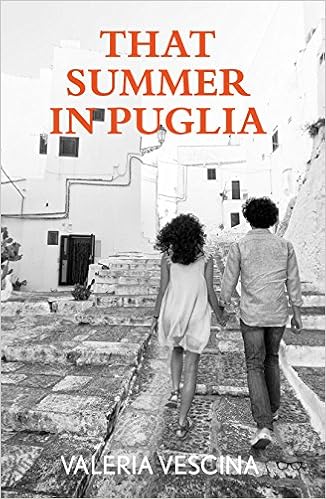 That Summer in Puglia by Valeria Vescina Eyewear Publishing March 1st 2018



 Book Description: