RESOURCES FOR THE PRESS AND FOR READERS CURIOUS TO GAIN MORE INSIGHT INTO THAT SUMMER IN PUGLIA
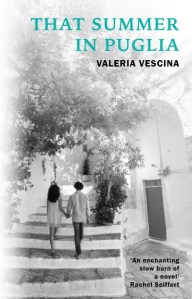
Praise for That Summer in Puglia:
‘This is an enchanting slow burn of a novel; a notable debut. Vescina’s voice is admirably clear, her descriptions lucid, and her characters are human to the core.’ Rachel Seiffert
‘Very beautiful, surprising and evocative.’ Simonetta Agnello Hornby
‘Here is the discovery through literature of Puglia, with its remarkable synthesis of Mediterranean history and cultures.’ Edoardo Winspeare
‘A story of great quality, captivating you with the world it magnificently recreates. This brilliant novel confirms with delicacy and intelligence the redemptive power of words and claims forgiveness as the truest form of love.’ Teresa Franco
‘A novel so finely crafted… so unforgettable in its poignant depiction of human frailty, and so rich in terms of rapturous descriptions of the cuisine and culture of southern Italy, that one’s hope in the ability of literature to uplift and renew the human spirit is restored. I can’t recommend it strongly enough.’ Dennis Shirley
‘A beautiful piece of literature… A gem of a novel.’ Claudia White
‘I feel bereft as I close the last page… A beautifully written novel.’ Gail Aldwin
‘Valeria Vescina writes with such wisdom about the human condition… It’s typical of this novel that an observed detail produces a flood of insight and a shift in my own perceptions and sense of place in the world.’ Maria Donovan
‘An absorbing story of star-crossed lovers and an account of the region that could only be written by an Apulian.’ Laurie Garrison
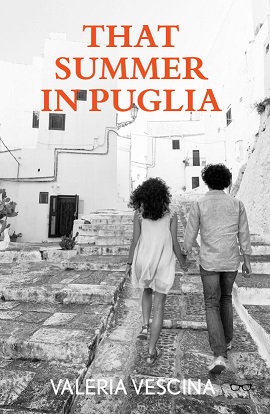
Book launch events:
- Oxford Literary Festival, Friday 23 March 2018, 4 pm to 5 pm – the interviewer was Oxford University lecturer and Il Sole 24 Ore contributor Teresa Franco. An account and images of the event can be found here.
- Waterstones Kensington, Tuesday 27 March 2018, 6 pm to 7:30 pm – details here. The interviewer was award-winning writer Rachel Seiffert (A Boy In Winter, The Dark Room, The Walk Home). An account and images of the event can be found here.
- Italian Cultural Institute, London, Monday 16 April 2018, 7 pm to 8:30 pm – details here and here. The interviewer was the acclaimed journalist and presenter Rosie Goldsmith. An account and images of the event can be found here.

The novel is available from major retailers, including Amazon, Waterstones, and independent bookshops, as well as from Breakthrough Books’ web shop.
For reviews and other media coverage of That Summer in Puglia, click here.
Brief overview of That Summer in Puglia
Amazon profile of That Summer in Puglia
Contact: here.
Social media:
- Website: https://valeriavescina.com/
- Bluesky: @valeriavescina.bsky.social
- Twitter: @ValeriaVescina and #ThatSummerInPuglia
- Facebook: Valeria Vescina Author
- On LinkedIn
Author photographs: in colour and black & white, below.


Publisher: That Summer in Puglia is being released in a second edition by Breakthrough Books, the independent literary press, from April 2026. Later in the year, Breakthrough will also publish Habit of Disobedience.
Frequently asked questions:
- What is That Summer in Puglia about?
Tommaso has escaped discovery for thirty years – but a young private investigator, Will, has tracked him down in London. Tommaso asks him to pretend never to have found him. To persuade Will, he recounts the story of his life and of his great love, Anna. In the process, he becomes aware of the consequences of unresolved grief and of the power of compassion. That Summer in Puglia is a tale of loss and of the power of love in its many forms.
The Southern Italian region of Puglia provides an ideal setting: its layers of history are integral to the story. Tommaso’s increasingly vivid memories of its sensuous colours, aromas and tastes, and of how it felt to love and be loved, and to grieve, eventually overwhelm and transform the discomforting tone with which he at first tries to keep Will at a distance.


- What are the novel’s themes?
In one of my favourite books of literary criticism, The Naïve and the Sentimental Novelist, Orhan Pamuk says that ‘Often the centre emerges as the novel is written’. This was my experience with That Summer in Puglia. I started drafting a story, and trusted that I’d gradually discover what I cared most deeply to communicate. The themes and the connections between them surfaced as the plot and character sketches became a narrative. The entire process was therefore partly intuitive, partly analytical – what Pamuk calls being ‘the naïve and the sentimental novelist’.
The main theme of That Summer in Puglia is the value of compassion – not ‘pity’, but the ‘feeling with’ suggested by its Latin root – towards others and oneself. Other themes feature, too: the perils of unresolved grief; the power of love in its many forms; the importance of dialogue and mildness; the lifelong nature of the task of ‘Know(ing) thyself’. However, compassion is notable for playing a vital role in them all.
It think that’s because it runs through every form of love: from a stranger’s kindness, to the affection of parents and children; from profound friendship, to romantic love, and all the way to the concept of agápē. I hope that as you read That Summer in Puglia you’ll find yourself moving from judging Tommaso to really caring for him, and that his tale speaks to how acts of love great and small can transform lives.
In the story, unpredictable combinations of factors impact the characters’ internal worlds, relationships and actions. In the process, a theme closely related to compassion is explored: the need to test the goodness of any action by asking whether love for others would enjoin us to take it or not. As philosophers have cautioned since ancient times, certainty of one’s own virtue can so easily slide into self-righteousness.
This is where the theme of the importance of dialogue and mildness comes in – we live in times where the need for them is more evident than ever at a societal level, but it starts at a personal and inter-personal one. Open-mindedness and compassion facilitate the task of accepting, transcending or synthesizing the contradictions of human existence – what E.M. Forster described as ‘connecting the fragments’ – and, in the process, make for a more peaceful world. The Delphic maxim ‘Know thyself’ relates in obvious ways to this cluster of interdependent themes.
- Can you talk about key stylistic choices you made in this novel?
Throughout the writing of That Summer in Puglia, I aimed for lightness of touch. Here you’ll find a blog post about why and how I pursued a reading experience suffused with lightness and warmth.
Amongst other things, it was important to weave history into the story with lightness, in order to gradually reveal its weight on the characters’ lives. The invitation to speak at the Goldsmiths Writers’ Centre on Fiction and History reflects the centrality of this aspect.
Another key decision was that of narrative form: That Summer in Puglia uses dramatic monologue. Why did I opt for it? The answer is here.
- What is your connection with Puglia? And with the UK?
I was born and brought up in Puglia, where my family of origin still lives. I’ve spent the summer holidays there with them every year, though I’ve lived abroad for a long time. My secondary education took place in Switzerland in a bilingual German/English school, with French our foreign language. I moved to the UK for my undergraduate degree in International Studies, which included a German component and time in Germany. Thereafter I lived and worked in London for many years, and received two Master’s degrees by University of London colleges. I moved back to Switzerland in 2020 but remain closely involved with all things literary in the UK.
Given my personal history, elements of various European cultures and literary traditions inevitably flowed into the writing. So, I hope you’ll find that the characters face universal challenges in settings that my background allowed me to describe with authenticity. Being both deeply integrated in the UK and rooted in Italy made me aware of their cultural nuances – these often reveal similarities beneath the apparent differences, as you’ll see in That Summer in Puglia.
I also hope the novel will help readers discover the cultural richness and huge variety within Southern Italy – the geography of its constituent regions shaped their history and their present. In Puglia, traces of the past surface in unexpected ways: in the art of its early, Hellenised Illyrian settlers; in the remains of Roman cities; in Byzantine paintings and Norman churches; in citadels built on hilltops to withstand attack from the sea; in Emperor Frederic II’s castles; in the palaces, fortifications and churches built under the Anjou, the Aragonese, the Venetians and the Spanish; in its cuisine; and, of course, in its inhabitants.
- What was your journey to becoming a published author?
I’ve been asked to answer the question of how I made the change from a job in management to that of writing novels. The first thing to say is that there wasn’t a time when I didn’t enjoy writing; the second, that the path to publishing a novel was long; the third, that the degree of continuity between my previous career and a novelist’s might surprise you; and finally, that we all hold the potential for several directions in our lives, but that a given choice may become more obvious or feasible at a later stage.
My first career involved a great deal of writing: on my MSc in Management, I specialised in strategy and organisational behaviour, and my jobs called on these two disciplines. Their intersection requires genuine interest in people, and a mix of structured thinking and creative problem-solving, all of which proved helpful while writing the novel. My work experience also turned out to be a rich source of insights into human existence.
The arts are a constant in my life. My mother is an art historian and my father directed a gallery of twentieth-century art, so our home was a busy harbour for painters, sculptors, poets, novelists, historians, actors, composers… Some of my earliest memories are of sitting down with books of old-master paintings. Aside from writing, I especially loved music – I’ve never stopped studying it.
My journey as a novelist has gone hand in hand with commitment to the value of the arts and humanities, as I feel strongly that they nourish us as individuals and societies: their economic impact may defy easy measurement, but that on everyone’s well-being and happiness is immense.
I did an MA in Creative Writing at Goldsmiths (University of London), whose Faculty boasts superb authors. Their teaching, feedback and encouragement were invaluable. I learnt much from fellow-students, too; a few of us formed a highly supportive writing group which still meets. I’ve reviewed for the European Literature Network (and its magazine The Riveter), Seen And Heard International, and the School of Advanced Study’s Talking Humanities. I also served as a trustee and literary director of the Hampstead Arts Festival of music and words. I’ve taught creative writing lectures and workshops for two British universities, three London boroughs, St Paul’s Girls’ School, and NAWE 2016 and 2018 (the annual conferences of the National Association of Writers in Education), as well as for the Literaturhaus Zentralschweiz in Switzerland. I also run creative-writing retreats. For a post specifically about the transition to writing as a second career, see here.
My second novel is set in Southern Italy in the late 1500s. It has taken years of painstaking research, and explores the challenges facing women’s lives from an angle that I hope will cut through the centuries.
 Valeria Vescina