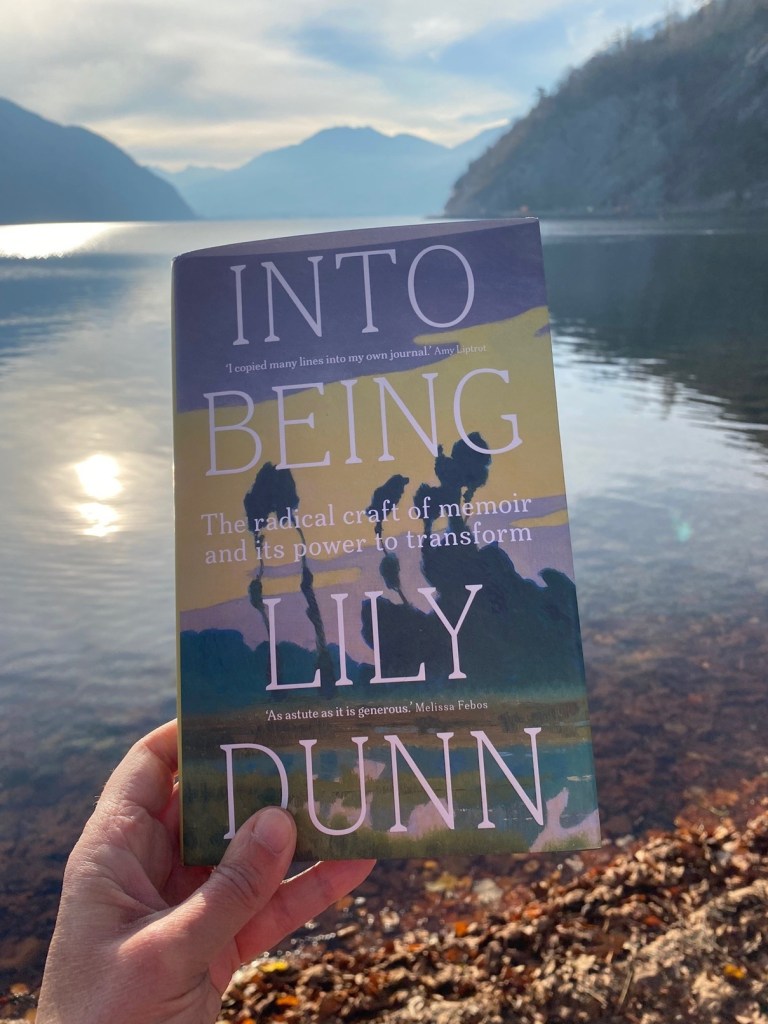
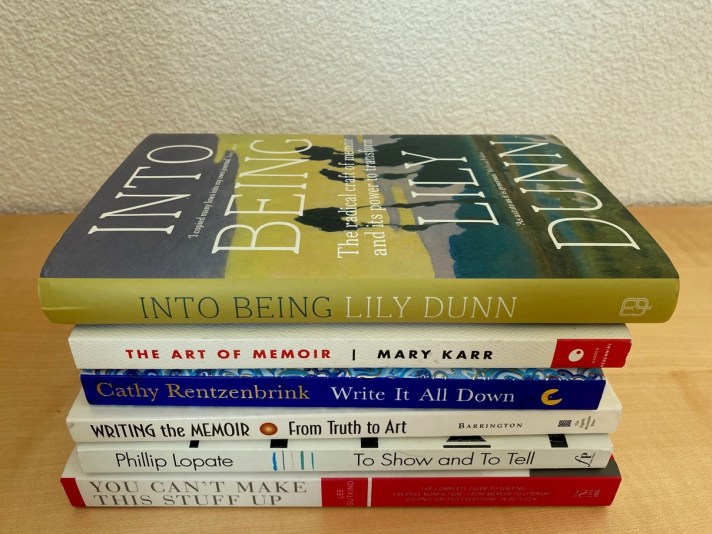
I’ve read many titles on the craft of memoir, but Into Being is about so much more than the craft. I can’t recommend it strongly enough. Lily Dunn’s focus on the transformative power of the process, her handling of philosophical questions, the generosity with which she shares her experience, the inclusion of other writers’ insights, and the voice – which blends authority and wisdom with modesty and empathy – make for a powerful mixture that I’m sure will be invaluable to memoirists for a long time to come.
I love how Lily conveys ‘the dance between writing and gaining in self-understanding in life, and how intimately connected they are.’ Her view of memoir-writing has a remarkable life-enhancing quality. ‘We are touching on questions not only of how to write better, but also how to live better, to be more self-aware and honest as we move through the world. The best memoirs, I believe, evolve alongside their authors who gain in understanding and wisdom […].’
In January, I had the privilege of interviewing Lily on behalf of the Women Writers’ Network. We discussed how she balances her work as a memoirist, teacher, and mentor; her aims for the book; how to nurture the ‘gift of noticing’; approaches to concerns over protecting oneself and others; degrees of emotional distance; finding clarity of both vision and voice; unearthing the best shape for one’s memoir.
You can read the interview of 22.1.2026 by clicking on the six questions below. Happy reading!
As some of you may know, eight of us – all volunteers, based in four countries – set up the Women Writers Network in 2017 to encourage, support, and promote fellow women writers. The result of our little group’s passion and commitment has been the creation of a vibrant writing community: originally on Twitter/X with c. 8,500 followers; and, since September of this year, on Bluesky, to which we’ve moved as it’s more closely aligned with our values. If you haven’t already, come and say hi on @womenwritersnet.bsky.social!
We’re running monthly #skychats on the third Thursday of (almost) every month. We’ve also introduced regular #AuthorInterviews on Bluesky (on the fourth Thursday). Below is one I was privileged to host in November with Stephanie Bretherton, author of The Fire In Their Eyes (reviewed here in July). Happy reading: just click on the six questions! And come and join us for our upcoming interviews in 2026, when you can pose your own questions to our fantastic guests!
‘Undercurrents’ (Broken Sleep Books) by Richard Skinner
What a breath of fresh air this slim volume is: a collection of uncompromisingly thought-provoking essays, and the variety of topics so stimulating. It feels like listening to a friend talking about subjects that deeply matter to him but that are also universal, and that he handles as only someone both knowledgeable and passionate about them can.
Richard Skinner is an author of literary fiction, life-writing, essays, non-fiction and poetry, and a highly regarded creative-writing tutor. In Undercurrents, he brings together essays about books, the writing craft, films and music, his own life experiences, as well as interviews with poets. Naturally, the tone varies as a function of each essay’s topic: from the more analytical one for a review, to the reflective and intense one about two beloved friends’ deaths.
Skinner’s thoughts on the link between Eisenstein’s ‘montage of attractions’ principle and making connections in one’s writing intrigued me. I enjoyed the expansiveness with which an essay about Talking Heads’ Remain in Light takes in Isiah Berlin, Marcel Proust and the ancient Greek chorus. The description of the state of ‘self-emptying’ and ‘belonging’ to the landscape while on a long hike resonated. The reflections on friendship, death, and acceptance of the unknowable, with regard to the death of dear friends, were relatable and made me think.
This is a rare gem in the current publishing landscape. All credit to the author, and to Broken Sleep Books for its ambitious publishing programme.
Our September 2025 writing retreat has just wrapped up! This special gathering brought together writers who had previously attended one of my tutored retreats. They returned for a week of workshops, focused writing time, supportive feedback sessions, and refreshing walks in the breathtaking Alpine landscape. It was such a joy to welcome them back! By the end of the week, old friendships had been deepened and new ones forged, and the group left with a promise to continue meeting online for ongoing feedback and support.
The attendees came from various groups but shared a common writing-craft foundation from their first retreat, so they were keen to take the experience one step further, together. Finding dates that suited everyone was the main challenge, but five participants were able to make the week of 7 to 13 September. Three stayed at the apartment in Hasliberg-Reuti that had welcomed them before, while two (since the flat wasn’t big enough for everyone) stayed at a lovely nearby B&B. The large seminar room in the apartment comfortably held us all for the workshops and feedback sessions.
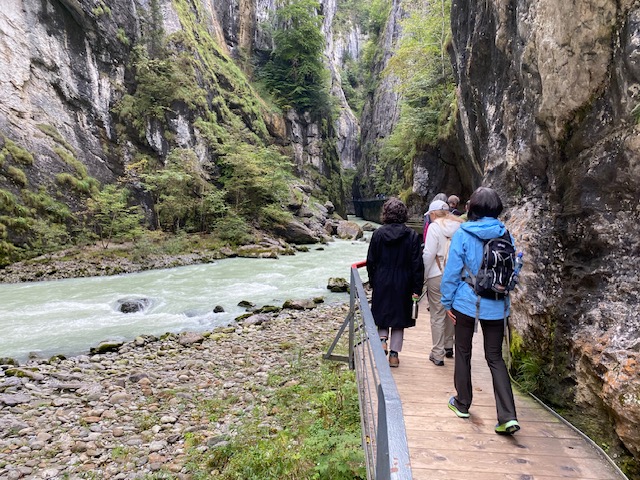
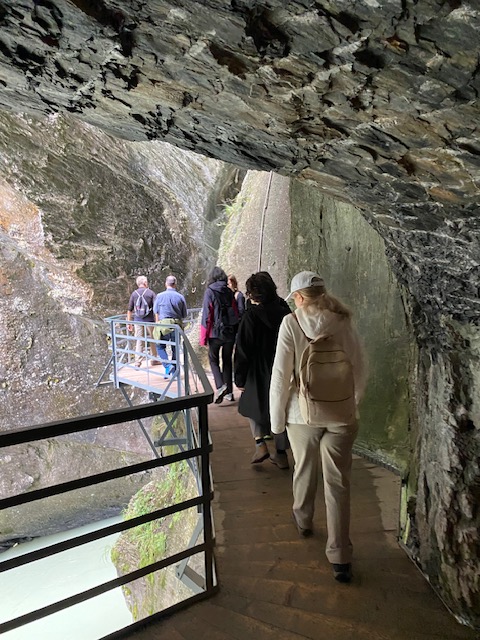
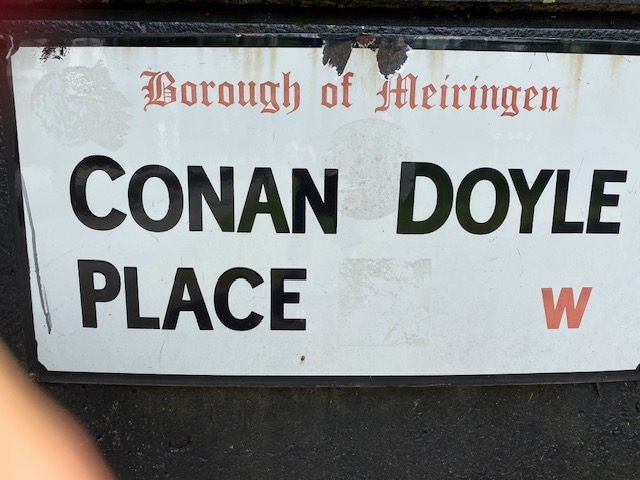
Each morning began with a 90-minute workshop to inspire creativity, deepen knowledge of the craft, and strengthen the group’s bond. Ample personal writing time during the day gave everyone space to advance their projects. In the afternoons, we reconvened for two and a half hours of group feedback. A short daily walk in the fresh mountain air – and a mid-week excursion to the spectacular Aare Gorge just outside Meiringen – provided not only physical activity but also inspiration and the chance to connect more deeply. Much talk and laughter were shared also over breakfast, lunch (at the nearby Hotel Reuti restaurant), and dinner!
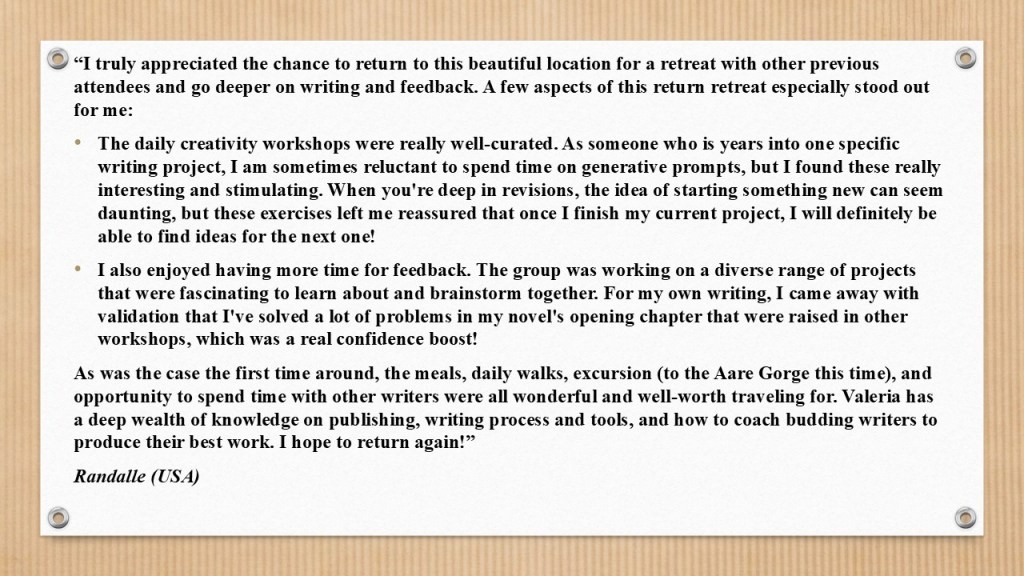
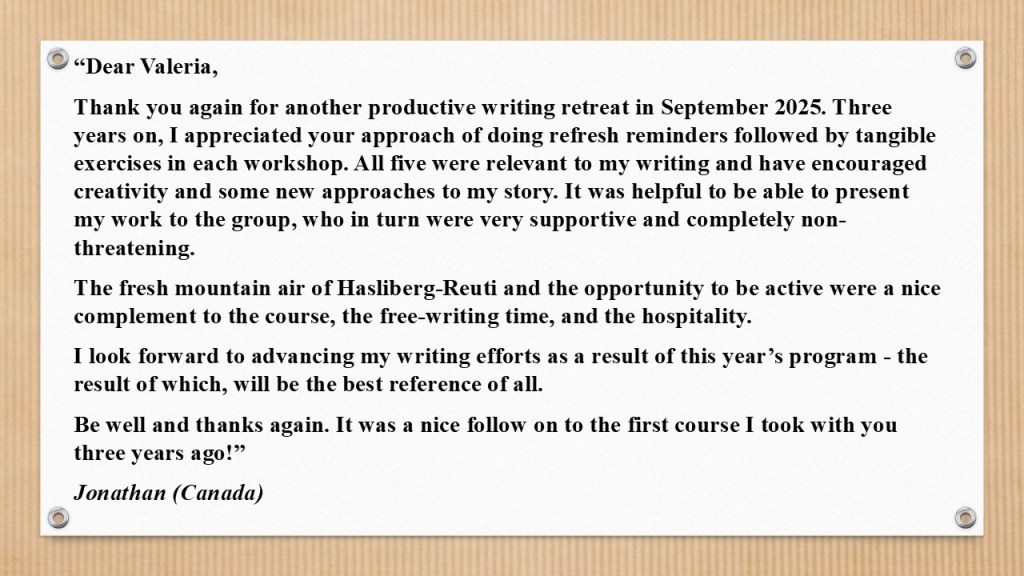
The workshops built on the group’s shared knowledge base. I provided recaps of what we had covered during their previous retreats: on Day 1, Story Structure and Plot Development; on Day 2, Story Openings; on Day 3, Characterisation… We quickly reviewed these notes together, then moved on to exercises that drilled down into the relevant topic while introducing something new and unleashing creativity. For example, our session on Characterisation was paired with exploring the uses and effects of music (in both fiction and life writing); another exercise delved into the narrative possibilities of photographs, to experiment with Point of View and ‘Psychic Distance’; and so on. You can read attendees’ feedback in their own words. The response has been so enthusiastic that I plan to repeat this retreat next year. I’ll be contacting the community of former participants soon to find out which dates work best.
In the meantime, the next tutored retreat (open to participants at all levels of experience) will run from 1 to 7 March 2026 – an inspiring week designed to nurture your writing, spark new ideas, and connect you with a community of fellow writers. If you’d like to be part of it, you can find details here: https://valeriavescina.com/teaching/writing-retreats/ In that period, Hasliberg-Reuti is often covered in snow, making the landscape magical in yet another way.
Any one-liner for describing what this memoir is about would do it an injustice: it could not encompass its range. It’s about depression, attempted suicide, surviving it, recovering, building a new life… About societal expectations and how they shape us. About our system of mental healthcare. And it’s very much about love.
‘Love Lay Down’ is an important book. Helen Murray Taylor shares with generous openness and formidable eloquence her story of depression’s vortex and of her recovery. Her memoir is vivid, raw, at many points heartbreaking. At the same time, it’s infused with wit, with her ability to perceive the surreal and the outright comedic in some of the worst circumstances. She lets us into her intense emotions and thoughts at the time, as well as into her capacity for looking back at them now with hard-won distance.
Love blazes a luminous, life-saving path throughout this memoir: the love between Helen and her husband; that of family; of friends, colleagues… The whole book strikes me also as a real act of love by its author towards readers: as a gift of hope – and of feeling seen and heard – to sufferers from depression; and as a gift of understanding to all. ‘I hope that no one who reads this has ever found, or will ever find, themselves being dragged under by the force of their depression. But if that is you, […] please, please, call out for help. The help when it comes might not steer you to dry land but it might be the lifejacket that lets you turn on your back and float, the thing that lets you rest awhile, that keeps you afloat a little bit longer. Survival isn’t always about kicking against the waves. Tomorrow the tide might turn and wash you ashore.’
‘It was my father who made the arrangements. My uncle helped, since he lived down south, where all this kind of business is carried out.’
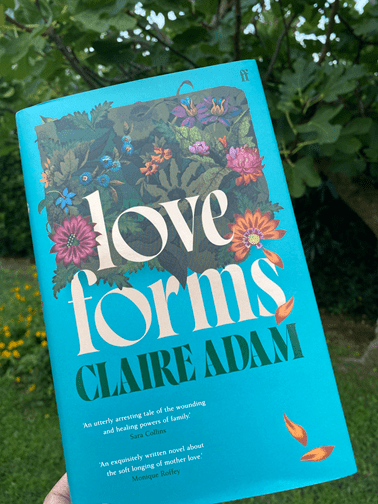
The opening of ‘Love Forms’ sets the tone for the whole novel: a voice that immediately draws you in with its fresh, direct, familiar cadence; and ‘the arrangements’ at the heart of the story. These arrangements see the then sixteen-year-old protagonist, Dawn, whisked off from her home in Trinidad to Venezuela, where she must give birth in secret and surrender her baby for adoption. The reason? ‘She made a mistake and brought shame to her family.’
It’s not long before Dawn realises that the real mistake – whether really hers or her parents’ – was to give up her daughter. The intense longing to find her again impacts the rest of Dawn’s life. Though she goes on to graduate in medicine in the UK, work, marry, and raise two beloved sons, her yearning for the lost child becomes an ever-present, aching part of who she is. When she’s fifty-eight, we witness one of her many attempts to track down her daughter – a search that plays out as a roller coaster of emotions.
Dawn feels so real, that I was absorbed by her evolving feelings and her growing understanding of herself, of her family, and of the changing world around her. This is partly thanks to Claire Adam’s sensitive psychological portrayal of her main character, and partly because of the three-dimensionality she lends to the places – Trinidad, Tobago, Venezuela and London – and times the protagonists inhabit. The dialogue across generations – between Dawn and her parents, siblings, and children – is deeply affecting, as powerful in its silences as in its words. These exchanges and the characters’ actions sustain a taut narrative tension: I often found myself wondering about the consequences of certain conversations – and discovered their outcomes in the novel’s final chapters.
It’s all there in the title: ‘Love Forms’ is about different kinds of love (starting with that of a mother for her child), and about the ways it’s kindled, grows, is challenged, changes… and how it changes us in turn. It’s a poignant, beautifully written novel, and one of the finest I’ve read in a long time. I couldn’t recommend it more highly.
“The Fire In Their Eyes” is a breath of fresh air: a thriller that keeps you hooked right up to the end, it’s boldly original, unafraid to experiment with form, and courageous in its engagement with urgent issues. It reveals the interconnections between these issues, while weaving a narrative that is both emotionally gripping and intellectually engaging. If you crave fiction that does more than entertain – stories that challenge you to think and that spark meaningful conversation – this book is for you. Structured across dual timelines, the novel follows three female protagonists, all of them gripped by a strong sense of impending danger. Each woman fights, with grit and intelligence, to prevent a catastrophe. Though separated by time and geography, the threats they face are connected. In the Arctic, geneticist Eloise races against time at a scientific research station to neutralise a fresh danger to humanity. What is its link to the DNA of “Sarah,” a woman whose 74,000-year-old remains were discovered on Mt. Kenya? Meanwhile in Manchester, psychiatric nurse Jessica – whose husband Max unearthed Sarah’s remains – is experiencing a heightened sense of threat. What is the cause of this change in her? And how will it affect her deep, tender bond with Max? In a lush Kenyan valley 74,000 years ago, the shamanic Old Woman – Sarah’s daughter – perceives an impending danger that could annihilate her people. It falls to her to discern the precise nature of the threat and devise a way to combat it. Stephanie Bretherton’s novel is underpinned by meticulous research. Complex scientific ideas – particularly in biology, genetics, and virology – are conveyed with clarity and precision and linked back to some of the most profound questions of our time. For example, the author draws links between globalisation, climate change and other environmental issues, rising population density, and the emergence of new pathogens. She also explores the spiritual and philosophical questions raised by natural disasters, political opportunism, and the consequences of human actions. One question resonates especially strongly: from one generation to the next, how do we pass on the best of what it means to be human? The power of all forms of love to help us meet the toughest challenges is one of the novel’s connecting threads. This is not, however, a didactic book. Each of its three narrative strands is as gripping as a thriller, with high stakes and expertly controlled pacing. The tension builds steadily towards an emotionally resonant climax. I found Jess and Max’s story particularly moving – an honest, tender portrayal of love and the difficulties it must overcome. The novel’s intricate structure is beautifully handled. You always know exactly where you are and feel secure in the hands of a confident storyteller. Each of the three protagonists is surrounded by sharply drawn secondary characters: family, friends, and colleagues who feel fully alive. The integration of emails, text messages, and unsent letters lends further realism and emotional depth. The settings are equally immersive: Eloise’s sterile research facility and the bleak beauty of the Arctic; Jess at the psychiatric hospital where she works, in the swimming pool where she finds release, and in the quiet refuge of memory – drifting back to a long-ago dive among minnows; and the Old Woman’s tribal village – rich with ritual and community – and its wild surroundings. This is a novel of gripping storytelling, literary substance, and lasting insight – one I wholeheartedly recommend. “The Fire In Their Eyes” is the second book in “The Children of Sarah” series, and I already look forward to its sequel.
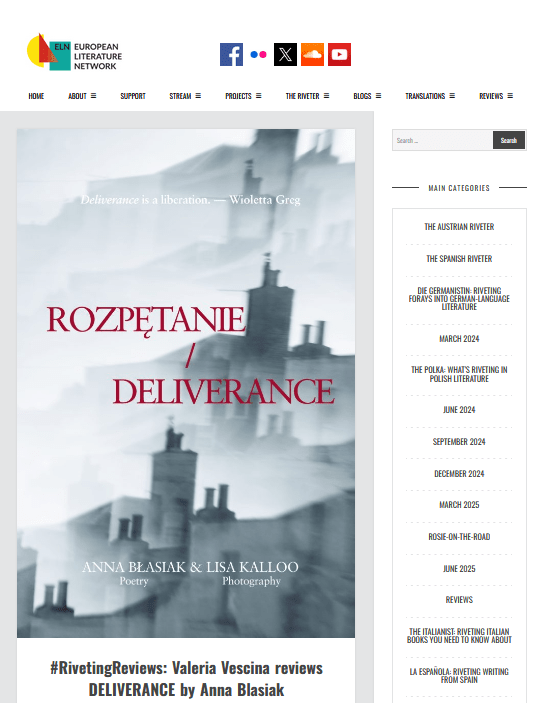
The European Literature Network’s latest Riveting Reviews include one from me on Anna Błasiak’s Deliverance (Holland House Books). It’s a moving poetry collection about growing up queer in Poland and gradually attaining one’s full identity. Its superbly inventive blend of art forms holds rich layers of meaning that thoroughly reward attentive reading. I felt privileged to be asked to review this memorable collection.
Here is the link to the article, and here one to the book publisher’s website.
If you’re looking for exciting content and discussion – including book recommendations – about European literature (especially, but not only, in English translation), take a look at all that the European Literature Network‘s website has to offer – it’s a real treasure trove!
I’ve always loved historical fiction, so putting together a full list of titles I’d recommend would make for a very long post. The first novels to captivate me were Nathaniel Hawthorne’s The Scarlet Letter and Giuseppe Tomasi di Lampedusa’s The Leopard at secondary school. Soon after, I discovered Dacia Maraini’s The Silent Duchess. To these, over the years, I added books by Umberto Eco, Carol Shields, A.S. Byatt, Hilary Mantel, Rose Tremain, Tracy Chevalier, and many others.
What must historical fiction do, for it to stand out for me? First, it must be beautifully written. I’m very open to experimentation with form – perhaps a result of my own background as a novelist and creative writing tutor. I prize books strong in characterisation, sense of place, story structure and plot development, and other elements of the craft. Second, I’m thrilled when a novel teaches me something surprising. It could be an event central to the whole book, or a small, striking detail. I’m especially drawn to forgotten or silenced perspectives. Third, I value insights and themes that shed light on the past and the present: do they challenge harmful narratives or illuminate legacies we’re still contending with? And fourth, the story must be painstakingly researched and imagined, to possess the authenticity on which everything else rests. That includes a serious attempt at immersing me in the worldviews of the time and place depicted.
If any of this resonates with you, here are seven books I read in the past twelve months that I hope you’ll enjoy. They’re listed in alphabetical order.
This powerful little volume (115 pages) won the 2024 Weatherglass Novella Prize. Set on a ship in the nineteenth century, it’s about a cargo of female convicts destined for Australia. We experience events from the point of view of fifteen-year-old Maryanne. It’s a haunting yet hopeful tale of resilience and camaraderie in the face of misery and brutality. The narration is viscerally immersive, anchored in Maryanne’s raw physical and mental perceptions. Look out for Kate Kruimink, who has already published two other novels.
Costanza Piccolomini, the woman at the centre of this novel, was the muse, lover and model of Gianlorenzo Bernini, the leading sculptor of seventeenth-century papal Rome. In a horrific act of violence, Bernini ordered a servant to disfigure her, in the belief she had been unfaithful to him with his younger brother. Basing herself on the facts that have come down to us about Costanza and the other protagonists, Rachel Blackmore has painstakingly reimagined her life. The reconstruction of the all-important social and cultural context is outstanding, and her conjectures about what happened highly plausible, while her portrayal of Costanza’s inner world is empathetic and engaging. The novel tackles enduring themes: double standards, the abuse of power, and coercive control.
For Thy Great Pain Have Mercy on My Little Pain – Victoria MacKenzie (2023, Bloomsbury)
This slim novel brings to life two well known English mystics, Julian of Norwich and Margery Kempe. They are, respectively, the first woman to have written a book in English, and the first author of an autobiography in English. Victoria MacKenzie imagines their meeting in 1413. She draws on their writings and on her research into the medieval context to offer us vivid portrayals of both. Their personalities and circumstances differ greatly from each other: Julian, a reflective anchoress, and Margery, a chaotic mother of fourteen. And yet, their experiences and spirituality make for a strong connection between the two. MacKenzie balances their alternating voices with a poet’s precision and sensitivity. A luminous reading experience.
Once The Deed Is Done – Rachel Seiffert (2025, Virago)
This is the fifth novel by Rachel Seiffert, whose The Dark Room (historical fiction) was shortlisted for the Booker Prize. Once The Deed Is Done opens in March 1945, as the collapse of the Reich draws near. A multi-point-of-view narration gives us access to the thoughts, choices, and personal histories of several inhabitants of a Northern German village. Ruth, a British Red Cross officer, is tasked with supervising and caring for displaced people in a camp the advancing Allied Forces have just set up on the village’s outskirts. Gradually, a dark, shocking secret harboured by some of the villagers emerges. The novel highlights an issue rarely covered in WW2 fiction: the fate of forced labourers during and after the war. With her moving, unsentimental prose, Seiffert poses tough questions about individual and collective responsibility.
The Painter’s Daughters – Emily Howes (2024, Simon & Schuster) Peggy and Molly Gainsborough are the charming objects of portraits by their father Thomas, one of eighteenth-century England’s most acclaimed painters. Emily Howes turns the two sisters into the subjects of her deeply moving debut novel. Molly suffers episodes of mental confusion from a young age and Peggy instinctively shields her. When the family moves from rural Ipswich to fashionable Bath, hiding Molly’s condition becomes harder. Add to this mix a beguiling composer who enters the sisters’ lives, disrupting their close bond and putting Molly’s fragile sanity at risk. Howes steeps the characters’ thinking firmly in the mentality of the era, rendering their feelings, actions, and dilemmas convincing and deeply affecting. The novel delicately examines themes of devotion, mental illness, sisterly love and rivalry, and other family dynamics. It thoughtfully explores the complex area between protectiveness and control in challenging circumstances, without casting judgment.
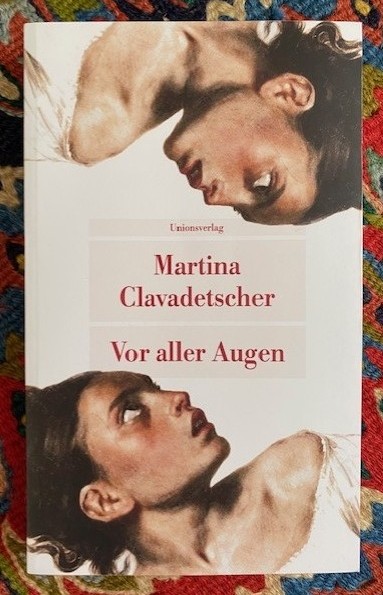
Vor Aller Augen – Martina Clavadetscher (2022, Unionsverlag) I’m afraid this one isn’t available in English yet. Martina Clavadetscher is a well-known author of books and plays, and the winner of the 2021 Swiss Book Prize. In Vor Aller Augen (In Plain Sight), she foregrounds nineteen women portrayed in iconic paintings: from Cecilia Gallerani in Leonardo’s Lady with an Ermine to Victorine-Louise Meurent and Laure in Edouard Manet’s Olympia, from Joanna Hiffernan in James Whistler’s Symphony In White no. 1 to Dagny Juel in Edvard Munch’s Madonna. Clavadetscher not only captures the moments immortalised on canvas, but, above all, lets each protagonist recount her life story in her own distinctive voice. The silenced object of the painter’s (and the viewer’s) gaze thus becomes the active subject, a real-life woman demanding recognition.
And finally, a bonus recommendation: not a novel, but a piece of historical life writing. Fiction can vividly evoke what it was like to live in another era, but so can micro-history and exceptionally well-crafted family memoirs like the one featured below. Originally published in German, it appears in a superb English translation by Jamie Bulloch.
Alice’s Book – by Karina Urbach, trans. Jamie Bulloch (2022, MacLehose Press)
The title refers to So kocht man in Wien!, a bestselling cookbook authored in 1935 by historian Karina Urbach’s Jewish grandmother, Alice. Forced to flee Austria for England in 1938, Alice survived, while her sisters perished in concentration camps. After the war, she discovered that her book had been reissued in 1939 in an ‘Aryanised’ edition: the author ostensibly a German man; and the names of Jewish and foreign recipes germanised. Despite her repeated appeals, the publisher refused for decades to acknowledge Alice as the true author; it returned the rights to her heirs only after being publicly exposed in 2020. In Alice’s Book, the cookbook is symbolic of loss. It offers a powerful vehicle for tracing the devastating impact of Nazi persecution on one Jewish family – dispersed across China, England, and the U.S. – and for honouring Alice’s spirit of resilience, generosity, and hope. It also sheds light on the disturbing reality of companies and individuals that continued to profit from crimes committed against Jews long after the war had ended.
About me:I’m Italian and British, and moved from England to Switzerland a few years ago. I hold an MA in Creative & Life Writing from Goldsmiths College (University of London). My debut novel, That Summer in Puglia, was published in 2018. I’ve just completed the manuscript of my second novel, Habit of Disobedience, set in Southern Italy in the late 1500s. Inspired by true events, this tale of nuns who stood up to the Church explores themes of power, control and female resistance that resonate today.
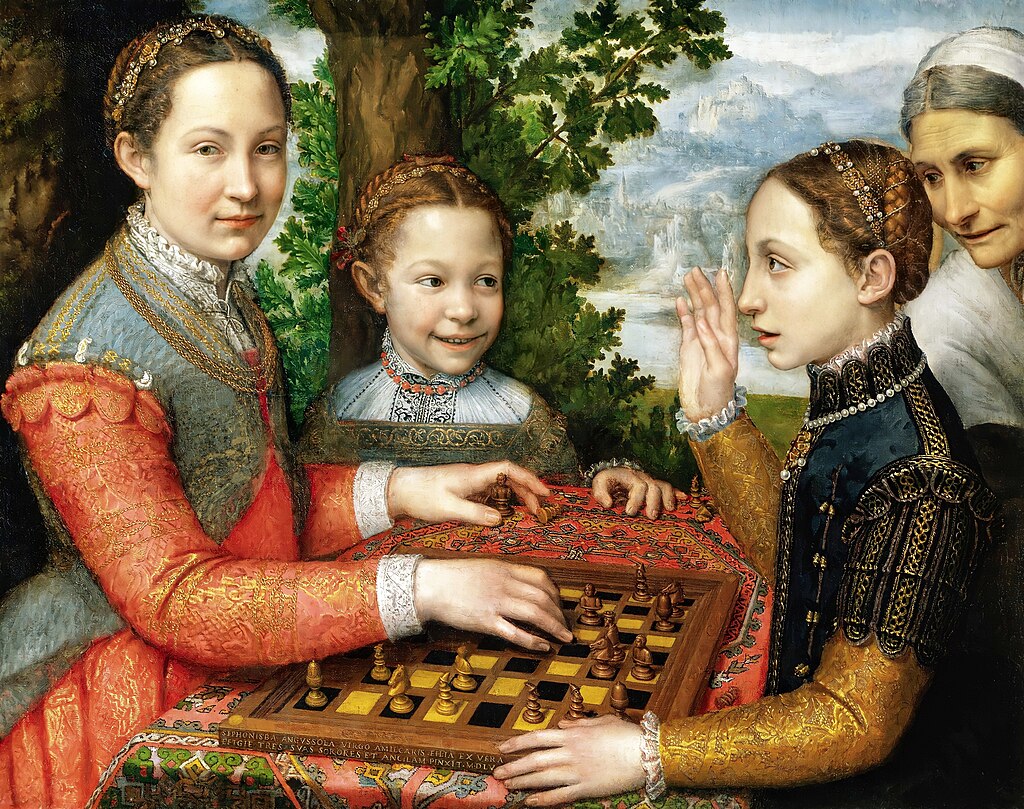
Sofonisba Anguissola’s The Chess Game (1555) is packed with meaning. Among other things, it’s a statement about women’s agency and about Sofonisba and her sisters’ exceptional education. The strategy game of chess was normally the preserve of men. Dama (le jeu de dames) was considered more appropriate for women.
Speak of accuracy and authenticity in historical fiction, and you’ll find writers agreeing on some things but not on others. “Shoulds” abound. Accuracy, you’ll often hear, is objective: it involves verifiable facts, from dates and places to furniture and dress. Authenticity, by contrast, is somewhat subjective: the reader must perceive the story’s world as faithful to the era in question.
Like many dichotomies, this clear-cut view of accuracy as objective and of authenticity as subjective is an over-simplification. The accurate details that authors of historical fiction work so hard to respect are unavoidably a selection, made from their own perspective and as a function of the story; conversely, readers may query the authenticity of well-documented elements that clash with widely held stereotypes and tropes. This matters because authors’ answers to these challenges lead to differing choices. It’s particularly important with respect to fictional re-imaginings of the female experience: recent decades of scholarly findings into ordinary women’s lives – whose legacy most impacts the present – now provide us with invaluable insights.
I’ve spent years researching and writing Habit of Disobedience, a novel inspired by real-life 16th-century women in Southern Italy. Scouring manuscripts, books, and articles in historical archives and libraries; attending history conferences; visiting museums of all kinds; corresponding with historians, in my search for missing details… You’ll gather my efforts at faithfulness – accuracy and authenticity – were not half-hearted. Still, since the key protagonists of my story are ordinary women, there are too many gaps to fully piece together the micro-history. I’m a novelist and tutor in creative writing, not a historian: my interest lay in attempting to inhabit the past until I could ‘see’ and ‘hear’ the characters in places that today convey only a faint echo of their struggles, joys, fears, and dilemmas. Where history left voids, I found doors I could open to fictional elements: characters and threads that capture people and the heartrending situations they experienced.
It’s the approach that felt right for this novel. The true events that inspired Habit of Disobedience are dramatic, and the fictional yarns I wove through them had to be highly consistent with their contemporary context. I’ve aimed to offer what Stephen Greenblatt expressed superbly in a 2009 article: for my protagonists to ‘carry the burden of a vast, unfolding historical process that is most fully realized in small, contingent, local gestures.’1
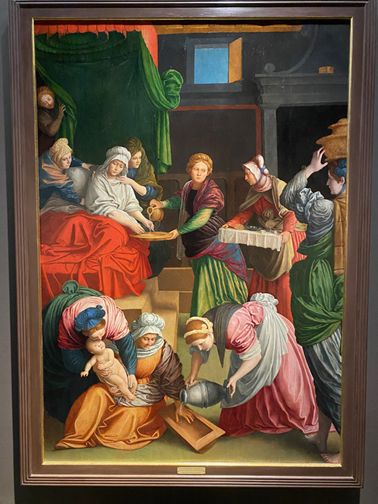
A realistic ‘women’s world’ in Gaudenzio Ferrari’s Birth of the Virgin (1541-43). The water from a baby’s first bath was thrown into the hearth for a girl and outside the front door for a boy.
There’s an additional reason why I’ve strived for faithfulness: I wanted to give a voice to these unheard women because of their relevance to the present day. The novel highlights their acquiescence in a system they thought they could not change, the areas of agency they carved out for themselves, and the trigger for their resistance. It holds a mirror to our times, without anachronisms. That’s also why I’ve aimed to immerse readers in the mentality of the time (to the extent available to me, five centuries later) – our value system affects how we frame and express our emotions in different eras and cultures.2 The more deeply readers let themselves be drawn into my protagonists’ worldview, the greater their surprise at how much of it persists today in changed forms.
Participants at a recent Women Writers Network discussion felt that most people today still live in a patriarchal society. The impact on women is obvious, but it is, ultimately, negative for everyone. It’s a framework of attitudes, beliefs, behaviours, and rules that most of us, no matter our gender, have absorbed and unwittingly sustain until we recognise them. Historical fiction can shine a powerful light on them.
As authors, we strive for accuracy and authenticity – seeking to shift perceptions, however slightly, away from stereotypes and tropes. In doing so, we can contribute much-needed nuance to the public discourse, making it more inclusive and less polarised.
In the words of Hilary Mantel: ‘What can historical fiction bring to the table? It doesn’t need to flatter. It can challenge and discomfort. If it’s done honestly, it doesn’t say, “believe this” – it says “consider this.” It can sit alongside the work of historians – not offering an alternative truth, or even a supplementary truth – but offering insight.’3
I look forward to telling you more about Habit of Disobedience as soon as it finds its publisher.
Sofonisba Anguissola’s The Chess Game (1555). Photo by Mortendrak, reproduced under Creative Commons Attribution-Share Alike 4.0 international license.
Gaudenzio Ferrari’s Birth of The Virgin (1541-43). Photo by the author, taken at the Pinacoteca di Brera.






















 Valeria Vescina
_1555_(4096x3236px).jpg)